
Set Of Gray Constructive Triangles
The first photo is the maker's own. The other shots are illustrative.
Inv. no. NIE-00490042
- Maker
- Nienhuis Montessori, since 1929
- Approval
- AMI
- Base Material
- Wood
- Finish
- Gray paint or laminate with black lines
- EAN
- 8719924003012
Final price incl. VAT. Delivery €5.90, €95.10 to go for free delivery.
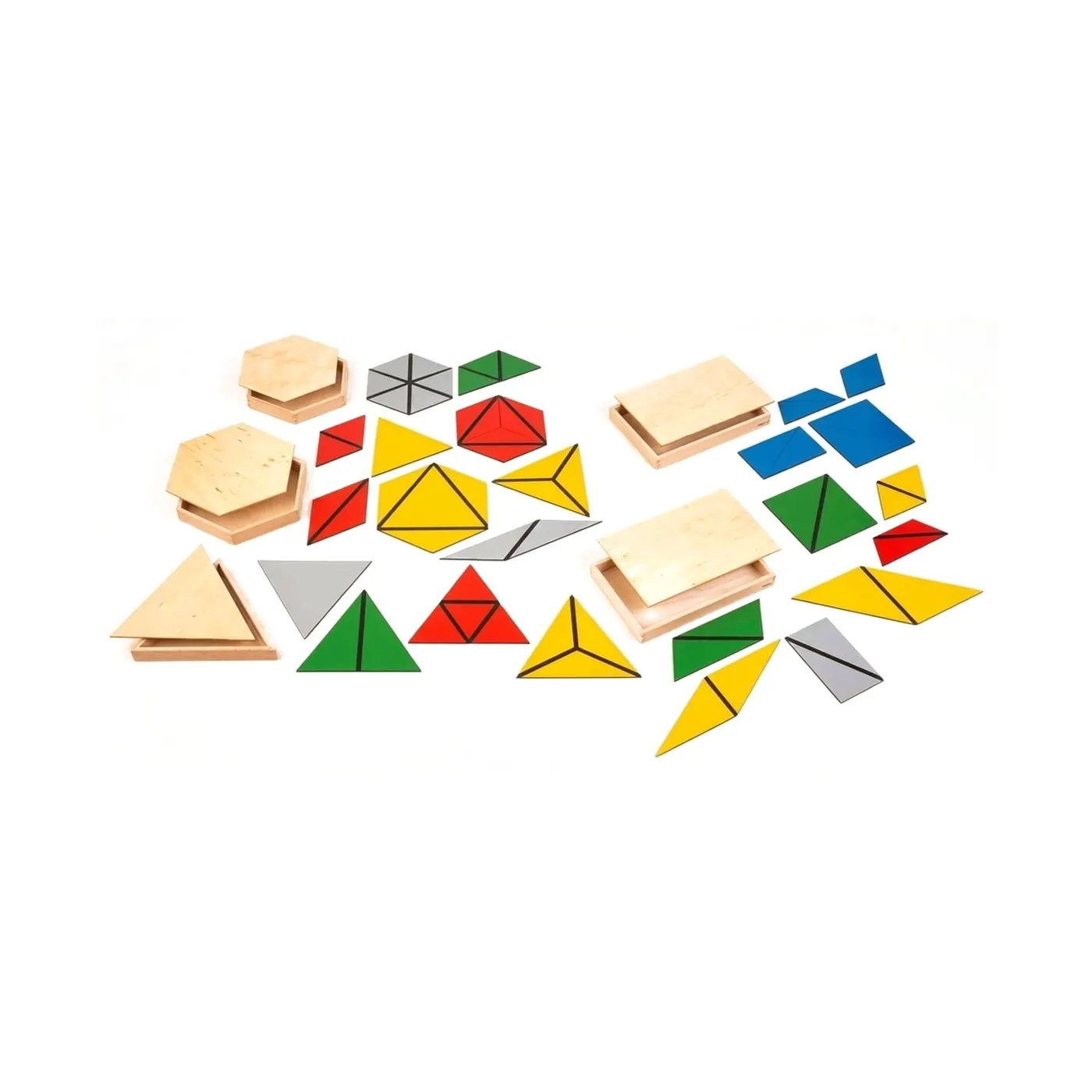 Constructive Triangles (Nienhuis) €339.90
Advice, warranty and returns are handled by us.
Why it costs €53.90
Behind the price of the original are things you can check yourself.
AMI approval
The material is approved by the Association Montessori Internationale (AMI). Nienhuis has made Montessori materials since 1929.
A verifiable original
The EAN 8719924003012 is on the box. It is the maker's number, not ours.
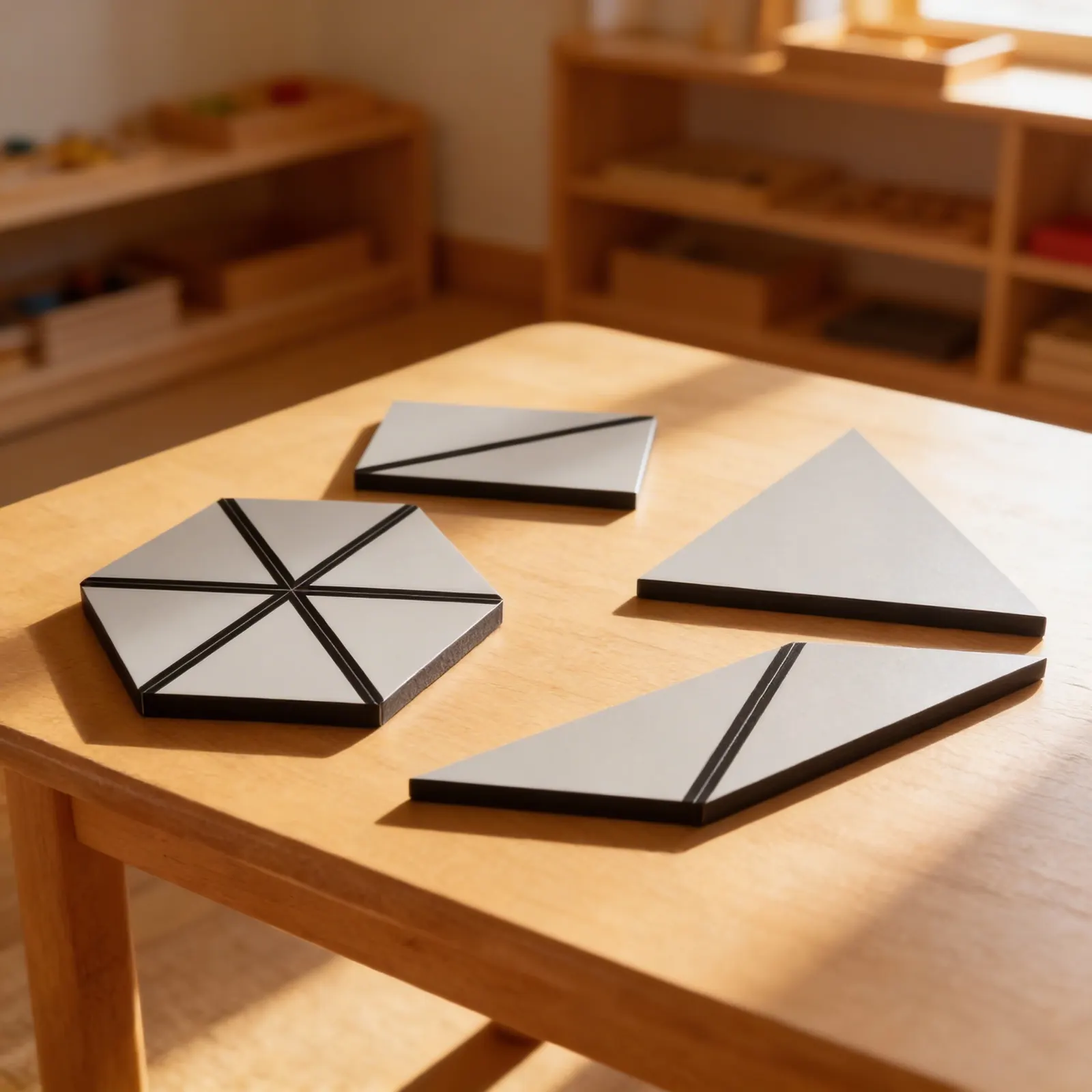
Set Of Gray Constructive Triangles in a child's hands
The Set of Gray Constructive Triangles opens the door to advanced geometric exploration through hands-on manipulation. This Montessori material consists of gray triangular pieces with precise black dividing lines that guide the child in discovering how triangles combine to form other geometric shapes. Through systematic work with these triangles, children develop spatial reasoning and geometric understanding while preparing for later studies in mathematics.
Geometric Understanding
Children discover how triangles combine to create hexagons, rectangles, and larger triangles, building foundational geometry concepts.
Visual Discrimination
The black guide lines help children perceive how shapes can be divided and combined, refining visual analysis skills.
Mathematical Preparation
Working with equivalent shapes prepares children for understanding fractions, area, and geometric proofs.
Problem-Solving Skills
Children develop logical thinking as they experiment with different triangle combinations to create target shapes.
How to present it
Place the Gray Constructive Triangles box on a work mat. Ensure ample space for arranging multiple triangular combinations. Work on a solid-colored mat to provide contrast against the gray pieces.
- 1Remove all triangles from the box and arrange them randomly on the mat
- 2Select two identical right triangles and demonstrate sliding them together to form a rectangle
- 3Invite the child to match remaining pairs of triangles, using the black lines as guides
- 4Once all pairs are matched, explore combining different triangular sets to create new shapes
- 5Challenge the child to recreate specific shapes using different triangle combinations
3 tips for parents
- Look for triangular shapes in architecture and everyday objects to reinforce geometric awareness
- Create simple tangram puzzles at home using paper triangles for additional practice
- Support geometric vocabulary by using precise shape names during daily conversations

If you are not sure it suits your child, we answer in person.
Norbert Kovalčín, founder of Faborino · write to him
There is no review here yet. We will ask you for one after you buy. Write the first review
What's in the Box
- Gray triangular pieces: Approx. 14 pieces with black dividing lines
- Storage box: Wooden compartmentalized box
Size and material
| Packaging | 32 × 24 × 4 cm |
| Base Material | Wood |
| Finish | Gray paint or laminate with black lines |
| Recommended Age | 3-6 years |
Care
Wipe with slightly damp cloth, dry immediately
Frequently Asked Questions
What shapes can children create with the gray constructive triangles?
Children can form various polygons including squares, rectangles, parallelograms, trapezoids, rhombuses, and hexagons by combining the gray triangles along their black dividing lines. This material demonstrates how all polygons can be constructed from triangular units.
How do the black lines on the triangles help with learning?
The black dividing lines serve as visual guides showing where triangles should be joined together. These lines help children understand the relationships between shapes and develop precision in their geometric constructions without requiring verbal instruction.
What is the difference between the gray triangles and other constructive triangle sets?
The gray constructive triangles are typically the most advanced set, focusing on creating various polygons from identical triangular pieces. Unlike the colored sets that introduce basic shapes, the gray set emphasizes the mathematical principle that all polygons can be divided into triangles.
What skills does this material develop in children?
This material develops spatial reasoning, visual discrimination, fine motor control, concentration, and geometric understanding. It also prepares children for advanced mathematical concepts including area calculation, angles, and the properties of polygons.
How should this material be presented to a child?
Start by showing the child how to match triangles along the black lines to form simple shapes like squares. Gradually introduce more complex formations, allowing the child to discover patterns independently. Store triangles in their designated compartments to maintain order and teach organization.
Product safety
Manufacturer: Nienhuis Montessori, Anders Celsiusstraat 15, 7442 PB Nijverdal, Netherlands
Set Of Gray Constructive Triangles