
Set Of Red Constructive Triangles
The first photo is the maker's own. The other shots are illustrative.
Inv. no. NIE-00490043
- Maker
- Nienhuis Montessori, since 1929
- Approval
- AMI
- Primary Material
- Solid wood
- Finish
- Red lacquer with black borders
- EAN
- 8719924003029
Final price incl. VAT. Delivery €5.90, €94.10 to go for free delivery.
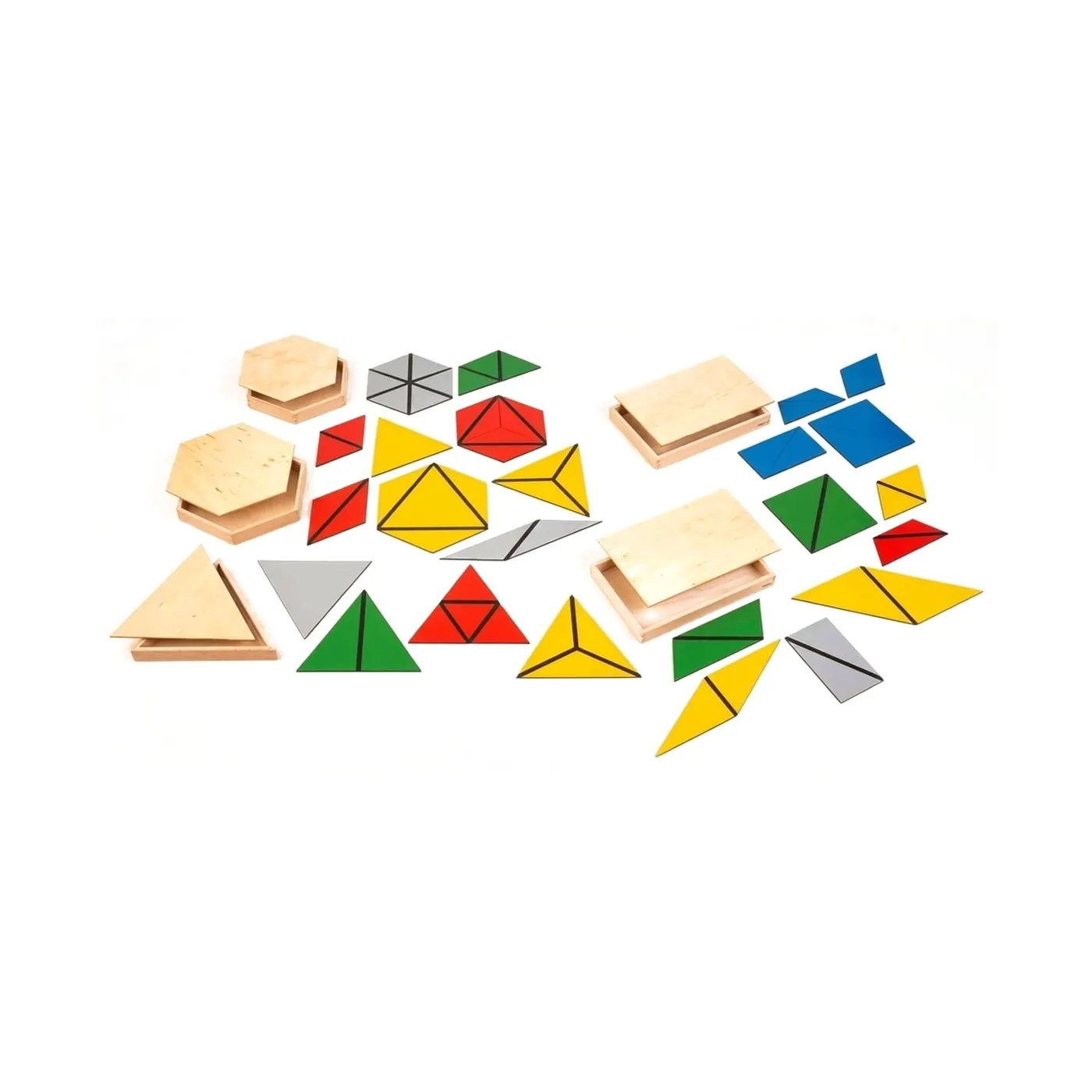 Constructive Triangles (Nienhuis) €339.90
Advice, warranty and returns are handled by us.
Why it costs €54.90
Behind the price of the original are things you can check yourself.
AMI approval
The material is approved by the Association Montessori Internationale (AMI). Nienhuis has made Montessori materials since 1929.
A verifiable original
The EAN 8719924003029 is on the box. It is the maker's number, not ours.
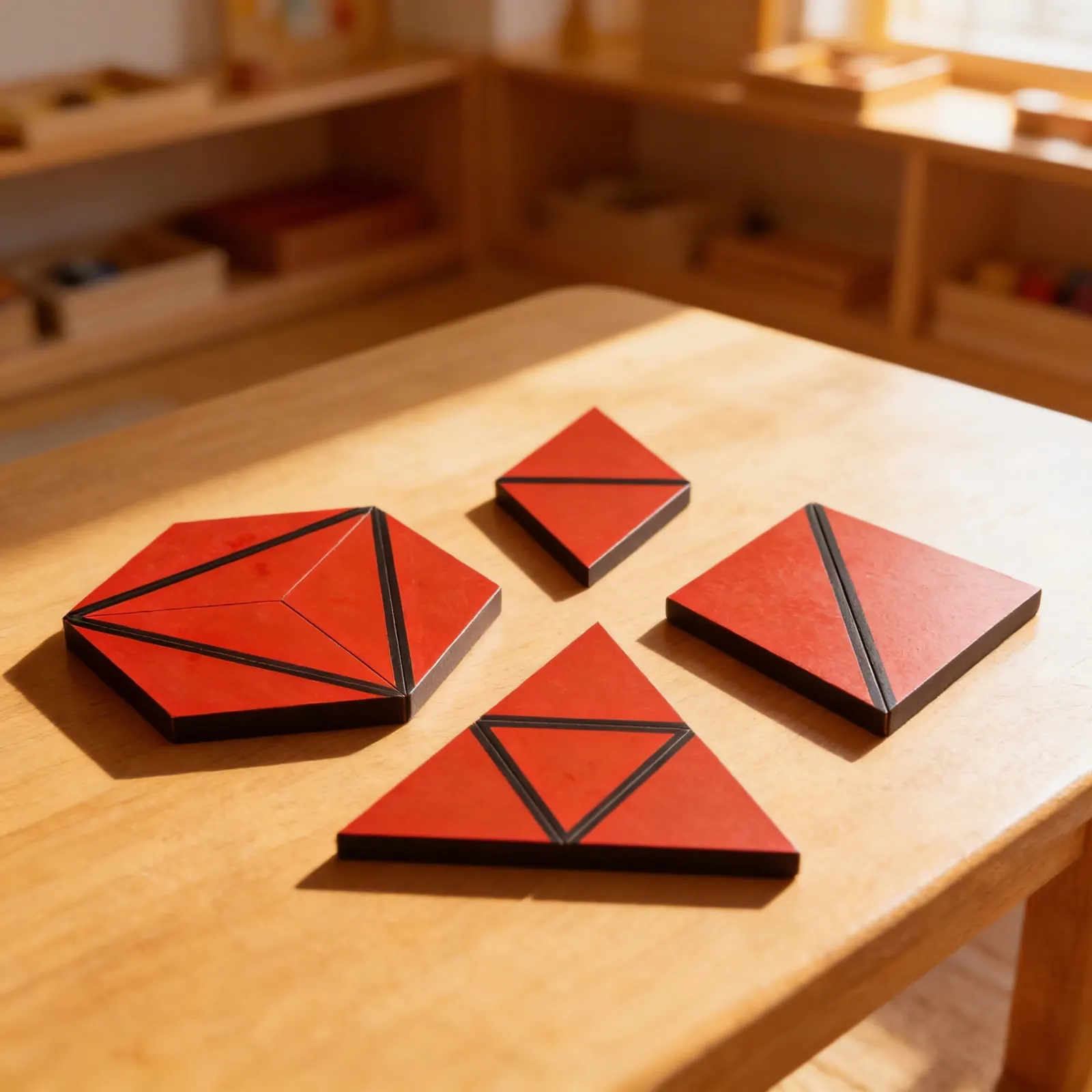
Set Of Red Constructive Triangles in a child's hands
The Set of Red Constructive Triangles is a fundamental Montessori sensorial material that puts children in direct contact with geometric relationships through real-world practice. Each precisely crafted wooden piece features distinctive black borders that guide proper alignment, which means children can discover how triangles combine to form squares, rectangles, and other polygons through independent manipulation and experimentation.
Geometric Understanding
Children discover how triangles combine to create other shapes, building foundational geometry concepts through hands-on exploration.
Visual Discrimination
The contrasting red surfaces and black borders develop the child's ability to perceive geometric boundaries and relationships.
Problem-Solving Skills
Experimenting with different triangle combinations encourages logical thinking and spatial problem-solving abilities.
Preparation for Mathematics
Direct preparation for later work with fractions, angles, and geometric proofs through concrete sensorial experience.
How to present it
Place the red triangle box on a solid-colored mat. Ensure adequate workspace for spreading out all triangles. Work on the floor or a large table where the child can move around to view constructions from different angles.
- 1Remove all triangles from the box and arrange them randomly on the mat
- 2Select two identical right triangles and show how their black borders guide alignment
- 3Demonstrate joining the triangles along their longest edge to form a square
- 4Invite the child to match other triangles by their black borders
3 tips for parents
- At home, point out triangular shapes in everyday objects - roof gables, sandwich cuts, or folded napkins
- Create simple challenges like 'Can you make a rectangle using only triangles?' without showing the solution
- Resist purchasing supplementary geometric toys - the simplicity of red triangles with black borders maintains focus

If you are not sure it suits your child, we answer in person.
Norbert Kovalčín, founder of Faborino · write to him
There is no review here yet. We will ask you for one after you buy. Write the first review
What's in the Box
- Red Triangular Pieces: Approx. 5 geometric shapes with black borders
- Wooden Storage Box: 30 × 25 × 3 cm with lid
Size and material
| Packaging | 32 × 24 × 4 cm |
| Primary Material | Solid wood |
| Finish | Red lacquer with black borders |
| Recommended Age | 3-6 years |
Care
Wipe with slightly damp cloth, dry immediately
Frequently Asked Questions
What shapes can children create with the Red Constructive Triangles?
Children can create squares, rectangles, parallelograms, trapezoids, and rhombuses by combining the triangular pieces. The black borders on each triangle serve as visual guides for proper alignment, helping children discover geometric relationships independently.
How many triangles are included in this set?
The Red Constructive Triangles set typically contains 11 triangles of various sizes and types, including right-angled triangles, equilateral triangles, and isosceles triangles, all stored in a red wooden box for easy organization.
What skills does this material develop?
This material develops visual discrimination, spatial awareness, geometric understanding, fine motor control, concentration, and problem-solving abilities. It also prepares children for later geometry studies by providing concrete experiences with abstract concepts.
How do the black borders help with learning?
The black borders indicate which edges should be aligned when combining triangles. This self-correcting feature allows children to work independently and discover correct formations without adult intervention, building confidence and understanding through exploration.
What's the recommended presentation sequence for this material?
Start by showing how two identical right triangles form a rectangle, then progress to creating squares, parallelograms, and more complex shapes. Allow ample time for free exploration after initial presentations, as children often discover additional combinations independently.
Product safety
Manufacturer: Nienhuis Montessori, Anders Celsiusstraat 15, 7442 PB Nijverdal, Netherlands
Set Of Red Constructive Triangles