
Short Bead ChainsIndividual Beads Glass
The first photo is the maker's own. The other shots are illustrative.
Inv. no. NIE-0080G0
- Maker
- Nienhuis Montessori, since 1929
- Approval
- AMI
- Beads
- Premium glass
- Chain Structure
- Metal wire
- EAN
- 8719924004552
Final price incl. VAT. Free delivery.
Advice, warranty and returns are handled by us.
Why it costs €171.90
Behind the price of the original are things you can check yourself.
AMI approval
The material is approved by the Association Montessori Internationale (AMI). Nienhuis has made Montessori materials since 1929.
A verifiable original
The EAN 8719924004552 is on the box. It is the maker's number, not ours.
Short Bead Chains in a child's hands
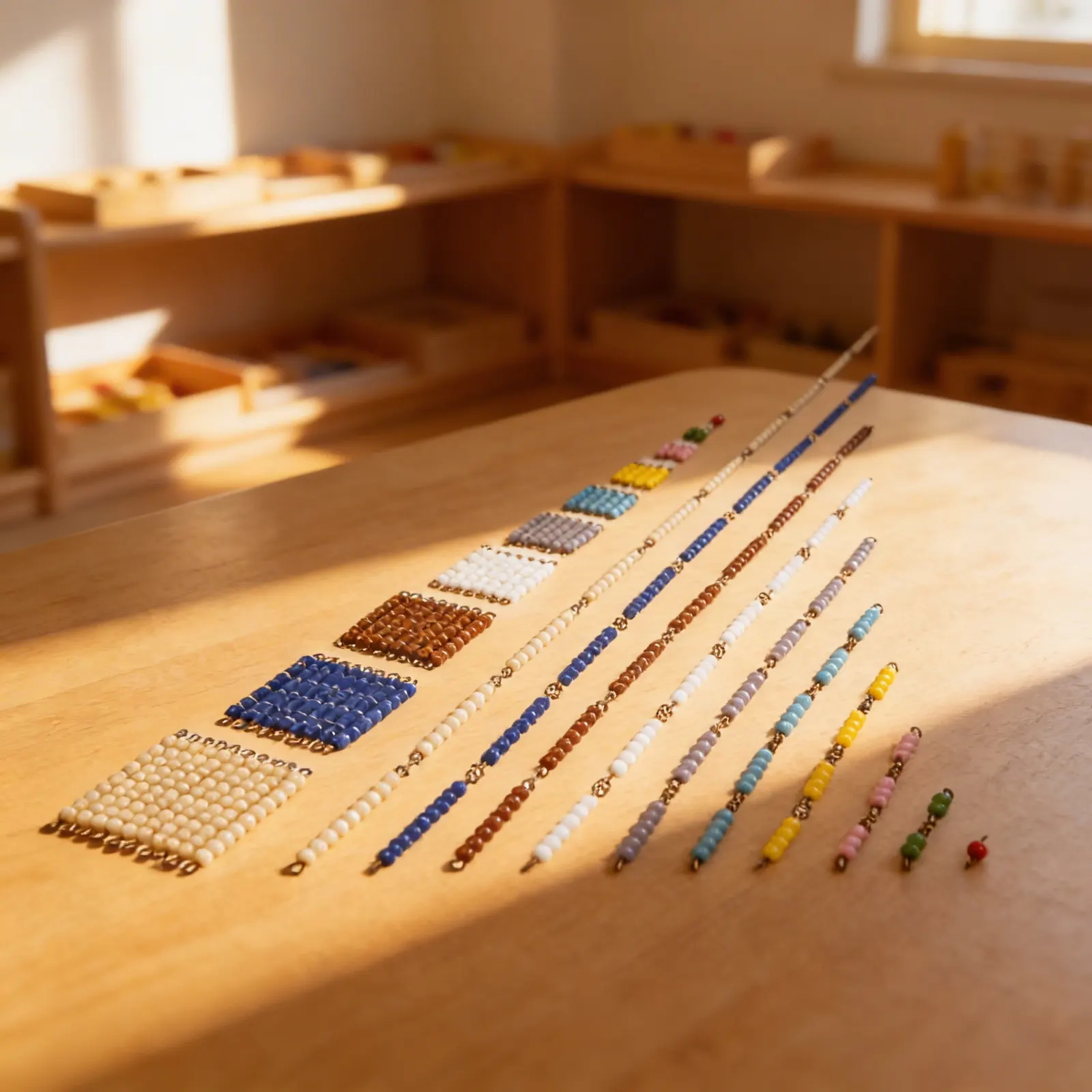
Bead chains for skip counting, with a bead square for each number from one to ten. The child lays a chain out straight, counts along it in its own unit, three, six, nine, and then folds the same chain into its square and sees that the counting arrived exactly at the square's total. Multiplication is not introduced as a rule here; it is what the chain turns out to have been doing all along. Glass beads on wire, for ages 3 to 6.
Linear & Skip Counting
Children develop systematic counting skills and discover patterns in number sequences through tactile manipulation.
Introduction to Squaring
Comparing chains to squares provides concrete understanding of squared numbers and geometric relationships.
Mathematical Order
Color-coded system reinforces number hierarchy and helps children recognize numerical patterns.
Preparation for Abstraction
Concrete manipulation of quantities prepares the mathematical mind for later abstract operations.
How to present it
Place the bead chain stand on a work mat. Arrange chains from 1-10 in order, with corresponding bead squares positioned above each chain. Have number arrows 1-100 available in a separate container.
- 1Invite the child to select one chain, starting with shorter lengths
- 2Demonstrate unfolding the chain completely on the mat, counting each bead aloud while touching it
- 3Place number arrows at appropriate intervals for skip counting
- 4Show how to fold the chain to match its corresponding bead square
- 5Invite the child to work with the material independently
3 tips for parents
- Practice counting objects at home - buttons, pasta, or coins - to reinforce linear counting skills
- Point out skip counting in daily life: pairs of shoes (counting by 2s) or fingers on hands (counting by 5s)
- Support mathematical language by using terms like 'altogether,' 'how many more,' and 'groups of'

If you are not sure it suits your child, we answer in person.
Norbert Kovalčín, founder of Faborino · write to him
There is no review here yet. We will ask you for one after you buy. Write the first review
What's in the Box
- Bead chains 1-10: Color-coded glass bead chains
- Bead squares 1-10: Corresponding square arrangements
- Complete set: Approx. 20 components total
Size and material
| Packaging | 18 × 15 × 3 cm |
| Beads | Premium glass |
| Chain Structure | Metal wire |
| Recommended Age | 3-6 years |
Care
| Cleaning | Wipe glass beads with soft, slightly damp cloth |
| Storage | Store flat to prevent tangling of chains |
Frequently Asked Questions
What exactly is included in the Short Bead Chains set?
This set includes 10 bead chains (chains 1-10) made of high-quality glass beads in Montessori's color-coded system, plus 10 corresponding bead squares. Each chain represents linear counting while the squares demonstrate the squared value of each number.
How do children use the Short Bead Chains in Montessori mathematics?
Children lay out the chains to practice linear counting (1, 2, 3...) and skip counting (2, 4, 6... or 3, 6, 9...). They can fold the chains to match the bead squares, discovering that a chain of 4 beads equals a square of 2x2, building concrete understanding of squared numbers.
Why are glass beads used instead of plastic or wood?
Glass beads provide superior weight, texture, and aesthetic appeal that engage children's senses. The substantial feel helps children internalize mathematical concepts through tactile experience, while the beauty of the material invites repeated use and careful handling.
What mathematical concepts do Short Bead Chains teach?
Short Bead Chains introduce linear counting, skip counting, number patterns, squared numbers, and the relationship between linear and area measurements. They prepare children for multiplication, division, and more advanced mathematical operations.
How are Short Bead Chains different from Long Bead Chains?
Short Bead Chains represent numbers 1-10 with their squares, while Long Bead Chains show the cube of each number (1-1000). Short chains focus on basic counting and squaring, making them appropriate for younger children (3-6), while long chains extend to cubing concepts.
Product safety
Manufacturer: Nienhuis Montessori, Anders Celsiusstraat 15, 7442 PB Nijverdal, Netherlands
Short Bead Chains