
Short Bead ChainsIndividual Beads Nylon (Nienhuis)
The first photo is the maker's own. The other shots are illustrative.
Inv. no. NIE-0080M0
- Maker
- Nienhuis Montessori, since 1929
- Approval
- AMI
- Beads
- Nylon
- Stringing
- Copper wire
- EAN
- 8719924004569
Final price incl. VAT. Delivery €5.90, €46.10 to go for free delivery.
Advice, warranty and returns are handled by us.
Why it costs €102.90
Behind the price of the original are things you can check yourself.
AMI approval
The material is approved by the Association Montessori Internationale (AMI). Nienhuis has made Montessori materials since 1929.
A verifiable original
The EAN 8719924004569 is on the box. It is the maker's number, not ours.
Short Bead Chains in a child's hands
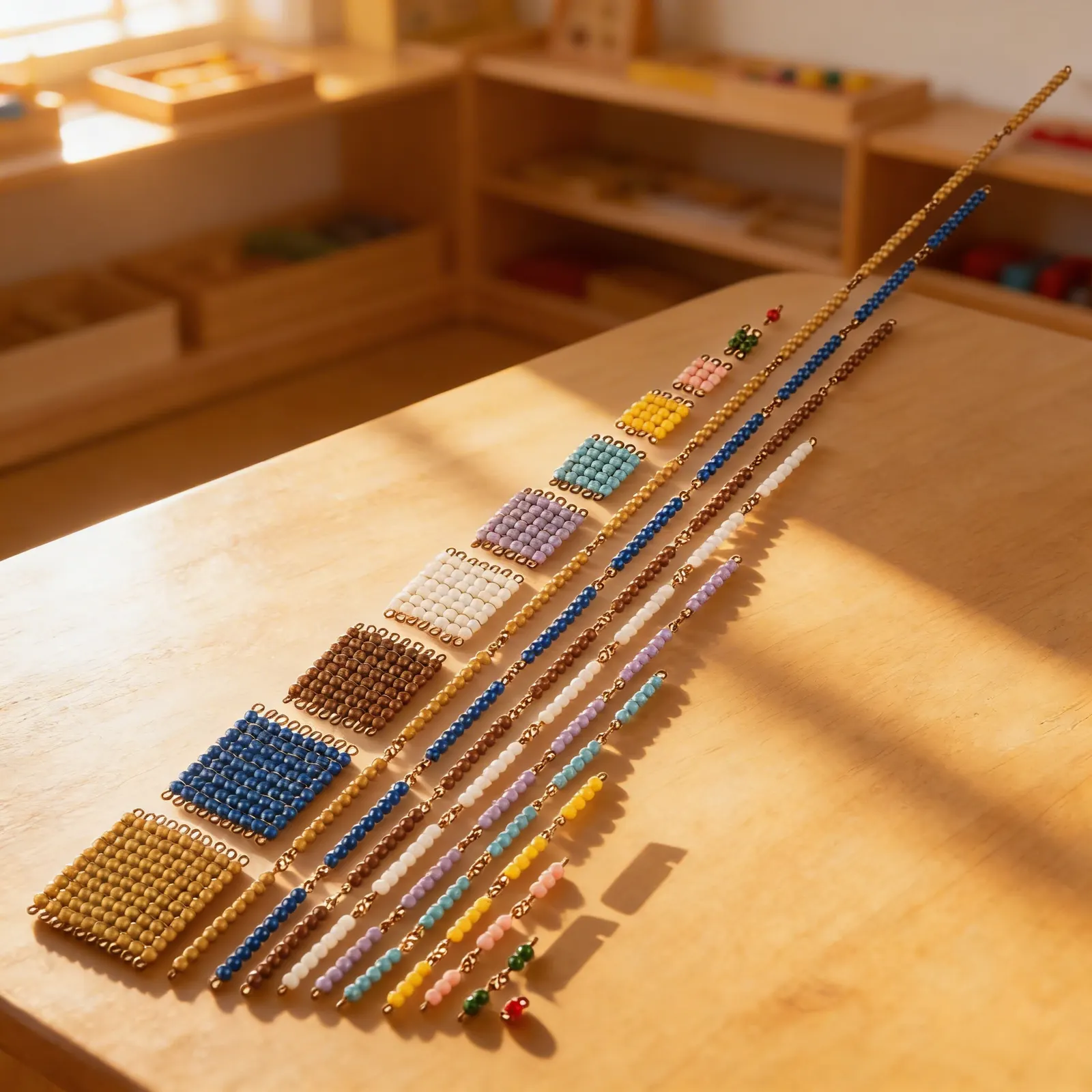
Bead chains for skip counting in nylon, with a bead square for each number from one to ten. Laid out straight, a chain is counted in its own unit; folded into its square, the same beads show that the counting arrived exactly where the square says it should. Nylon is the version that survives being unrolled across a floor daily, which is what these chains are for. Preparation for multiplication before multiplication is named. Nylon beads on wire, for ages 3 to 6.
Mathematical Understanding
Provides concrete representation of squaring numbers and the relationship between linear counting and square numbers.
Skip Counting Skills
Chains enable practice of skip counting by 2s, 3s, 4s, etc., laying foundation for multiplication.
Visual-Spatial Recognition
The assorted colours help children recognise number patterns and develop visual memory for quantities.
Fine Motor Precision
Handling individual beads and chains refines pincer grasp and hand-eye coordination.
How to present it
Lay out the chains on a large work mat in order from 1 to 10. Place the corresponding bead squares above each chain. Ensure adequate space for the child to stretch out the longest chains fully.
- 1Begin with the chain of 1, counting the single bead and matching it to the square of 1
- 2Progress to chain of 2, counting 1, 2 and then showing how two groups of 2 make the square
- 3Continue with longer chains, introducing skip counting group by group
- 4Compare the stretched chain length to its corresponding square formation
3 tips for parents
- Practice skip counting during daily activities like climbing stairs or setting the table
- Use small objects at home (buttons, coins) to create simple counting chains
- Celebrate when your child discovers number patterns independently rather than pointing them out

If you are not sure it suits your child, we answer in person.
Norbert Kovalčín, founder of Faborino · write to him
There is no review here yet. We will ask you for one after you buy. Write the first review
What's in the Box
- Bead chains: Nylon beads strung on copper wire
- Bead squares: One square for each number from 1 to 10
Size and material
| Packaging | 20 × 15 × 1 cm |
| Beads | Nylon |
| Stringing | Copper wire |
| Recommended Age | 3-6 years |
Care
Wipe beads with damp cloth, air dry completely
Frequently Asked Questions
What ages are these Short Bead Chains suitable for?
These Short Bead Chains are designed for children ages 3-6, aligning with the Montessori early childhood curriculum for introducing mathematical concepts through concrete, hands-on materials.
What mathematical concepts do the Short Bead Chains teach?
The Short Bead Chains teach skip counting, squaring numbers, number sequences 1-10, and the relationship between linear counting and square representations. Children also develop understanding of multiplication and mathematical patterns.
What materials are the beads and chains made from?
The beads are made of nylon and strung on copper wire. A bead square for each number from 1 to 10 is also included.
How do children use the bead squares and chains together?
Children lay out the linear chain and fold it to match the bead square, discovering that 3x3=9 or 4x4=16. This concrete manipulation helps them understand squaring as repeated addition and see the physical relationship between linear and square formats.
Do I need other materials to use with these Short Bead Chains?
While the chains can be used independently, they work best with number arrows for labeling, a mat for layout work, and ideally coordinate with the Montessori bead cabinet. The chains also prepare children for later work with long bead chains and cubing materials.
Product safety
Manufacturer: Nienhuis Montessori, Anders Celsiusstraat 15, 7442 PB Nijverdal, Netherlands
Short Bead Chains