
Single Shape Puzzle Set (Nienhuis)
The first photo is the maker's own. The other shots are illustrative.
Inv. no. NIE-044100
- Maker
- Nienhuis Montessori, since 1929
- Approval
- AMI
- Construction
- Plywood base
- Puzzle Pieces
- Painted wood with knobs
- EAN
- 8719924012656
Final price incl. VAT. Delivery €5.90, €53.10 to go for free delivery.
Advice, warranty and returns are handled by us.
Why it costs €95.90
Behind the price of the original are things you can check yourself.
AMI approval
The material is approved by the Association Montessori Internationale (AMI). Nienhuis has made Montessori materials since 1929.
A verifiable original
The EAN 8719924012656 is on the box. It is the maker's number, not ours.
Single Shape Puzzle Set (Nienhuis) in a child's hands
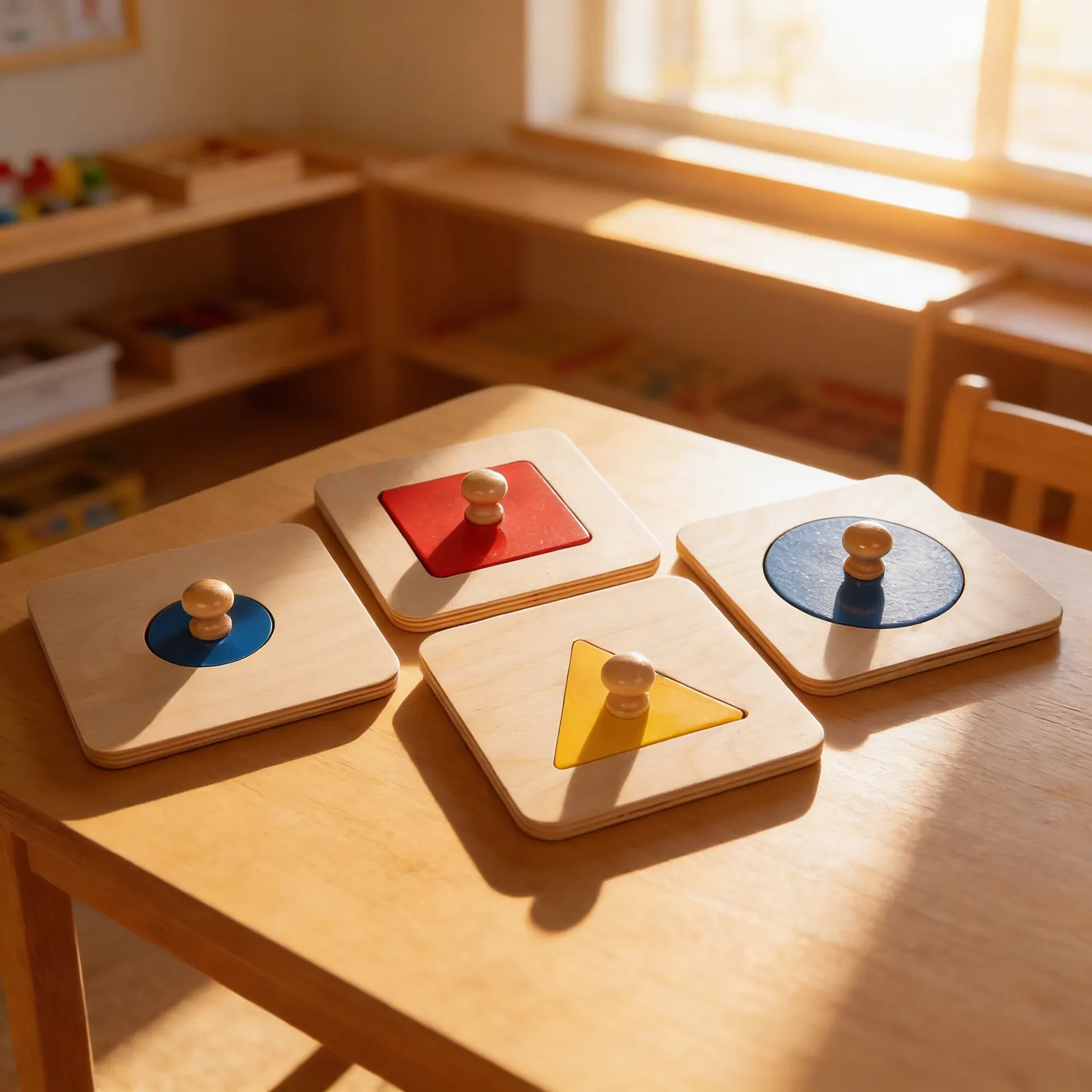
Four one piece puzzles: a large circle, a small circle, a square and an equilateral triangle. One piece is the whole point at this age. A toddler lifting a single knobbed shape out and putting it back is doing the complete cycle of a piece of work, start to finish, with nothing left over, and completing something is what makes a child return to it. The two circles teach that size is a difference even when shape is not. Plywood with painted wood, for ages 0 to 3.
Pincer Grasp Development
The wooden knobs are precisely sized to encourage proper thumb and finger positioning, strengthening the muscles needed for writing.
Shape Discrimination
Isolating each shape on its own board allows focused exploration of circles, squares, triangles, and other fundamental forms.
Hand-Eye Coordination
Matching shapes to their corresponding recesses develops visual-motor integration through repeated successful placements.
Concentration Building
The single-shape format eliminates distractions, allowing deep focus on one concept at a time.
How to present it
Place one puzzle board on a small mat or tray at the child's work space. Store remaining boards separately to maintain isolation of concept.
- 1Demonstrate slowly removing the shape by grasping the knob with thumb and forefinger
- 2Trace the empty recess with your index finger in a smooth, continuous motion
- 3Trace the removed shape piece with the same smooth motion
- 4Return the shape to its recess, releasing the knob gently
- 5Invite the child to try, observing without correcting
3 tips for parents
- Resist naming the shapes initially - let your child explore the physical properties first
- Store puzzles where your child can choose independently once demonstrated
- When your child masters all four, play 'mystery shape' by tracing shapes on their back

If you are not sure it suits your child, we answer in person.
Norbert Kovalčín, founder of Faborino · write to him
There is no review here yet. We will ask you for one after you buy. Write the first review
What's in the Box
- Shape Puzzle Boards: 4 individual boards
- Knobbed Pieces: 1 per board (4 total)
Size and material
| Packaging | 31 × 16 × 7 cm |
| Construction | Plywood base |
| Puzzle Pieces | Painted wood with knobs |
| Finish | Smooth coating |
| Recommended Age | 12-36 months |
Care
Wipe with slightly damp cloth, dry immediately
Frequently Asked Questions
What shapes are included in the Single Shape Puzzle Set?
The set includes four individual wooden puzzle boards, each featuring one fundamental geometric shape - typically a circle, square, triangle, and rectangle. Each shape has a grasping knob for easy manipulation by young children.
Why does each puzzle board have only one shape?
Following Montessori principles of isolation of difficulty, each board presents a single concept to prevent overwhelming the child. This allows complete focus on mastering one shape at a time, building confidence and understanding before moving to the next shape.
At what age should I introduce these puzzles to my child?
These puzzles are designed for children from birth to 3 years. Typically, children show readiness around 10-12 months when they develop the pincer grasp. Start with the circle (easiest to place) and progress to more complex shapes as the child develops.
How do these puzzles support my child's development?
The puzzles develop shape discrimination, fine motor control through the grasping knob, hand-eye coordination, concentration, and problem-solving skills. They also prepare the hand for writing through the refined finger movements required.
What is the proper way to present these puzzles to a child?
Sit beside the child and slowly demonstrate removing the shape using the knob with a pincer grasp. Place it beside the board, pause, then carefully return it. Invite the child to try. Start with one puzzle and introduce others only after mastery of the first.
Product safety
Manufacturer: Nienhuis Montessori, Anders Celsiusstraat 15, 7442 PB Nijverdal, Netherlands
Single Shape Puzzle Set (Nienhuis)