
Six Kingdom Chart
The first photo is the maker's own. The other shots are illustrative.
Inv. no. NIE-ELC4073
- Maker
- Nienhuis Montessori, since 1929
- Material
- Durable plastic
- Finish
- Pre-cut with rounded corners
- EAN
- 8719924044145
Final price incl. VAT. Delivery €5.90, €54.10 to go for free delivery.
Advice, warranty and returns are handled by us.
Six Kingdom Chart in a child's hands
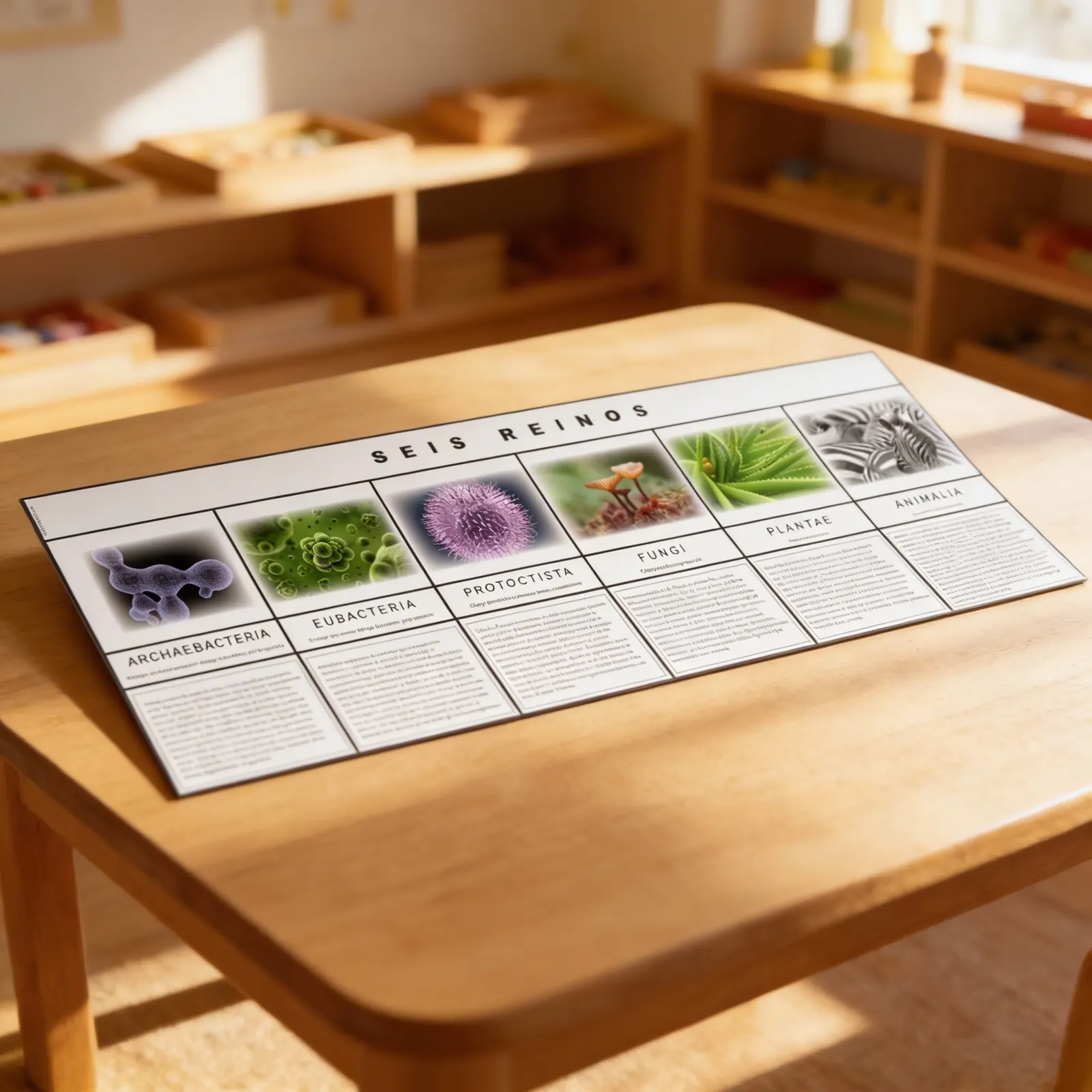
A complete teaching aid, this Six Kingdom Chart presents the biological classification system through vivid photographic examples and Spanish-language descriptions. The large-format laminated poster displays all six kingdoms of life (Bacteria, Archaea, Protista, Fungi, Plantae, and Animalia) with multiple representative organisms for each category. A good match for elementary classrooms, this durable educational chart supports scientific literacy and brings children face-to-face with the diversity of life on Earth.
Scientific Classification
Introduces the fundamental concept of biological kingdoms and helps children understand how scientists organize living things.
Visual Learning
Photographic examples provide concrete visual references that help children connect abstract classifications to real organisms.
Language Development
Spanish-language content supports bilingual education and scientific vocabulary development in a second language.
Natural World Connection
Encourages appreciation for biodiversity and sparks curiosity about the variety of life forms on Earth.
How to present it
Mount the Six Kingdom Chart at child eye-level on a wall where children can approach closely. Place a small table beneath with magnifying glasses and classification books.
- 1Begin with the Animal Kingdom section, inviting children to identify familiar creatures
- 2Move to the Plant Kingdom, connecting to plants in your classroom or outdoor environment
- 3Introduce the Fungi Kingdom using familiar mushrooms or bread mold examples
- 4Explore microscopic kingdoms using the chart's magnified images
- 5Practice Spanish pronunciation of kingdom names and example organisms
3 tips for parents
- During nature walks, help your child identify living things and recall which kingdom they belong to from the classroom chart
- At meals, discuss which kingdoms provided your food, plants for vegetables, fungi for mushrooms, animals for dairy or meat
- Support Spanish vocabulary development by learning kingdom names together: Reino Animal, Reino Vegetal, Reino Fungi

If you are not sure it suits your child, we answer in person.
Norbert Kovalčín, founder of Faborino · write to him
There is no review here yet. We will ask you for one after you buy. Write the first review
What's in the Box
- Six Kingdom Chart: 90×60 cm laminated poster
Size and material
| Packaging | 42 × 29 × 14 cm |
| Material | Durable plastic |
| Finish | Pre-cut with rounded corners |
| Recommended Age | 6-12 years |
Care
Wipe with damp cloth; avoid harsh chemicals
Frequently Asked Questions
Is this Six Kingdom Chart available in English or other languages besides Spanish?
This particular chart features Spanish-language descriptions. For English or other language versions, please check our catalog or contact customer service for availability of alternative language options.
What size is the Six Kingdom Chart and is it suitable for wall mounting?
This is a large-format laminated poster designed specifically for classroom wall display. The lamination provides durability and protection, making it ideal for long-term educational use in classrooms or learning spaces.
Is this chart appropriate for 3-6 year olds given the complexity of the six kingdom classification system?
While the six kingdom system is advanced, this visual chart introduces basic scientific classification through photographs. For ages 3-6, it serves as an early exposure tool where children can identify familiar organisms and begin understanding that living things are grouped into categories.
What types of organisms are shown as examples for each kingdom?
The chart displays multiple photographic examples for each kingdom: Bacteria (microscopic images), Archaea (extremophiles), Protista (algae, protozoa), Fungi (mushrooms, molds), Plantae (various plants), and Animalia (diverse animals), providing comprehensive visual representation of life's diversity.
How does this chart support Montessori biology curriculum?
This chart aligns with Montessori's systematic approach to classification and the study of life. It provides concrete visual references for abstract concepts, supports the elementary biology curriculum, and helps children understand the interconnectedness of all living things through scientific organization.
Product safety
Manufacturer: Nienhuis Montessori, Anders Celsiusstraat 15, 7442 PB Nijverdal, Netherlands
Six Kingdom Chart