
Small Number Cards 1-3000Plastic
The first photo is the maker's own. The other shots are illustrative.
Inv. no. NIE-0070C0
- Maker
- Nienhuis Montessori, since 1929
- Approval
- AMI
- Construction
- Durable plastic
- Printing
- Color-coded numerals
- EAN
- 8719924004309
Final price incl. VAT. Delivery €5.90, €133.10 to go for free delivery.
Advice, warranty and returns are handled by us.
Why it costs €15.90
Behind the price of the original are things you can check yourself.
AMI approval
The material is approved by the Association Montessori Internationale (AMI). Nienhuis has made Montessori materials since 1929.
A verifiable original
The EAN 8719924004309 is on the box. It is the maker's number, not ours.
Small Number Cards 1-3000 in a child's hands
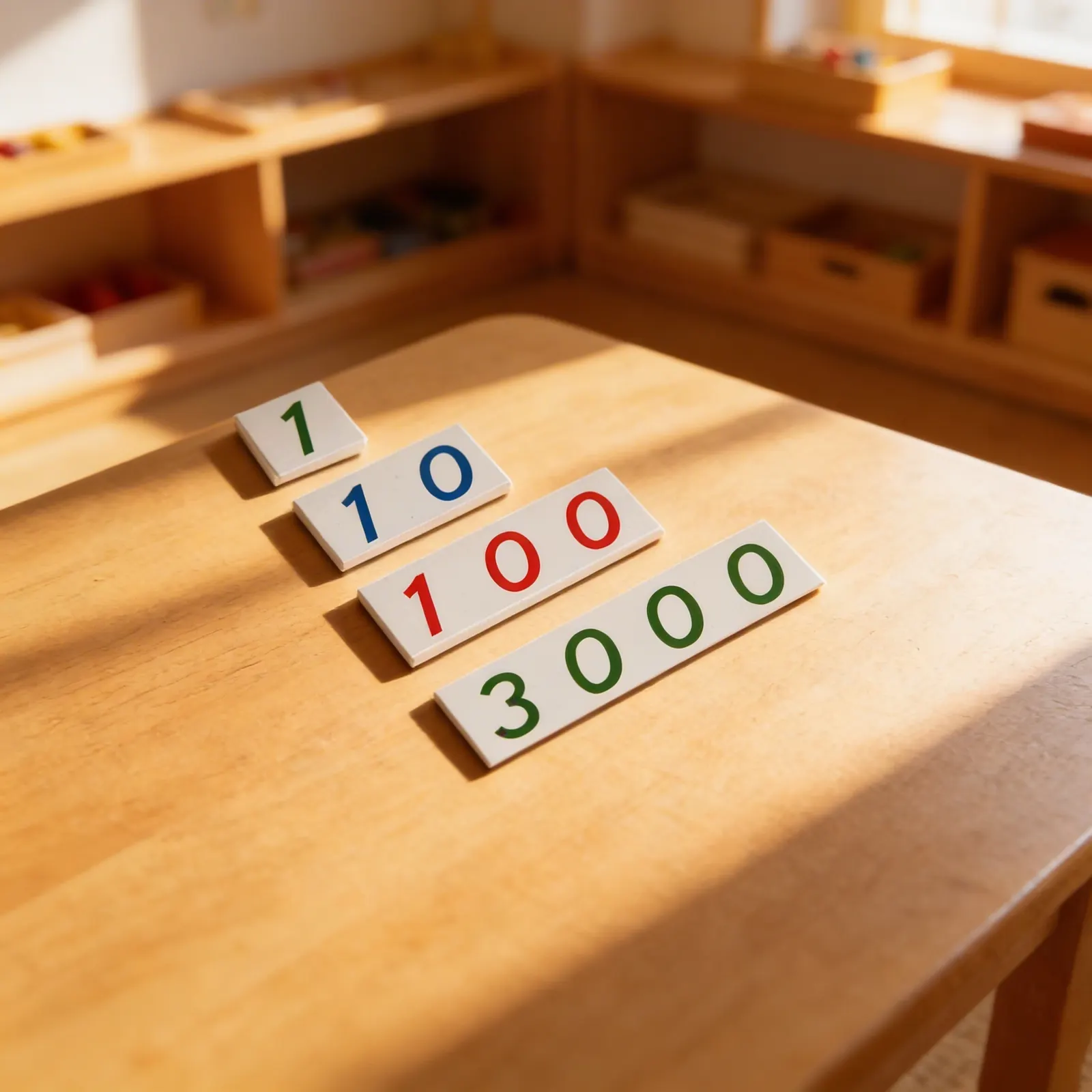
The small number cards from one to three thousand, in plastic: the child's own set, the one they lay out on the mat to build a number and then read back. Small cards are the working set and the large cards are the presentation set, which is why a room usually owns both and why they are separate items here. Plastic is the practical choice for the set that gets handled every day and carried across a room by a four year old. Plastic.
Mathematical Understanding
Builds concrete understanding of place value and the decimal system through color-coded visual hierarchy.
Number Composition
Enables hands-on exploration of how larger numbers are composed of units, tens, hundreds, and thousands.
Sequential Thinking
Develops understanding of number sequences and relationships between different place values.
How to present it
Arrange the cards in separate stacks by place value (units in green, tens in blue, hundreds in red, thousands in green). Place on a mat with units on the right, progressing to thousands on the left.
- 1Begin with single place values. Show the child how to select and name individual cards: '7', '40', '300'
- 2Demonstrate building a number like 245 by selecting 200, 40, and 5, then sliding them together with larger cards behind
- 3Invite the child to build specific numbers you name, starting with two-digit numbers before progressing
- 4Have the child read numbers you build, identifying each place value component before reading the whole
3 tips for parents
- Practice reading numbers in daily life (addresses, prices, pages) to reinforce place value understanding
- Ask your child to build significant numbers like their birth year or house number
- Support patience during number building by celebrating the process, not just correct answers

If you are not sure it suits your child, we answer in person.
Norbert Kovalčín, founder of Faborino · write to him
There is no review here yet. We will ask you for one after you buy. Write the first review
What's in the Box
- Number cards 1-9: Green units
- Number cards 10-90: Blue tens
- Number cards 100-900: Red hundreds
- Number cards 1000-3000: Green thousands
Size and material
| Packaging | 10 × 3 × 1 cm |
| Construction | Durable plastic |
| Printing | Color-coded numerals |
| Recommended Age | 3-6 years |
Care
Wipe with damp cloth and mild soap
Frequently Asked Questions
How do the color-coded place values work in these number cards?
The cards follow traditional Montessori color coding: units (1-9) are green, tens (10-90) are blue, hundreds (100-900) are red, and thousands (1000-3000) are green again. This visual system helps children recognize place values instantly and understand the hierarchical nature of our decimal system.
What activities can children do with these number cards?
Children can build numbers by overlaying cards (e.g., placing 40 over 5 to make 45), practice skip counting, create number sequences, play matching games with concrete materials like golden beads, and explore number composition. The cards support both individual work and small group activities.
Why are these cards made of plastic rather than cardboard?
Plastic cards offer superior durability for classroom use, resist bending and tearing from repeated handling, can be easily cleaned, and maintain their shape when overlapped. This ensures the materials remain precise and attractive throughout years of daily use by multiple children.
How do these cards differ from the Large Number Cards?
Small Number Cards are designed for table work and individual manipulation, measuring approximately 7cm x 4cm. They're perfect for exercises where children need to handle multiple numbers simultaneously. Large Number Cards are typically used for group presentations and initial introductions to place value concepts.
What prerequisites should children have before using these cards?
Children should have experience with quantities 1-10, understand one-to-one correspondence, and ideally have worked with golden bead materials. Familiarity with teen and ten boards helps, though these cards can be introduced alongside those materials to reinforce place value understanding.
Product safety
Manufacturer: Nienhuis Montessori, Anders Celsiusstraat 15, 7442 PB Nijverdal, Netherlands
Small Number Cards 1-3000