
Small Numerical Rods
The first photo is the maker's own. The other shots are illustrative.
Inv. no. NIE-025400
- Maker
- Nienhuis Montessori, since 1929
- Approval
- AMI
- Wood
- Birch plywood and beech
- Finish
- Smooth lacquered surface
- EAN
- 8719924011963
Final price incl. VAT. Delivery €5.90, €4.10 to go for free delivery.
Advice, warranty and returns are handled by us.
Why it costs €144.90
Behind the price of the original are things you can check yourself.
AMI approval
The material is approved by the Association Montessori Internationale (AMI). Nienhuis has made Montessori materials since 1929.
A verifiable original
The EAN 8719924011963 is on the box. It is the maker's number, not ours.
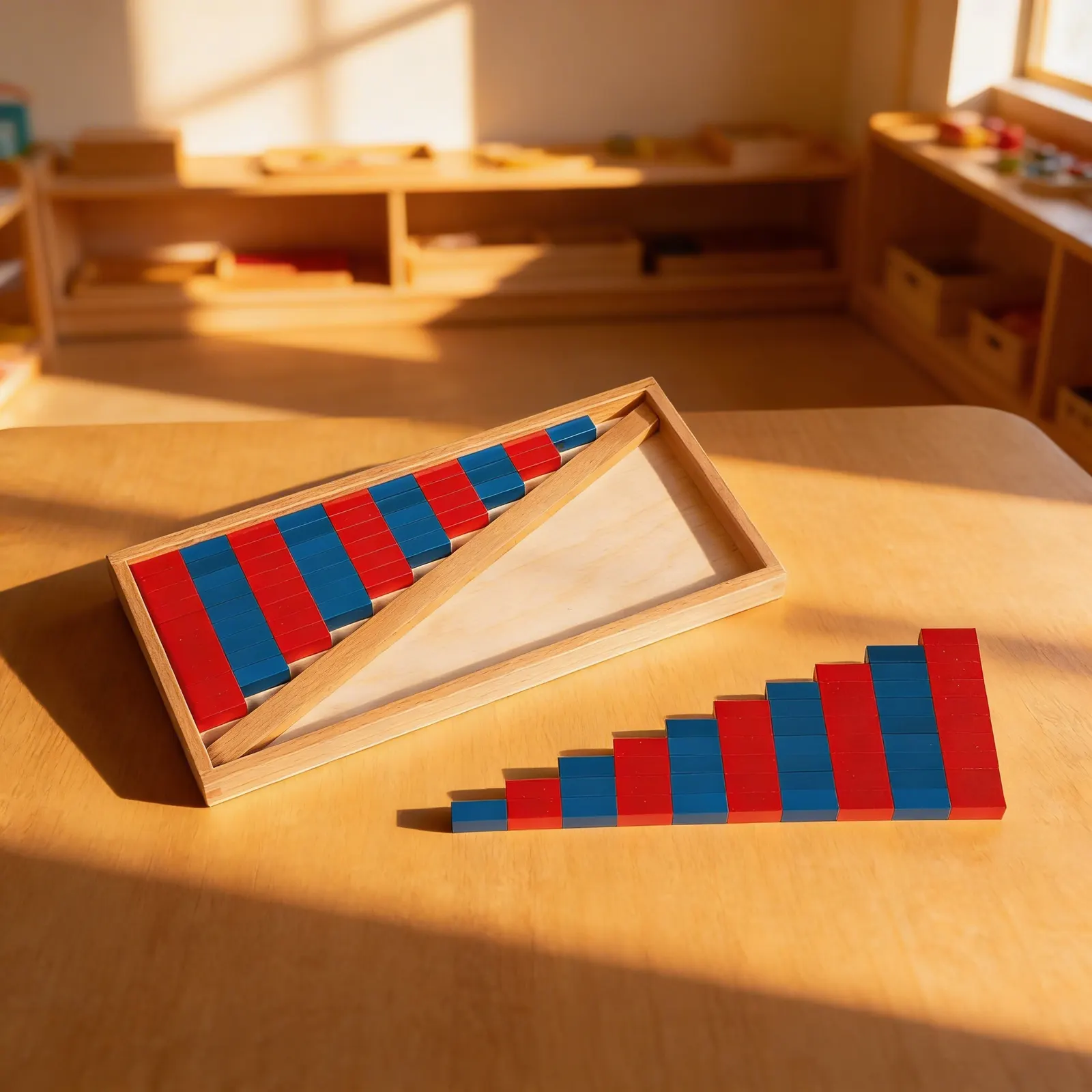
Small Numerical Rods in a child's hands
Two sets of ten rods, divided into units by alternating red and blue, sized for one child working at a table rather than on the floor. The large number rods need a mat and a lot of room; these do the same work in the space a child actually has, which is why they get used more often. Two sets rather than one is the point: with a second set the child can compare, combine and check a sum against a rod that was not part of building it. Supplied in a wooden storage box. Birch plywood and beech, for ages 6 to 12.
Mathematical Foundation
Introduces counting, sequence, and the decimal system through concrete manipulation of graduated lengths.
Visual Discrimination
The alternating color pattern helps children visually distinguish individual units within each quantity.
Order and Sequence
Arranging rods by length develops understanding of mathematical relationships and progression.
Preparation for Abstract Math
Physical representation of numbers 1-10 creates a sensorial foundation for later abstract mathematical concepts.
How to present it
Place the Small Numerical Rods in random order on a table. Have adequate space on the table for arranging rods horizontally. Ensure good lighting to distinguish red and blue segments clearly.
- 1Invite the child to carry one rod at a time to build a stair pattern, starting with the shortest
- 2Once arranged, trace along each rod from left to right, counting the segments aloud
- 3Select any rod and count its segments, then find its position in the stair
- 4Introduce combinations by placing rod 2 and rod 3 end-to-end beside rod 5
3 tips for parents
- Practice counting objects at home to reinforce one-to-one correspondence learned with the rods
- Point out patterns in everyday items (fence posts, floor tiles) that mirror the rod segments
- Avoid rushing to written numbers, let your child fully explore the physical quantities first

If you are not sure it suits your child, we answer in person.
Norbert Kovalčín, founder of Faborino · write to him
There is no review here yet. We will ask you for one after you buy. Write the first review
What's in the Box
- 2 sets of 10 Numerical Rods: Graduated lengths from 1 to 10 units, units alternating red and blue
- Wooden Storage Box: For storing the rods
Size and material
| Packaging | 31 × 16 × 4 cm |
| Wood | Birch plywood and beech |
| Finish | Smooth lacquered surface |
| Recommended Age | 6-12 years |
Care
Wipe with slightly damp cloth, dry immediately
Frequently Asked Questions
What mathematical concepts do the Small Numerical Rods teach?
The Small Numerical Rods teach quantity recognition, counting 1-10, linear measurement, number sequence, and the relationship between numbers and physical length. The alternating red and blue segments help children visually understand each unit, preparing them for addition and subtraction concepts.
How are Small Numerical Rods different from the Large Number Rods?
Small Numerical Rods are more compact and portable, designed for individual work at a table, while Large Number Rods are floor materials. Both teach the same concepts, but the smaller size makes them ideal for home use, limited classroom space, and allows children to manipulate them more easily.
What activities can children do with these rods?
Children can arrange rods in order from shortest to longest, count the segments, match rods with number cards, create staircases, compare lengths, combine rods to explore addition, and use them for measuring objects. These activities develop mathematical thinking and number sense.
What are the dimensions and materials used?
The set has 2 sets of 10 rods, divided into units by alternating red and blue. The rods are made of birch plywood and beech and are stored in a wooden box. The packaging measures 31 × 16 × 4 cm.
When should children start using Small Numerical Rods?
The manufacturer lists this material for ages 6 to 12. It is designed for individual work at a table. With it, a child can discover that the sum of the numbers up to n is always (n²+n)/2.
Product safety
Manufacturer: Nienhuis Montessori, Anders Celsiusstraat 15, 7442 PB Nijverdal, Netherlands
Small Numerical Rods