
Small SkittlesGreen, Blue, Red, (100)
The first photo is the maker's own. The other shots are illustrative.
Inv. no. NIE-009700
- Maker
- Nienhuis Montessori, since 1929
- Approval
- AMI
- Primary Material
- Durable plastic
- Finish
- Smooth, glossy surface
- EAN
- 8719924005696
Final price incl. VAT. Delivery €5.90, €127.10 to go for free delivery.
Advice, warranty and returns are handled by us.
Why it costs €21.90
Behind the price of the original are things you can check yourself.
AMI approval
The material is approved by the Association Montessori Internationale (AMI). Nienhuis has made Montessori materials since 1929.
A verifiable original
The EAN 8719924005696 is on the box. It is the maker's number, not ours.
Small Skittles in a child's hands
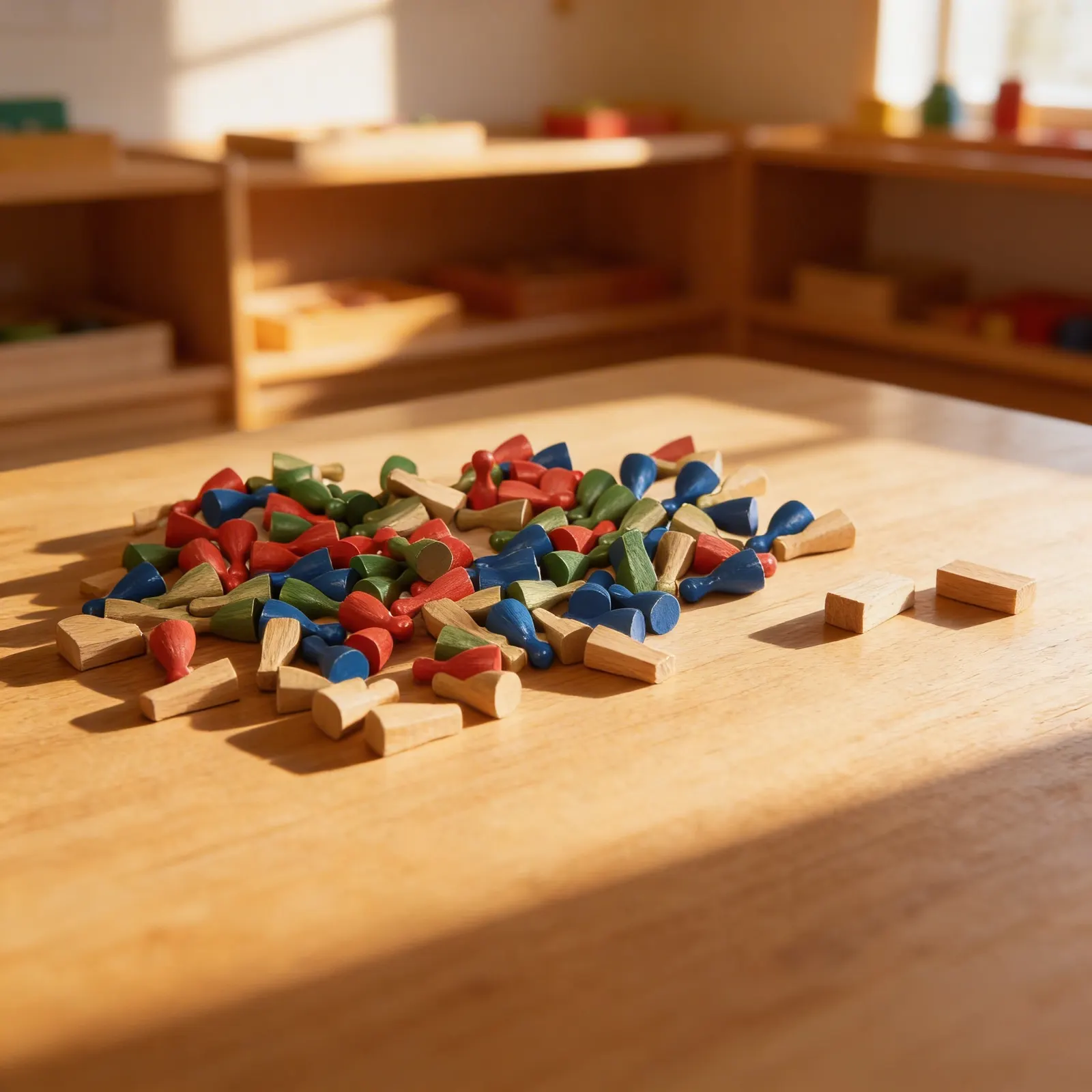
A hundred small skittles: fifty green, twenty five blue and twenty five red. The counts are not arbitrary. Green is the unit colour and units are what division consumes fastest, so twice as many are needed as of either other colour. Working with a hundred at once is also what makes long division on the board possible, since the skittles are the divisors and a big division needs a lot of them standing at the same time. Plastic, for ages 3 to 12.
Mathematical Concepts
Supports one-to-one correspondence, counting to 100, and early arithmetic through hands-on manipulation.
Classification Skills
Develops logical thinking through sorting by color and creating patterns with three distinct colors.
Fine Motor Control
The small size and smooth shape enhance pincer grasp and hand-eye coordination.
Visual Discrimination
Bright, contrasting colors support color recognition and visual perception skills.
How to present it
Place a tray with all 100 skittles mixed together on a mat. Set out three small bowls or containers for sorting.
- 1Invite the child to sort the skittles by color into the three containers
- 2Once sorted, count each color group separately, placing skittles in rows of ten
- 3Create simple patterns using two colors (red-blue-red-blue)
- 4Introduce skip counting by arranging skittles in groups of 2, 5, or 10
3 tips for parents
- Practice counting during cleanup by having your child count skittles as they put them away
- Create simple games like 'Close your eyes while I make a pattern - can you continue it?'
- Use skittles for practical math: 'If we share 20 skittles equally, how many do we each get?'

If you are not sure it suits your child, we answer in person.
Norbert Kovalčín, founder of Faborino · write to him
There is no review here yet. We will ask you for one after you buy. Write the first review
What's in the Box
- Plastic Skittles: Approx. 100 pieces in mixed colors (green, blue, red)
Size and material
| Packaging | 23 × 13 × 1 cm |
| Primary Material | Durable plastic |
| Finish | Smooth, glossy surface |
| Recommended Age | 6-12 years |
Care
Wipe with damp cloth and mild soap
Frequently Asked Questions
How many skittles of each color are included in the set?
The set contains 100 skittles total, distributed among green, blue, and red colors. The exact distribution per color may vary but provides sufficient quantities for sorting, counting, and pattern activities.
What size are these skittles and are they safe for 3-year-olds?
The skittles are specifically designed for small hands aged 3-6, with smooth edges and lightweight plastic construction. They are appropriately sized to prevent choking hazards while being easy for young children to grasp and manipulate.
What Montessori activities can I do with these skittles?
These skittles support numerous Montessori math activities including one-to-one correspondence, counting 1-100, sorting by color, creating patterns, skip counting, simple addition/subtraction, and developing pre-multiplication concepts through grouping.
Are these skittles durable enough for daily classroom use?
Yes, these plastic skittles are designed for regular classroom use with smooth, durable construction that withstands repeated handling by young children while maintaining their vibrant colors.
Can these skittles be used with other Montessori materials?
Absolutely! These skittles complement other Montessori materials like counting boards, number cards, sorting trays, and can be used alongside bead materials for comparative counting and mathematical concept development.
Product safety
Manufacturer: Nienhuis Montessori, Anders Celsiusstraat 15, 7442 PB Nijverdal, Netherlands
Small Skittles