
Small TriangleFraction Material
The first photo is the maker's own. The other shots are illustrative.
Inv. no. NIE-011700
- Maker
- Nienhuis Montessori, since 1929
- Approval
- AMI
- Base
- Wood with green finish
- Triangle Inset
- Durable plastic
- EAN
- 8719924006730
Final price incl. VAT. Delivery €5.90, €91.10 to go for free delivery.
Advice, warranty and returns are handled by us.
Why it costs €57.90
Behind the price of the original are things you can check yourself.
AMI approval
The material is approved by the Association Montessori Internationale (AMI). Nienhuis has made Montessori materials since 1929.
A verifiable original
The EAN 8719924006730 is on the box. It is the maker's number, not ours.
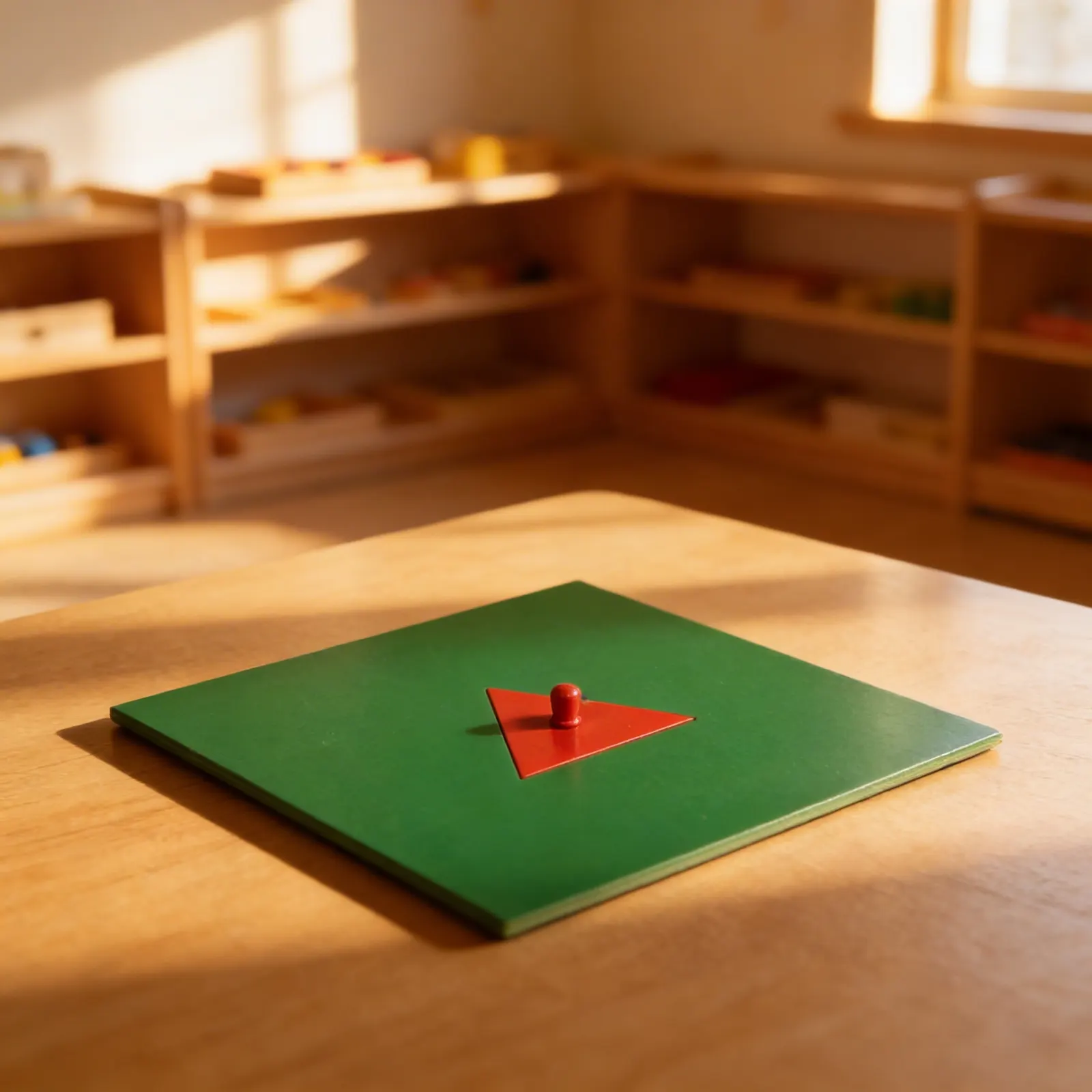
Small Triangle in a child's hands
A small triangle from the elementary geometry material, one of a set of plane figures worked alongside the trapezoid and the quatrefoils. Handling a shape is a different kind of knowing from seeing one drawn: a child who has turned this triangle over, laid it against others and found where it fits will recognise it later at any orientation, on any page, which is exactly what a child who has only met it in a textbook will not do. Wood and plastic, for ages 6 to 12.
Geometric Understanding
Introduces fundamental triangle properties and spatial relationships through concrete manipulation.
Visual Discrimination
High contrast colors support shape recognition and figure-ground perception skills.
Fine Motor Control
Cylindrical knob promotes proper pincer grip while placing and removing the triangle piece.
Mathematical Preparation
Lays foundation for advanced geometry concepts including angles, vertices, and shape properties.
How to present it
Place the Small Triangle on a work mat with the green square base positioned directly in front of the child. Ensure the red triangular piece is properly seated in its frame.
- 1Invite the child to grasp the cylindrical knob with a three-finger grip and slowly lift the red triangle from its base
- 2Place the triangle beside the square base and invite observation of both shapes
- 3Trace the perimeter of the empty triangular space with your index finger, then trace the red triangle piece
- 4Return the triangle to its base, rotating if necessary to find the correct fit
- 5Repeat the process, encouraging the child to work independently
3 tips for parents
- Look for triangular shapes in everyday life - roof lines, sandwich cuts, or traffic signs
- Support vocabulary development by using terms like 'triangular' and 'three-sided' at home
- Avoid rushing to name shapes - let your child discover relationships first

If you are not sure it suits your child, we answer in person.
Norbert Kovalčín, founder of Faborino · write to him
There is no review here yet. We will ask you for one after you buy. Write the first review
What's in the Box
- Wooden base board: Green painted square frame
- Triangle inset piece: Red plastic with cylindrical knob
Size and material
| Packaging | 14 × 14 × 1 cm |
| Base | Wood with green finish |
| Triangle Inset | Durable plastic |
| Knob | Plastic with smooth finish |
| Recommended Age | 6-12 years |
Care
Wipe with slightly damp cloth, dry immediately
Frequently Asked Questions
What specific geometric concepts does the Small Triangle teach?
The Small Triangle introduces fundamental concepts including shape recognition, spatial relationships, positive and negative space, and the properties of triangles. Children learn to identify triangular forms, understand how shapes fit together, and develop visual discrimination skills through hands-on manipulation.
How does the contrasting color design support learning?
The green square base and red triangular inset create strong visual contrast that helps children clearly distinguish between the frame and the shape. This color differentiation aids in shape isolation, making it easier for children to focus on the triangle's properties while developing visual perception and discrimination skills.
What is the purpose of the cylindrical knob on this material?
The cylindrical knob serves multiple purposes: it develops the three-finger pincer grip essential for writing preparation, provides a consistent grasping point for precise placement, and allows children to practice controlled movements while fitting the triangle into its corresponding space.
How does this material differ from the geometric cabinet triangles?
While the geometric cabinet contains multiple triangle variations, this Small Triangle is a standalone material that allows focused work with a single shape. It's typically introduced earlier as a simpler presentation, helping children master basic triangle recognition before progressing to more complex geometric comparisons.
What activities can children do with the Small Triangle beyond basic insertion?
Children can trace around both the inset and frame to create triangle art, use it for shape matching activities, combine it with other geometric materials for pattern work, explore concepts of congruence and symmetry, and use it as a template for creating triangles with other materials like clay or paper.
Product safety
Manufacturer: Nienhuis Montessori, Anders Celsiusstraat 15, 7442 PB Nijverdal, Netherlands
Small Triangle