
Small Wooden Scale
The first photo is the maker's own. The other shots are illustrative.
Inv. no. NIE-912900
- Maker
- Nienhuis Montessori, since 1929
- Approval
- AMI
- Frame
- Natural wood construction
- Weighing Pans
- Metal with chain suspension
- EAN
- 8719924031169
Final price incl. VAT. Free delivery.
Advice, warranty and returns are handled by us.
Why it costs €190.90
Behind the price of the original are things you can check yourself.
AMI approval
The material is approved by the Association Montessori Internationale (AMI). Nienhuis has made Montessori materials since 1929.
A verifiable original
The EAN 8719924031169 is on the box. It is the maker's number, not ours.
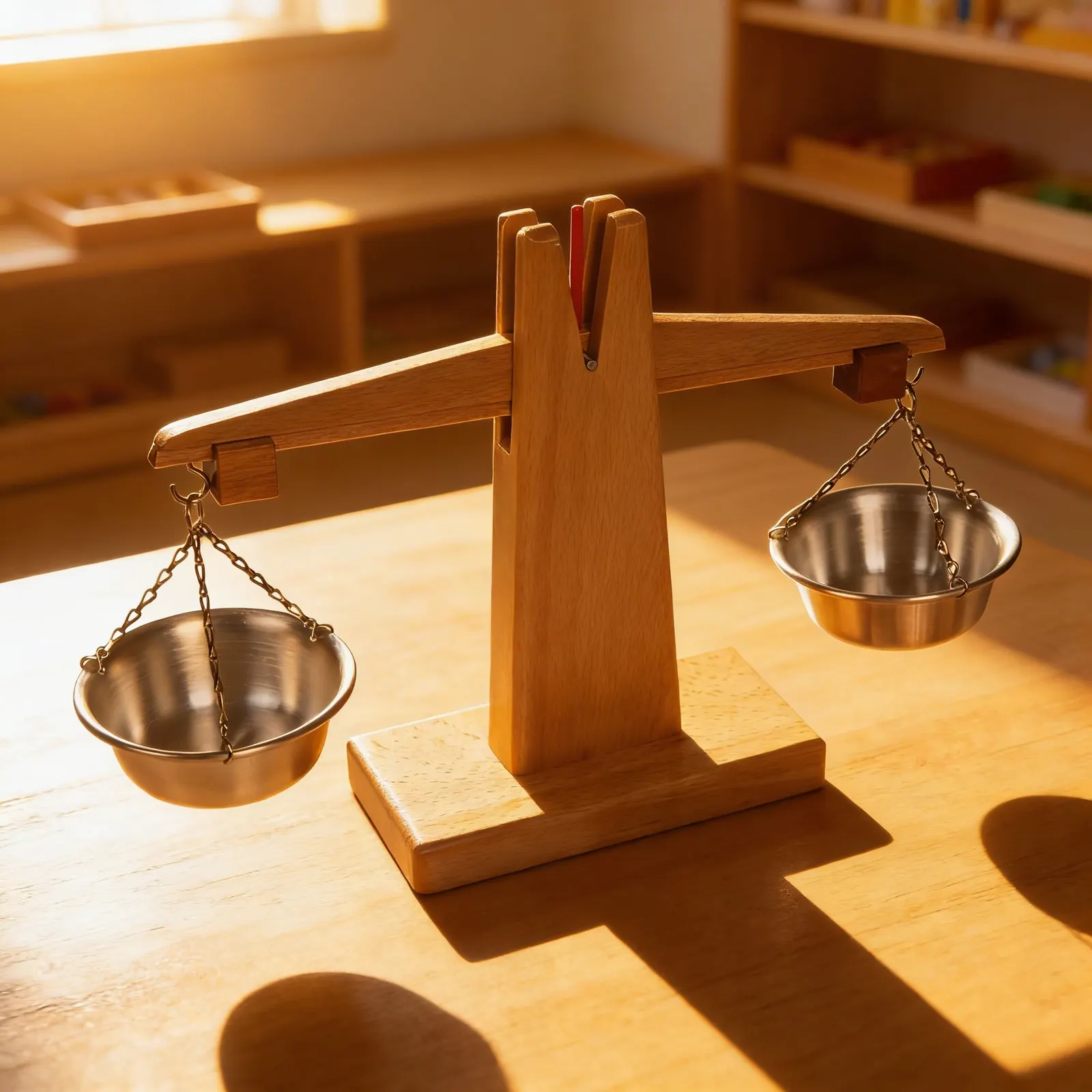
Small Wooden Scale in a child's hands
This precision balance scale introduces young learners to fundamental concepts of weight, mass, and equilibrium through tactile learning. The wooden beam construction with suspended metal weighing pans allows children to directly observe cause and effect as they compare objects, developing early mathematical thinking and scientific reasoning. The red fulcrum indicator provides clear visual feedback as materials are balanced, supporting the Montessori principle of concrete learning experiences.
Mathematical Reasoning
Comparing weights develops understanding of more than, less than, and equal to concepts through concrete manipulation
Scientific Method
Making predictions and testing hypotheses about weight relationships builds early scientific thinking skills
Fine Motor Control
Carefully placing objects in pans and adjusting for balance refines hand-eye coordination and precision movements
Problem-Solving Skills
Finding combinations of objects that balance encourages logical thinking and systematic exploration
How to present it
Place the scale on a stable, level surface at child height. Ensure both metal pans hang freely and the beam moves smoothly. Gather a collection of classroom objects of varying weights.
- 1Demonstrate placing one object in each pan, observing which side lowers
- 2Invite the child to predict which of two objects will be heavier before testing
- 3Explore making both sides equal using multiple small objects
- 4Record findings using simple drawings or tally marks
3 tips for parents
- Practice weight comparison during daily activities using terms like 'heavier' and 'lighter'
- Let your child help with cooking to experience measuring and comparing ingredients
- Point out see-saws at the playground as real-world examples of balance

If you are not sure it suits your child, we answer in person.
Norbert Kovalčín, founder of Faborino · write to him
There is no review here yet. We will ask you for one after you buy. Write the first review
What's in the Box
- Wooden balance scale: with vertical support post and horizontal beam
- Metal weighing pans (2): suspended by chains
- Red fulcrum indicator: for visual weight distribution feedback
Size and material
| Packaging | 77 × 15 × 7 cm |
| Frame | Natural wood construction |
| Weighing Pans | Metal with chain suspension |
| Indicator | Red painted wood |
| Recommended Age | 6-12 years |
Care
| Cleaning | Wipe wooden parts with damp cloth; dry metal components thoroughly |
| Storage | Store in dry area with pans nested to prevent chain tangling |
Frequently Asked Questions
What materials are included with this wooden scale for weight activities?
The scale features a wooden beam construction with two suspended metal weighing pans and a red fulcrum indicator. Additional weights or objects for comparison activities are typically purchased separately to allow customization based on classroom needs.
How does this balance scale support early mathematical development?
Children develop number sense, comparison skills, and pre-algebraic thinking by physically balancing objects. They explore concepts of heavier/lighter, equal/unequal, and begin understanding mass relationships through concrete manipulation and visual feedback from the red indicator.
What is the weight capacity and sensitivity of this educational scale?
This precision balance is designed for classroom materials and can typically handle up to 500-1000 grams per pan. The sensitive fulcrum allows children to observe even small differences in weight, making it ideal for comparing everyday classroom objects.
Can this scale be used with standard Montessori weight sets?
Yes, this scale is compatible with standard Montessori weight cylinders, metal insets, and other weight comparison materials. The metal pans accommodate various shapes and sizes of objects for versatile learning experiences.
How do I introduce this balance scale to 3-year-old children?
Begin with simple heavy/light comparisons using familiar objects. Demonstrate placing one item in each pan and observing the tilt. Progress to finding objects of equal weight, then introduce standard weights for more precise measurements as children develop understanding.
Product safety
Manufacturer: Nienhuis Montessori, Anders Celsiusstraat 15, 7442 PB Nijverdal, Netherlands
Small Wooden Scale