
Spain Control MapLabeled (Spanish Version)
The first photo is the maker's own. The other shots are illustrative.
Inv. no. NIE-553620
- Maker
- Nienhuis Montessori, since 1929
- Approval
- AMI
- Primary Material
- Heavy cardstock
- Finish
- Matte print surface
- EAN
- 8719924029357
Final price incl. VAT. Delivery €5.90, €136.40 to go for free delivery.
Advice, warranty and returns are handled by us.
Why it costs €12.60
Behind the price of the original are things you can check yourself.
AMI approval
The material is approved by the Association Montessori Internationale (AMI). Nienhuis has made Montessori materials since 1929.
A verifiable original
The EAN 8719924029357 is on the box. It is the maker's number, not ours.
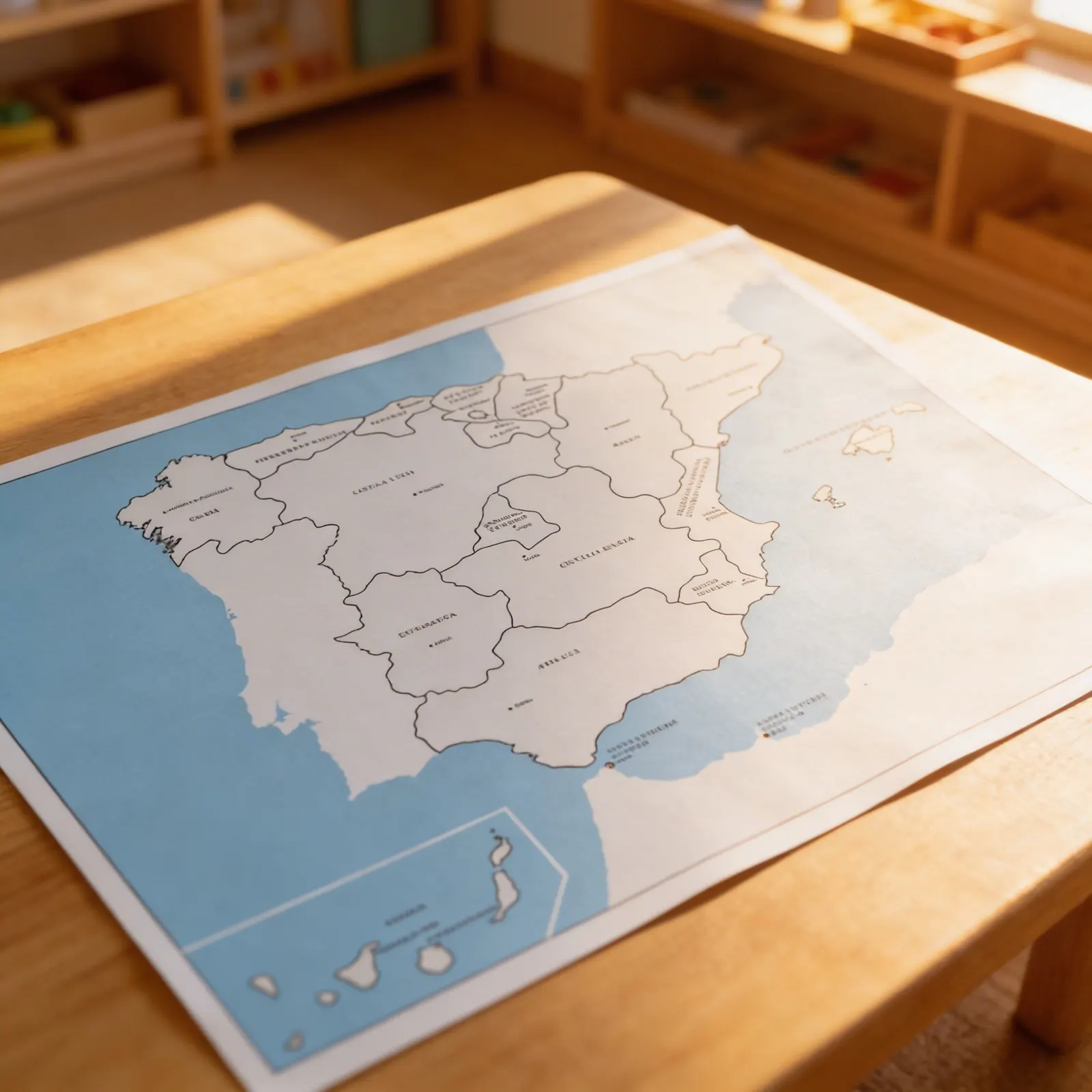
Spain Control Map in a child's hands
This labeled control map of Spain makes tangible the concepts behind the country's autonomous communities and major cities through clear, color-coded regions. The detailed cartographic representation shows all 17 autonomous communities, their capitals, and the Balearic and Canary Islands, supporting the child's exploration of Spanish geography and political divisions. Designed for use with puzzle maps and cultural studies, this control map serves as both a reference tool and an independent learning material.
Geographic Awareness
Children develop understanding of political boundaries, regional divisions, and the relationship between communities and their capital cities.
Visual Discrimination
Color-coding of regions helps children distinguish between different autonomous communities and recognize geographic patterns.
Language Development
Reading community names and capital cities enriches vocabulary and supports literacy skills in geographic context.
Cultural Understanding
Introduces children to Spain's diverse regions, fostering appreciation for cultural and linguistic variations within one country.
How to present it
Place the Spain Control Map on a mat or table at child's eye level. If using with puzzle map, position the control map to the right of the workspace. Ensure good lighting to distinguish colors clearly.
- 1Begin by tracing the outline of Spain with your finger, naming the country
- 2Point to one autonomous community, read its label aloud, then find and name its capital
- 3Invite the child to choose a colored region and read its name together
- 4If using with puzzle map, have child match puzzle pieces to corresponding regions on the control map
- 5Explore the island territories, noting their position relative to mainland Spain
3 tips for parents
- Look for Spain in news or conversations and reference the communities your child has learned
- If traveling to Spain, involve your child in locating destinations on their control map
- Support interest by finding Spanish music, food, or cultural items from specific regions

If you are not sure it suits your child, we answer in person.
Norbert Kovalčín, founder of Faborino · write to him
There is no review here yet. We will ask you for one after you buy. Write the first review
What's in the Box
- Spain Control Map: Labeled with autonomous communities and capitals
Size and material
| Packaging | 57 × 46 × 0 cm |
| Primary Material | Heavy cardstock |
| Finish | Matte print surface |
| Recommended Age | 3-6 years |
Care
| Cleaning | Wipe gently with dry cloth |
| Storage | Store flat in map cabinet or portfolio |
Frequently Asked Questions
What size is this Spain control map and what material is it made from?
This control map is typically printed on durable cardstock or laminated paper in a standard size suitable for table work (approximately A3 or 11x17 inches). The material is designed to withstand repeated handling by young children while maintaining clear, vibrant colors.
How does this labeled map support the Montessori geography curriculum?
The control map serves as a reference tool for children working with Spain puzzle maps, allowing them to check their work independently. It introduces concrete geographical concepts through color-coding and clear labeling, supporting the Montessori principle of moving from concrete to abstract learning.
What specific information is included on this labeled map?
The map displays all 17 autonomous communities of Spain with distinct colors, their capital cities, major cities, and includes both the Balearic Islands (Mallorca, Menorca, Ibiza) and Canary Islands. Each region is clearly labeled with its name for easy identification.
At what age should children begin using this control map?
While designed for ages 3-6, children typically begin with unlabeled puzzle maps around age 3-4, progressing to this labeled control map as they develop reading skills and geographical understanding, usually around ages 4-6.
Can this map be used without the corresponding Spain puzzle map?
Yes, this control map functions as an independent learning material for studying Spanish geography, identifying regions and cities, and supporting cultural studies about Spain. It can be used for map work, discussions about Spanish culture, and as a reference during related activities.
Product safety
Manufacturer: Nienhuis Montessori, Anders Celsiusstraat 15, 7442 PB Nijverdal, Netherlands
Spain Control Map