SpainLabels (Spanish Version)
The first photos are the maker's own. The other shots are illustrative.
Inv. no. NIE-553630
- Maker
- Nienhuis Montessori, since 1929
- Approval
- AMI
- Primary Material
- Cardstock
- Finish
- Matte paper
- EAN
- 8719924029364
Final price incl. VAT. Delivery €5.90, €134.90 to go for free delivery.
Advice, warranty and returns are handled by us.
Why it costs €14.10
Behind the price of the original are things you can check yourself.
AMI approval
The material is approved by the Association Montessori Internationale (AMI). Nienhuis has made Montessori materials since 1929.
A verifiable original
The EAN 8719924029364 is on the box. It is the maker's number, not ours.
Spain in a child's hands
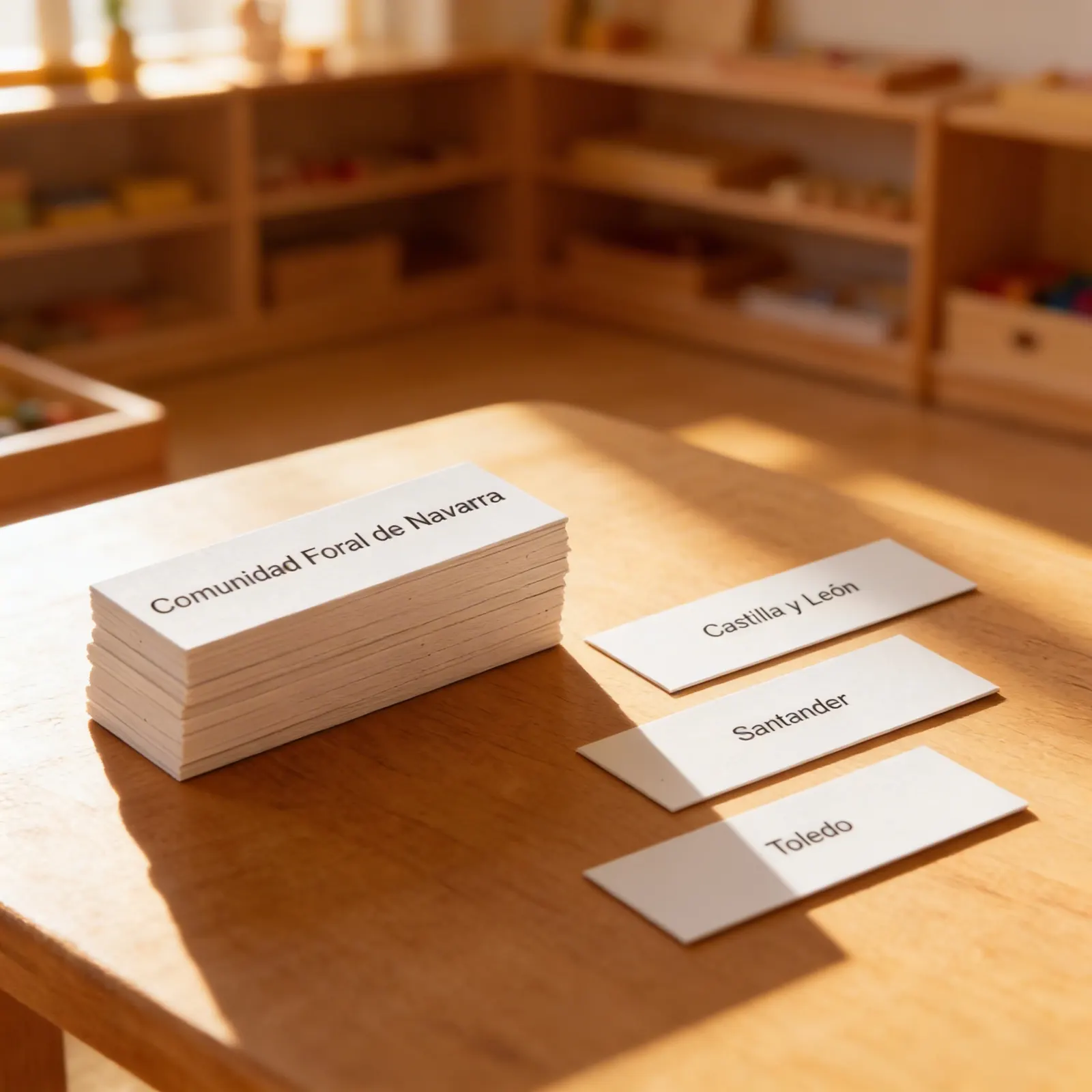
The printed labels for the Spain map, and the maker is explicit that they are available in Spanish only: the names on these labels are Spanish names. For a Spanish speaking room that is exactly right, and for anyone else it is the thing to know before ordering, because a label a child cannot read is not a label. They go onto the unlabeled control map and are checked against the labeled one, both separate items, as is the puzzle map.
Geography Knowledge
Children develop understanding of Spanish regions and cities while building spatial awareness through hands-on map work.
Reading Development
Clear text formatting supports early reading skills as children match written names to geographical locations.
Fine Motor Control
Handling and placing small labels precisely on maps strengthens pincer grip and hand-eye coordination.
Cultural Awareness
Introduces children to Spanish geography, fostering global awareness and appreciation for different cultures.
How to present it
Place the Spain map on a work mat. Arrange the label cards in a basket to the right of the map. Ensure adequate lighting for reading the text clearly.
- 1Begin with three region labels, reading each aloud before placing
- 2Demonstrate matching one label to its corresponding region on the map
- 3Invite the child to read and place the remaining two labels
- 4Gradually introduce more labels as competence grows
- 5Practice removing and replacing all labels in sequence
3 tips for parents
- Practice reading Spanish place names during meal conversations about regional foods
- Look for Spain in news stories and locate mentioned places together
- Create simple matching games using photocopies of the labels at home

If you are not sure it suits your child, we answer in person.
Norbert Kovalčín, founder of Faborino · write to him
There is no review here yet. We will ask you for one after you buy. Write the first review
What's in the Box
- Spain Label Cards: Approx. 4 regional/city labels
Size and material
| Packaging | 13 × 9 × 3 cm |
| Primary Material | Cardstock |
| Finish | Matte paper |
| Recommended Age | 3-6 years |
Care
Wipe gently with dry cloth; store in dry location
Frequently Asked Questions
What Spanish regions and cities are included in these label cards?
The label cards include all major Spanish autonomous communities and their capital cities, plus significant geographical features. The set covers mainland Spain, the Balearic Islands, and the Canary Islands, providing comprehensive coverage for elementary geography work.
How do these labels support Montessori map work activities?
Children use these labels with Spain puzzle maps or pin maps, matching each label to its corresponding location. This hands-on activity develops spatial awareness, reading skills, and geographical knowledge while following the Montessori principle of learning through movement and manipulation.
What size are the label cards and what material are they made from?
The labels are printed on durable cardstock in a child-friendly size that's easy to handle and read. Each label features clear, lowercase text following Montessori standards, with appropriate spacing for young readers developing their literacy skills.
Can these labels be used for language activities beyond geography?
Yes, these labels serve multiple purposes including reading practice, vocabulary building, and cultural studies. Children can trace the words, sort them alphabetically, or use them for Spanish language lessons, making them versatile classroom materials.
How should these label cards be stored and organized?
Store the labels in a labeled envelope or small box on your geography shelf. Many teachers laminate them for durability and organize them by region. Keep them near your Spain puzzle map or other Spanish cultural materials for easy access during work time.
Product safety
Manufacturer: Nienhuis Montessori, Anders Celsiusstraat 15, 7442 PB Nijverdal, Netherlands
Spain