
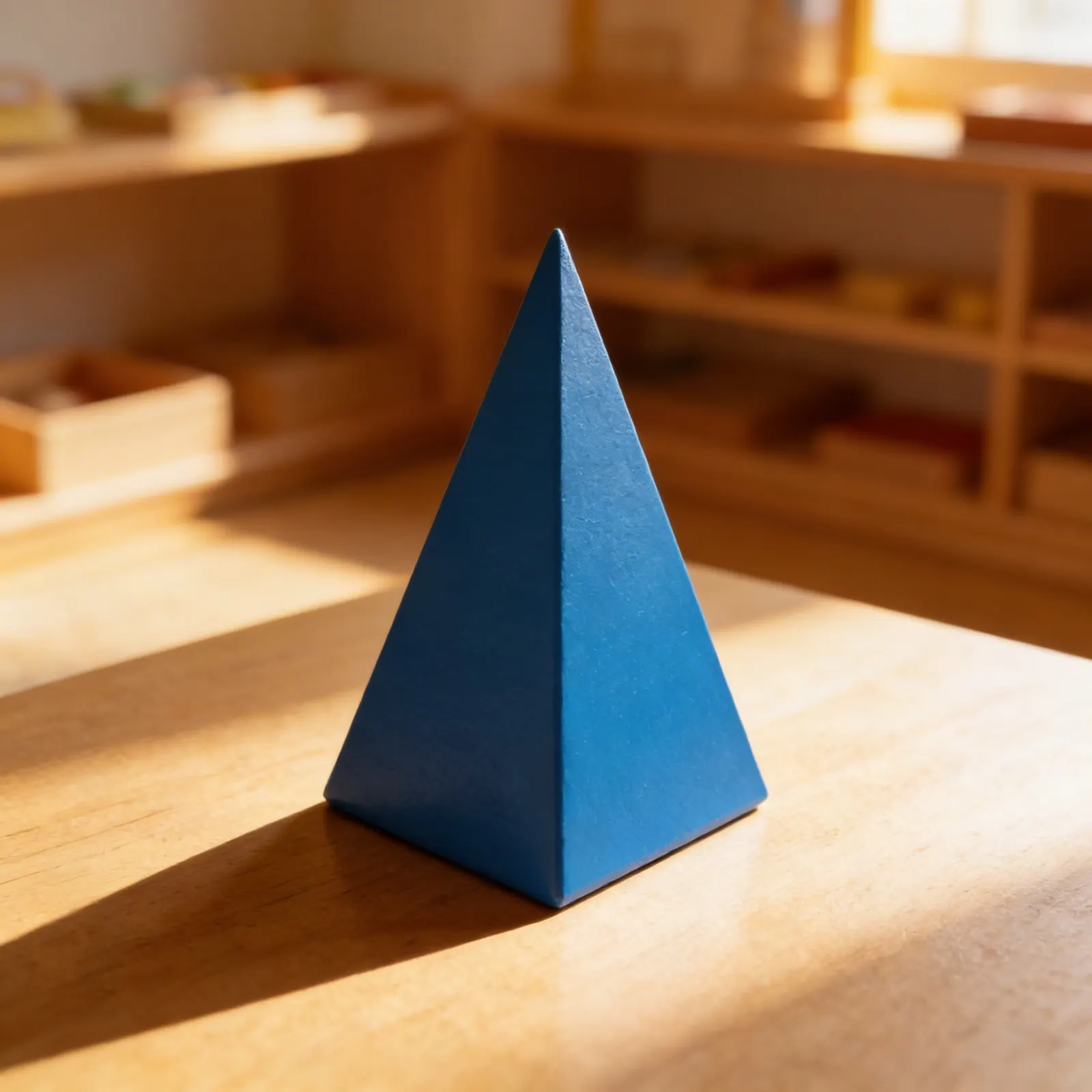
Square Based Pyramid
The first photo is the maker's own. The other shots are illustrative.
Inv. no. NIE-018809
- Maker
- Nienhuis Montessori, since 1929
- Approval
- AMI
- Product size
- Base 10 × 10 cm, height 20 cm
- Primary Material
- Beech wood
- Finish
- Lacquer with edge highlighting
- EAN
- 8719924009991
Final price incl. VAT. Delivery €5.90, €56.10 to go for free delivery.
Advice, warranty and returns are handled by us.
Why it costs €92.90
Behind the price of the original are things you can check yourself.
AMI approval
The material is approved by the Association Montessori Internationale (AMI). Nienhuis has made Montessori materials since 1929.
A verifiable original
The EAN 8719924009991 is on the box. It is the maker's number, not ours.
Square Based Pyramid in a child's hands
Manufactured with meticulous attention to detail, this Square Based Pyramid introduces elementary students to three-dimensional geometry through active discovery. The solid wooden form with its distinctive square base and four triangular faces provides a tactile reference for understanding pyramidal structures, volume concepts, and geometric relationships. The smooth lacquered finish and edge highlighting enhance visual discrimination while supporting advanced geometric studies.
Geometric Understanding
Develops spatial reasoning through exploration of pyramidal properties, faces, edges, and vertices
Mathematical Concepts
Introduces volume, surface area, and the relationship between 2D shapes and 3D forms
Abstract Thinking
Bridges concrete manipulation to abstract geometric principles through tactile experience
Visual Discrimination
Enhanced edge highlighting supports recognition of geometric elements and spatial relationships
How to present it
Place the Square Based Pyramid on a neutral work mat alongside paper and colored pencils. Have a ruler and protractor available for older children.
- 1Invite the child to explore all surfaces, counting faces, edges, and vertices
- 2Trace the square base on paper, then carefully trace each triangular face
- 3Compare the traced shapes, measuring and recording dimensions
- 4Build a paper net by arranging traced shapes to form an unfolded pyramid
3 tips for parents
- Look for pyramid shapes in everyday objects like roofs or food packaging
- Build pyramids with blocks or cards to reinforce the concept
- Discuss how pyramids distribute weight, connecting to engineering

If you are not sure it suits your child, we answer in person.
Norbert Kovalčín, founder of Faborino · write to him
There is no review here yet. We will ask you for one after you buy. Write the first review
What's in the Box
- Square Based Pyramid: Solid wooden geometric form
Size and material
| Product size | Base 10 × 10 cm, height 20 cm |
| Packaging | 23 × 15 × 13 cm |
| Primary Material | Beech wood |
| Finish | Lacquer with edge highlighting |
| Recommended Age | 6-12 years |
Care
Wipe with slightly damp cloth, dry immediately
Frequently Asked Questions
What specific geometric concepts does this Square Based Pyramid teach?
This pyramid introduces students to 3D geometry concepts including vertices (5), edges (8), faces (5 total - 1 square base and 4 triangular faces), surface area calculation, volume formulas, and the relationship between 2D shapes and 3D forms. It serves as a concrete reference for understanding pyramidal structures in architecture and nature.
How does the edge highlighting support learning?
The edge highlighting provides visual discrimination between the pyramid's geometric elements, helping students clearly identify and count edges, vertices, and faces. This feature is particularly valuable for elementary students who are transitioning from concrete to abstract geometric thinking, making mathematical properties more visually accessible.
What activities can children do with this pyramid model?
Students can trace faces to create nets, compare with other geometric solids, calculate surface area and volume, explore symmetry, build composite shapes, study ancient pyramids in cultural lessons, and use it as a reference for geometric drawing. It integrates seamlessly with Montessori geometry curriculum and constructive triangle work.
Is this pyramid solid or hollow, and why does it matter?
This is a solid wooden pyramid, which provides appropriate weight and stability for hands-on exploration. The solid construction allows students to experience the true heft of 3D forms, supports sensorial learning through weight comparison with other geometric solids, and ensures durability for classroom use over many years.
How does this pyramid connect to other Montessori geometry materials?
This pyramid complements the geometric solids set, blue constructive triangles (which form pyramid faces), and the geometric cabinet. It bridges early sensorial work with advanced elementary geometry studies, supporting lessons on volume, surface area, and spatial relationships while preparing students for more complex mathematical concepts.
Product safety
Manufacturer: Nienhuis Montessori, Anders Celsiusstraat 15, 7442 PB Nijverdal, Netherlands
Square Based Pyramid