
Squared Paper10 Mm (250)
The first photo is the maker's own. The other shots are illustrative.
Inv. no. NIE-016300
- Maker
- Nienhuis Montessori, since 1929
- Approval
- AMI
- Paper Type
- Squared paper (10 mm)
- EAN
- 8719924007836
Final price incl. VAT. Delivery €5.90, €113.10 to go for free delivery.
Advice, warranty and returns are handled by us.
Why it costs €35.90
Behind the price of the original are things you can check yourself.
AMI approval
The material is approved by the Association Montessori Internationale (AMI). Nienhuis has made Montessori materials since 1929.
A verifiable original
The EAN 8719924007836 is on the box. It is the maker's number, not ours.
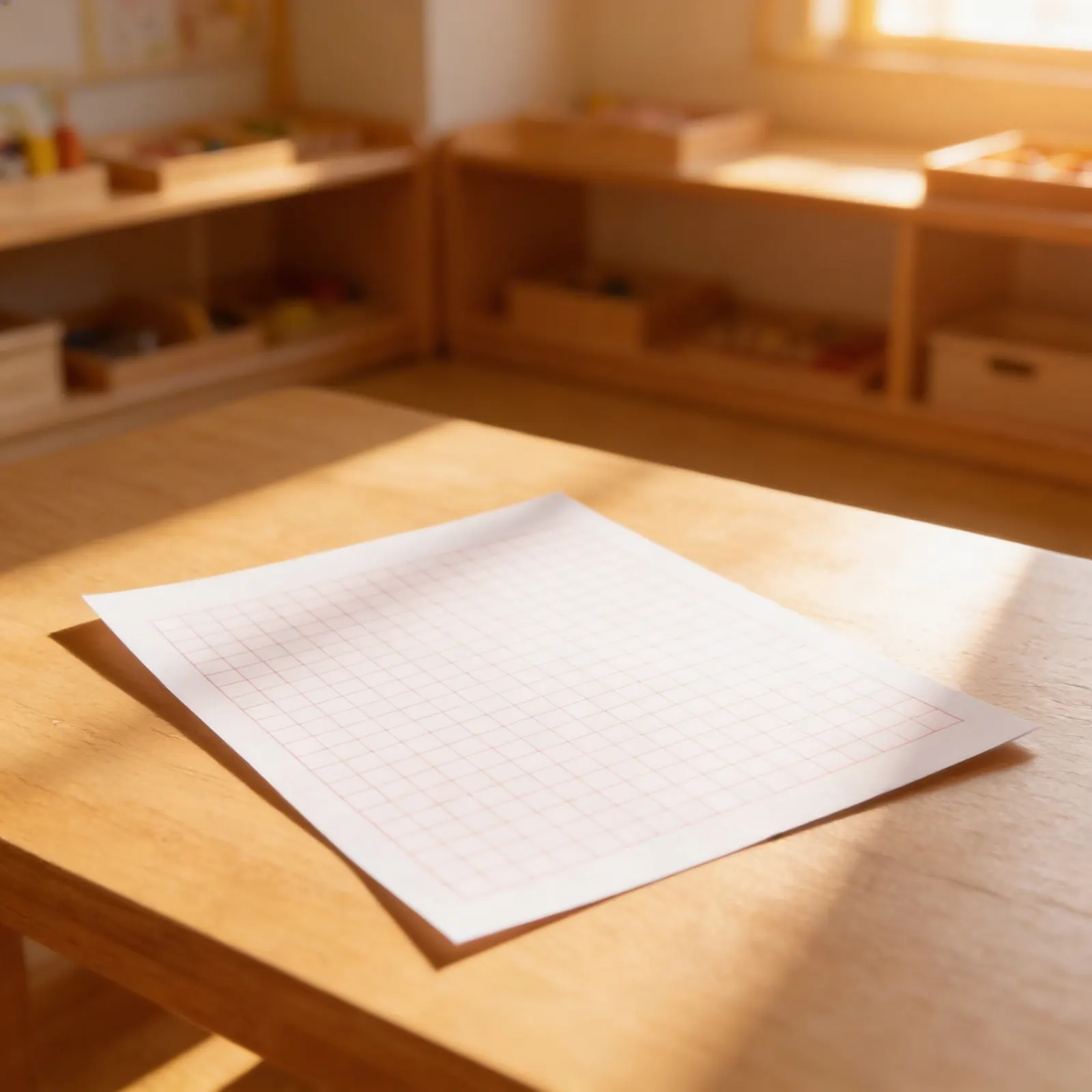
Squared Paper in a child's hands
Squared Paper: 10 mm (250) comes as 250 sheets printed with a grid of squares. Each square is 10 mm wide and 10 mm high. The child writes numbers and calculations into the grid, which keeps lines of figures straight and digits in columns. The sheets are meant for written calculation and for children aged 6 to 12. In the catalogue they are placed among the writing preparation materials. Store them flat in a dry place. Packed, the sheets measure 29 × 21 × 3 cm and weigh 1.22 kg.
Mathematical Precision
The consistent 10mm grid supports accurate geometric constructions and helps children develop spatial awareness essential for advanced mathematics.
Visual Organization
Grid structure helps children organize their work systematically, supporting the development of clear mathematical thinking and presentation skills.
Abstract Concept Representation
Provides the framework needed to represent abstract mathematical concepts concretely, bridging manipulative work with written mathematical expression.
Hand-Eye Coordination
Drawing precise lines and shapes on the grid refines fine motor control while reinforcing mathematical concepts through physical engagement.
How to present it
Ensure good lighting for precise work.
- 1Begin with simple shape construction - have the child count squares to create a 5x5 square
- 2Progress to creating rectangles of specific dimensions (e.g., 3x7 squares)
- 3Introduce diagonal lines by connecting opposite corners of square arrangements
- 4Create bar graphs using data from classroom surveys or observations
- 5Plot coordinate pairs to create pictures or patterns
3 tips for parents
- Use squared paper at home for practical projects like planning a garden layout or rearranging furniture
- Let your child create graphs tracking daily temperatures or rainfall over a month
- Play coordinate pair games where you give locations and your child marks treasure spots

If you are not sure it suits your child, we answer in person.
Norbert Kovalčín, founder of Faborino · write to him
There is no review here yet. We will ask you for one after you buy. Write the first review
What's in the Box
- Squared paper: 250 sheets, 10 mm squares
Size and material
| Packaging | 29 × 21 × 3 cm |
| Paper Type | Squared paper (10 mm) |
| Recommended Age | 6-12 years |
Care
Store flat in dry area
Frequently Asked Questions
How many sheets are included in this squared paper pad?
This pad contains 250 sheets of high-quality 10mm squared paper, providing ample supply for extended classroom use throughout the academic year.
What specific Montessori activities is this paper designed for?
This squared paper is ideal for geometry work including constructing shapes and angles, creating graphs and charts, fraction work, area and perimeter calculations, and algebraic graphing exercises for upper elementary students.
Is the paper quality suitable for repeated erasing and corrections?
Yes, the quality paper stock is designed to withstand erasing and corrections without tearing or leaving marks, supporting the Montessori principle of allowing children to perfect their work through repetition.
What age-appropriate activities can 6-8 year olds do with this paper?
Younger elementary students can use this for basic geometric shapes, simple bar graphs, pattern work, symmetry exercises, and early multiplication arrays, while older students progress to coordinate graphing and complex geometric constructions.
Product safety
Manufacturer: Nienhuis Montessori, Anders Celsiusstraat 15, 7442 PB Nijverdal, Netherlands
Squared Paper