
Statue Maria Montessori
The first photos are the maker's own. The other shots are illustrative.
Inv. no. NIE-977100
- Maker
- Nienhuis Montessori, since 1929
- Product size
- Height 15 cm, base Ø 5.5 cm
- Primary Material
- Neolith (resembles bronze)
- Base
- Inscribed with the name Maria Montessori
- EAN
- 8719924062842
Final price incl. VAT. Delivery €5.90, €104.10 to go for free delivery.
Advice, warranty and returns are handled by us.
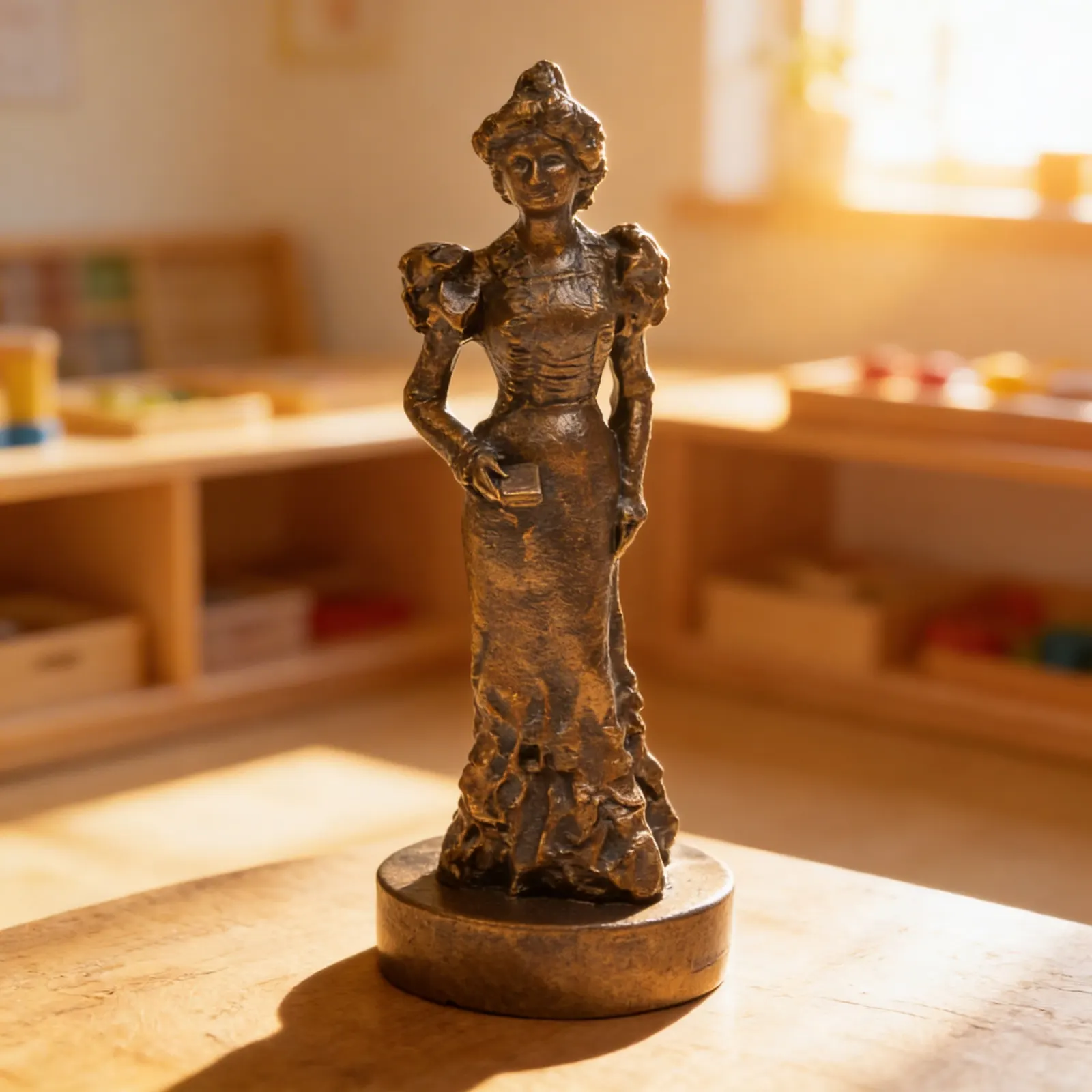
Statue Maria Montessori in a child's hands
A miniature statue of Maria Montessori, 15 cm tall, stands on a pedestal with a diameter of 5.5 cm. The pedestal is inscribed with her name. The statue is made of Neolith, a heavy material that, according to the manufacturer, resembles bronze. It is inspired by a well-known photograph in which she holds a small book as a symbol of her academic work. The manufacturer made it to start conversations between parents, teachers and children about Montessori education. It weighs 228 g and is dusted with a soft cloth.
Historical Connection
Introduces children to the founder of their educational method, fostering appreciation for learning heritage and inspiring role models.
Cultural Awareness
Supports discussions about important historical figures and the development of educational philosophies.
Environment Preparation
Creates a meaningful focal point in the classroom that honors the Montessori tradition and inspires respectful learning.
How to present it
Place the statue on a low shelf at children's eye level, with a small mat or tray beneath it. Include a magnifying glass and perhaps a photograph of Maria Montessori for comparison.
- 1Introduce the statue during circle time, explaining this is Dr. Maria Montessori who created their classroom
- 2Allow children to examine the details of the statue with a magnifying glass
- 3Share a brief story about how Dr. Montessori watched children to learn how they learn best
- 4Create a special place for the statue where children can visit and reflect
3 tips for parents
- Ask your child to tell you about Dr. Montessori and what she created for children
- Look for age-appropriate books about Maria Montessori to read together at home
- Support your child's interest by visiting Montessori historical sites if traveling

If you are not sure it suits your child, we answer in person.
Norbert Kovalčín, founder of Faborino · write to him
There is no review here yet. We will ask you for one after you buy. Write the first review
What's in the Box
- Maria Montessori Statue: 15 cm figurine with engraved base
Size and material
| Product size | Height 15 cm, base Ø 5.5 cm |
| Packaging | 17 × 10 × 9 cm |
| Primary Material | Neolith (resembles bronze) |
| Base | Inscribed with the name Maria Montessori |
| Recommended Age | 3-6 years |
Care
Dust gently with soft cloth
Frequently Asked Questions
What is the purpose of having a Maria Montessori statue in the classroom?
The statue serves as a visual reminder of the Montessori philosophy's founder, helping children develop historical awareness and connection to their educational heritage. It can be used during circle time discussions about the history of their school and learning method, fostering respect for the educational tradition they're part of.
How tall is the Maria Montessori statue and what material is it made from?
This figurine is 15 cm tall and made of Neolith, a heavy material that resembles bronze. The statue stands on an engraved circular base 5.5 cm across, making it stable for display on shelves or special areas in the prepared environment.
Where should the Maria Montessori statue be placed in the classroom?
The statue works best in the cultural area or on a special shelf dedicated to classroom heritage. Some teachers place it near photographs of the school's history or in the peace corner. It should be positioned at child-eye level on a stable surface where children can observe but handle with supervision.
How can teachers use this statue for educational activities?
Teachers can incorporate the statue into lessons about historical figures, women pioneers, Italian culture, or the history of education. It can spark conversations during circle time about how children learned in the past, inspire biographical research projects, or serve as a focal point when celebrating Montessori's birthday on August 31st.
Product safety
Manufacturer: Nienhuis Montessori, Anders Celsiusstraat 15, 7442 PB Nijverdal, Netherlands
Statue Maria Montessori