
Subtraction Snake GameIndividual Beads Glass
The first photo is the maker's own. The other shots are illustrative.
Inv. no. NIE-0291G0
- Maker
- Nienhuis Montessori, since 1929
- Approval
- AMI
- Beads
- Glass with smooth finish
- Storage Tray
- Natural wood
- EAN
- 8719924012298
Final price incl. VAT. Free delivery.
Advice, warranty and returns are handled by us.
Why it costs €223.90
Behind the price of the original are things you can check yourself.
AMI approval
The material is approved by the Association Montessori Internationale (AMI). Nienhuis has made Montessori materials since 1929.
A verifiable original
The EAN 8719924012298 is on the box. It is the maker's number, not ours.
Subtraction Snake Game in a child's hands
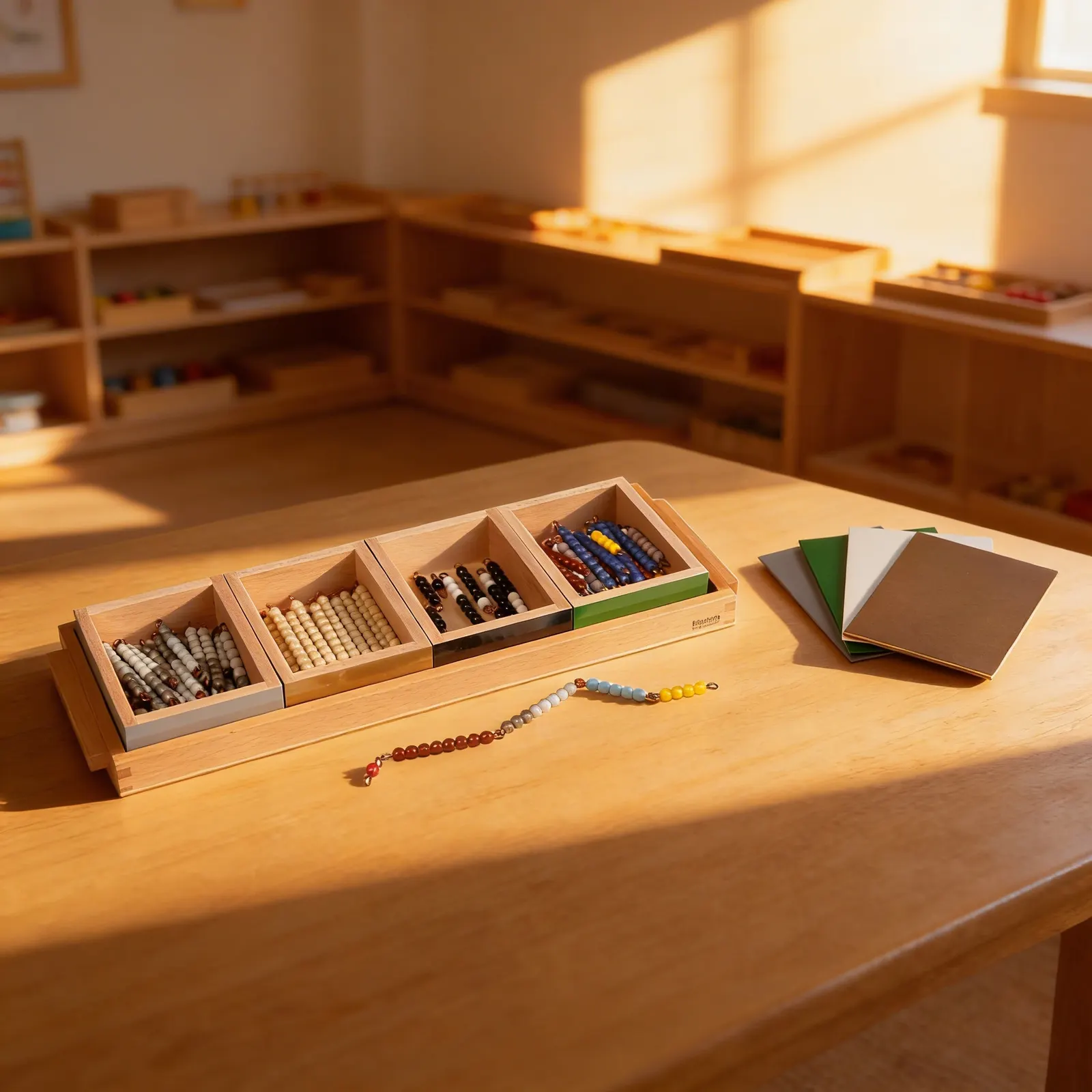
The Subtraction Snake Game with Individual Glass Beads introduces dynamic subtraction through hands-on manipulation of color-coded bead chains. Children exchange positive and negative quantities using glass beads organized in a compartmentalized wooden tray, building concrete understanding of subtraction facts to 18. The tactile glass beads and systematic color-coding support the transition from material to mental mathematical thinking.
Mathematical Reasoning
Builds concrete understanding of subtraction through physical exchange of positive and negative quantities.
Abstract Thinking
Transitions from concrete bead manipulation to mental arithmetic through repeated practice.
Pattern Recognition
Discovers mathematical patterns and relationships through color-coded bead combinations.
Problem Solving
Develops systematic approaches to solving subtraction problems through hands-on exploration.
How to present it
Place the wooden tray on a mat. Arrange positive beads (colored) in upper compartments by value 1-9. Place negative beads (typically gray/black) in lower compartments. Set out the empty snake tray.
- 1Create a 'snake' using colored positive beads, laying them end-to-end
- 2Count the first bead bar and exchange it for an equivalent negative bead
- 3Continue counting and exchanging, replacing positive beads with negative ones
- 4When reaching 10 or more, exchange for a golden ten-bar and continue
- 5Complete the snake, counting remaining positive beads as the answer
3 tips for parents
- Practice counting backwards from 10 during daily activities to prepare for bead exchanges
- Use colored blocks or buttons at home to create simple subtraction stories
- Focus on the process of exchanging rather than rushing to find answers

If you are not sure it suits your child, we answer in person.
Norbert Kovalčín, founder of Faborino · write to him
There is no review here yet. We will ask you for one after you buy. Write the first review
What's in the Box
- Wooden storage tray: With 6 compartments
- Glass bead chains: Color-coded by value
- Colored cardboard squares: For marking exchanges
Size and material
| Packaging | 39 × 14 × 5 cm |
| Beads | Glass with smooth finish |
| Storage Tray | Natural wood |
| Markers | Cardboard squares |
| Recommended Age | 3-6 years |
Care
Wipe tray with damp cloth; handle glass beads with care
Frequently Asked Questions
What is included in the Subtraction Snake Game set?
The set includes color-coded glass beads representing quantities 1-9, black and white negative beads, golden ten bars, a wooden tray with compartments for organized storage, and typically a small notched card for counting. All beads are made of high-quality glass for durability and sensory appeal.
How does this material teach subtraction to young children?
Children build a 'snake' using colored beads, then exchange them systematically with negative quantities and golden ten bars. This hands-on process allows them to physically see and feel subtraction happening, making abstract concepts concrete. The game naturally leads to memorization of subtraction facts through repetition and self-discovery.
What is the difference between this and the regular Snake Game?
While the Addition Snake Game uses only positive colored beads to practice addition, the Subtraction Snake Game introduces gray/black and white negative beads. This allows children to explore taking away, exchanging, and understanding negative quantities, preparing them for more advanced mathematical concepts.
What prerequisites should my child have before using this material?
Children should be comfortable with the Addition Snake Game, understand quantities 1-10, and have experience with the golden bead material. They should also be able to count accurately and have developed sufficient fine motor control to handle the small glass beads safely.
Why are glass beads used instead of plastic or wood?
Glass beads provide superior sensory feedback through their weight and smooth texture, helping children focus and concentrate. The aesthetic beauty of glass beads attracts children to the work, while their durability ensures the material will last through years of classroom use. The distinct feel also helps children distinguish between different quantities.
Product safety
Manufacturer: Nienhuis Montessori, Anders Celsiusstraat 15, 7442 PB Nijverdal, Netherlands
Subtraction Snake Game