
Subtraction Working Charts (Nienhuis)
The first photo is the maker's own. The other shots are illustrative.
Inv. no. NIE-0142B0
- Maker
- Nienhuis Montessori, since 1929
- Approval
- AMI
- Materials
- HDF, birch plywood, beech
- Answer chips
- Wood
- EAN
- 8719924007454
Final price incl. VAT. Delivery €5.90, €35.10 to go for free delivery.
Advice, warranty and returns are handled by us.
Why it costs €113.90
Behind the price of the original are things you can check yourself.
AMI approval
The material is approved by the Association Montessori Internationale (AMI). Nienhuis has made Montessori materials since 1929.
A verifiable original
The EAN 8719924007454 is on the box. It is the maker's number, not ours.
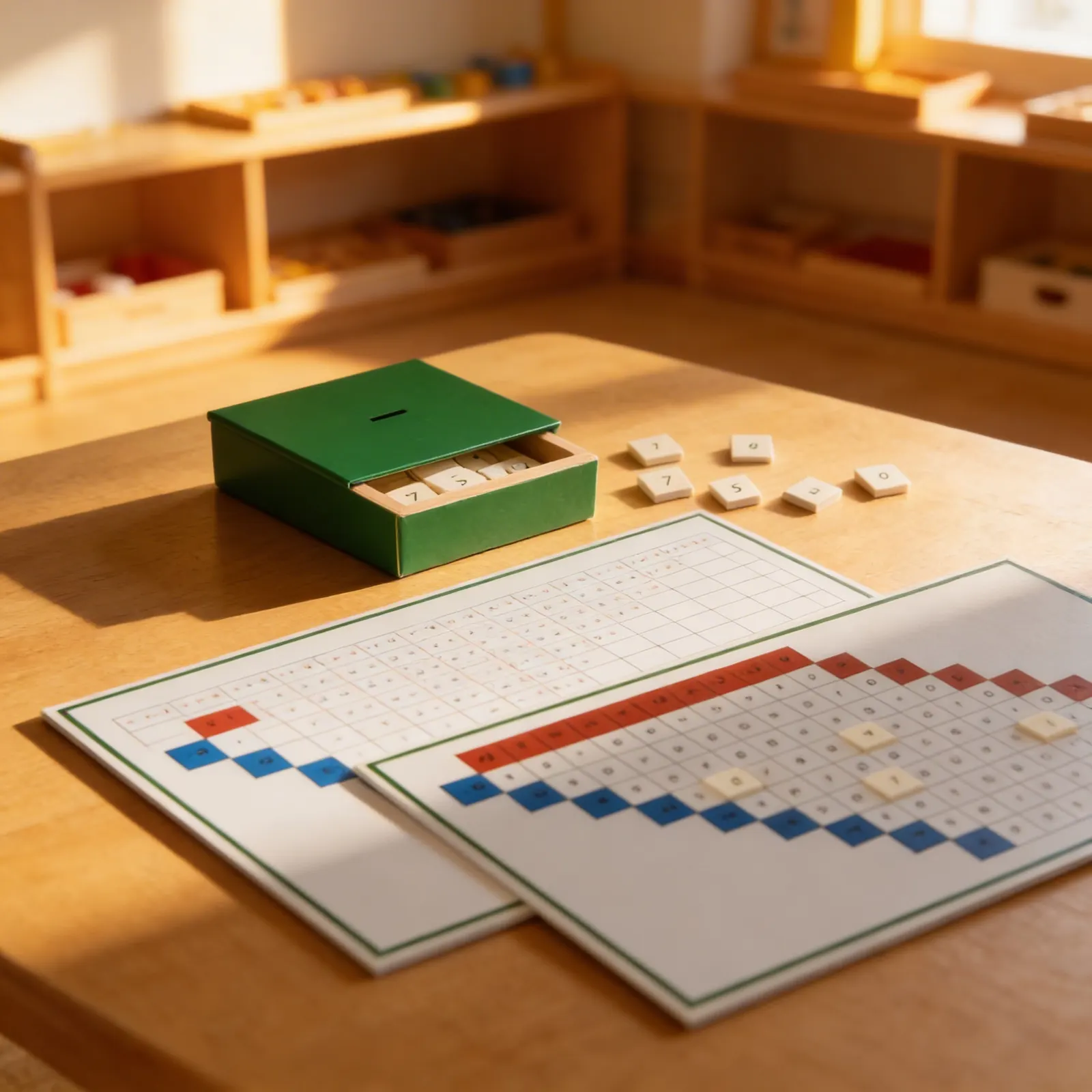
Subtraction Working Charts (Nienhuis) in a child's hands
A control chart, two working charts and a box of wooden answer chips for the subtraction combinations. Memorisation in a Montessori environment is the last step rather than the first: the child has already built every one of these facts with the strip board, and these charts are where the built knowledge is exercised until it becomes quick. Chips instead of writing means an error costs nothing to correct, so children keep going instead of stopping at the first mistake. HDF, birch plywood and beechwood, for ages 3 to 12.
Mathematical Memory
Systematic practice with subtraction facts builds automatic recall through repetitive, hands-on work with wooden chips.
Pattern Recognition
Systematic work with the subtraction combinations helps children identify mathematical relationships and patterns within subtraction families.
Fine Motor Control
Precisely placing the wooden chips on the chart refines pincer grip and hand-eye coordination.
Sequential Thinking
Working through charts systematically develops logical thinking and understanding of number relationships.
How to present it
3 tips for parents
- Practice simple subtraction during daily activities before introducing charts
- Allow completion of entire chart even if some answers are incorrect initially
- Celebrate pattern discoveries rather than speed of completion

If you are not sure it suits your child, we answer in person.
Norbert Kovalčín, founder of Faborino · write to him
There is no review here yet. We will ask you for one after you buy. Write the first review
What's in the Box
- Control chart: 1 piece for checking the answers
- Working charts: 2 pieces
- Box of wooden chips: Wooden answer chips
Size and material
| Packaging | 59 × 25 × 6 cm |
| Materials | HDF, birch plywood, beech |
| Answer chips | Wood |
| Recommended Age | 3-12 years |
Care
Wipe the charts with a dry cloth; keep the wooden chips dry
Frequently Asked Questions
What are the Subtraction Working Charts for?
They help the child practise and memorise the subtraction combinations. The child should understand the relationships between quantities before memorising the facts.
What's included with the Subtraction Working Charts set?
The set includes a control chart, 2 working charts and a box of wooden answer chips.
What materials are the charts made of?
The set is made of HDF, birch plywood and beechwood. The answer chips are wooden.
What age are the Subtraction Working Charts made for?
They are made for children aged 3 to 12.
Can children use these charts independently?
Yes, after the initial presentations, children can work with these charts independently. The control chart lets the child check their own work, building confidence and independence while practising the subtraction combinations at their own pace.
Product safety
Manufacturer: Nienhuis Montessori, Anders Celsiusstraat 15, 7442 PB Nijverdal, Netherlands
Subtraction Working Charts (Nienhuis)