
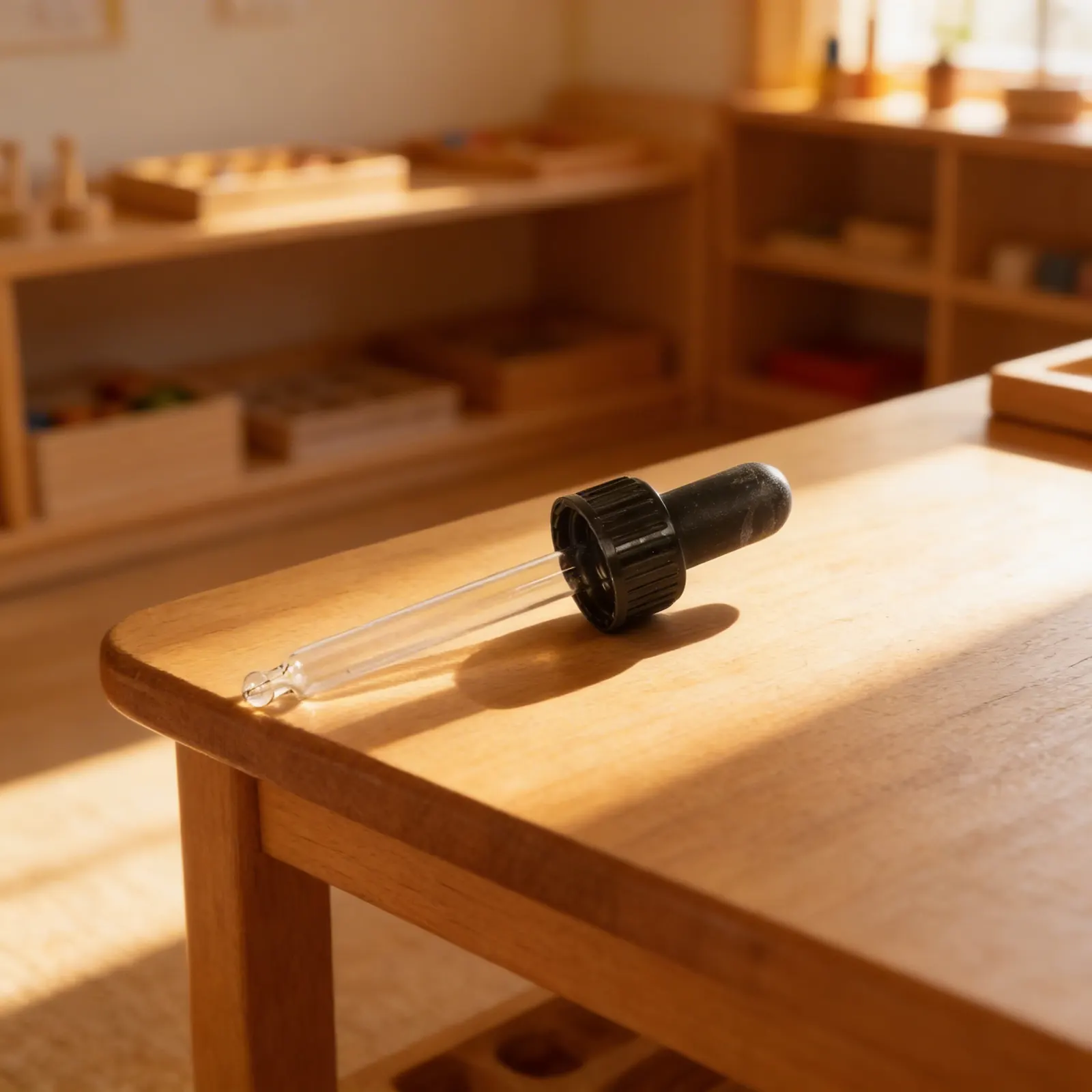
Tasting ExerciseDropper With Screw Cap - Black / Black
The first photo is the maker's own. The other shots are illustrative.
Inv. no. NIE-00157003
- Maker
- Nienhuis Montessori, since 1929
- Approval
- AMI
- Tube
- Glass, polymer
- Bulb & Cap
- Rubber and plastic
- EAN
- 8719924000240
Final price incl. VAT. Delivery €5.90, €143.50 to go for free delivery.
Advice, warranty and returns are handled by us.
Why it costs €5.50
Behind the price of the original are things you can check yourself.
AMI approval
The material is approved by the Association Montessori Internationale (AMI). Nienhuis has made Montessori materials since 1929.
A verifiable original
The EAN 8719924000240 is on the box. It is the maker's number, not ours.
Tasting Exercise in a child's hands
This is a dropper with a screw cap for the Montessori tasting exercise, in black; the product name reads Black / Black. Nienhuis gives glass and polymer as the materials and lists the dropper for indoor use. A dropper takes up a little liquid and releases it a drop at a time, so the child can work with very small amounts of the liquid to be tasted. A bottle and the liquids to taste are not listed with it. The screw cap is part of the item. For children aged 3 to 6.
Fine Motor Control
Squeezing the rubber bulb develops hand strength and precision needed for writing preparation.
Sensorial Discrimination
Enables controlled tasting exercises to refine the gustatory sense and vocabulary.
Practical Life Skills
Teaches careful liquid handling and develops concentration through precise movements.
Scientific Thinking
Introduces concepts of measurement, transfer, and cause-effect relationships.
How to present it
Prepare four small glass bowls with taste solutions: sweet (sugar water), salty (salt water), sour (lemon water), and bitter (tonic water). Place dropper in neutral water bowl for rinsing. Set up on a tray with small pitcher of drinking water and glass.
- 1Demonstrate squeezing the rubber bulb before inserting dropper tip into solution
- 2Release bulb slowly to draw liquid up into the dropper tube
- 3Hold dropper vertically above extended tongue and gently squeeze one drop
- 4Rinse dropper thoroughly in neutral water between tastes
- 5Secure black cap tightly after completing all taste tests
3 tips for parents
- Create a home tasting station using everyday liquids: honey water, pickle juice, or herbal teas
- Practice dropper skills during bath time with colored water for stress-free exploration
- Use the dropper for practical life: watering small plants or adding vanilla to cookie dough

If you are not sure it suits your child, we answer in person.
Norbert Kovalčín, founder of Faborino · write to him
There is no review here yet. We will ask you for one after you buy. Write the first review
What's in the Box
- Dropper with rubber bulb: Clear tube with squeeze bulb
- Black screw cap: Ribbed design for easy grip
Size and material
| Packaging | 11 × 4 × 3 cm |
| Tube | Glass, polymer |
| Bulb & Cap | Rubber and plastic |
| Recommended Age | 3-6 years |
Care
Rinse with warm water after each use, air dry completely
Frequently Asked Questions
What activities can I do with this dropper in a Montessori classroom?
This dropper is perfect for tasting exercises where children sample different flavors (sweet, sour, salty, bitter), color mixing experiments, transferring water activities, and science explorations. It helps develop pincer grip, concentration, and sensorial discrimination.
What size is this dropper and how much liquid does it hold?
This is a standard laboratory-style dropper that typically holds 1-3ml of liquid. The precise control allows children to transfer single drops or small amounts, perfect for developing fine motor control and careful movements.
How do I clean and maintain the dropper?
Rinse thoroughly with warm water after each use. For deeper cleaning, use mild soap and warm water, squeezing the bulb repeatedly to flush the tube. Allow to air dry completely before storing with the cap on. Replace if the rubber bulb becomes cracked or the glass tube chips.
What other materials do I need for a complete tasting exercise?
You'll need small containers or bowls for different liquids, a tray to organize materials, small tasting spoons or cups, and labels for identifying tastes. Consider adding a pitcher of water and cloth for spills to promote independence and practical life skills.
Product safety
Manufacturer: Nienhuis Montessori, Anders Celsiusstraat 15, 7442 PB Nijverdal, Netherlands
Tasting Exercise