
Teething BallInfant Grasping
The first photo is the maker's own. The other shots are illustrative.
Inv. no. NIE-048600
- Maker
- Nienhuis Montessori, since 1929
- Approval
- AMI
- Primary Material
- Rubber
- EAN
- 8719924012939
Final price incl. VAT. Delivery €5.90, €140.10 to go for free delivery.
Advice, warranty and returns are handled by us.
Why it costs €8.90
Behind the price of the original are things you can check yourself.
AMI approval
The material is approved by the Association Montessori Internationale (AMI). Nienhuis has made Montessori materials since 1929.
A verifiable original
The EAN 8719924012939 is on the box. It is the maker's number, not ours.
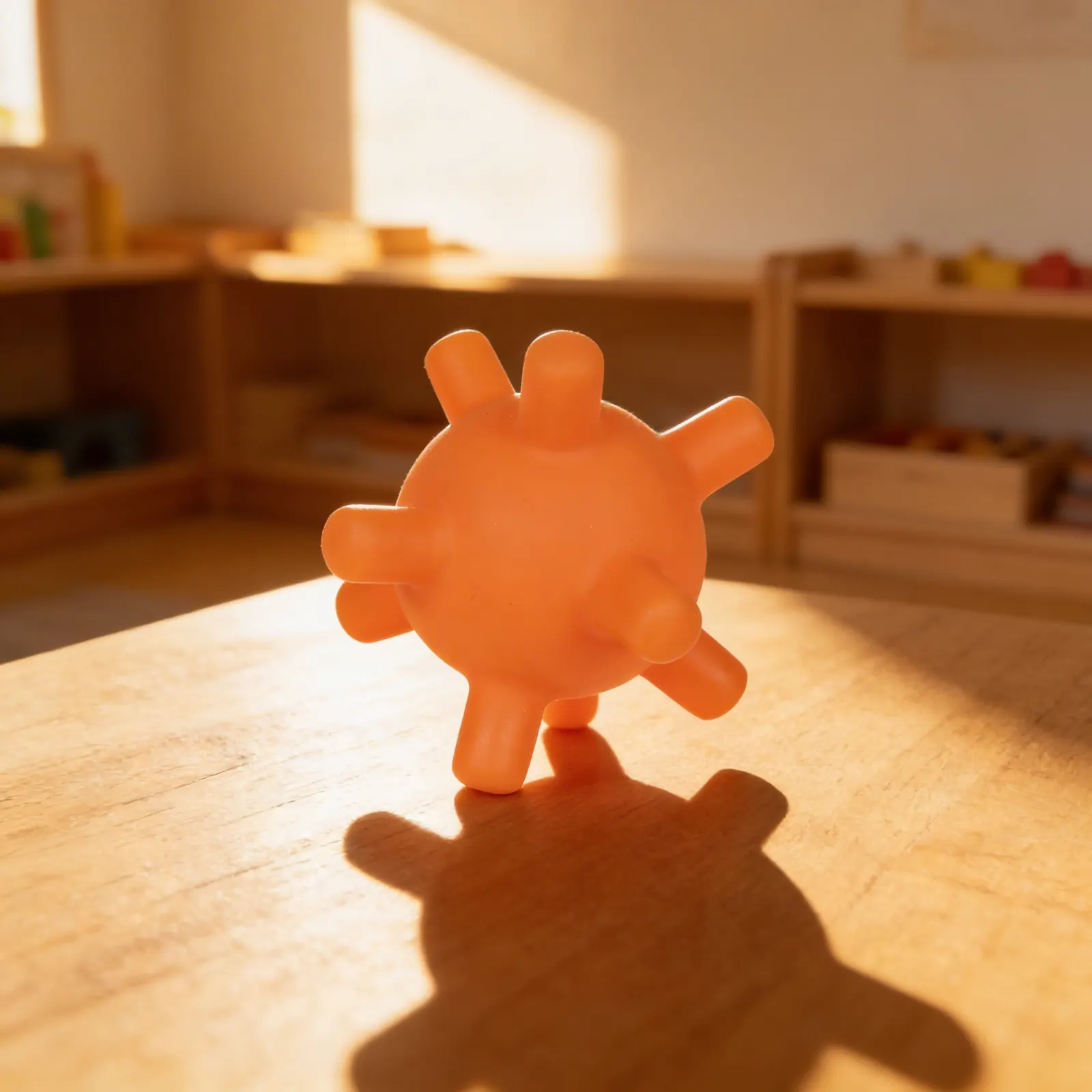
Teething Ball in a child's hands
A teething ball with knobs over its surface, made to be chewed while the first teeth are coming through. An infant examines everything with the mouth long before the hands are reliable, so a ball meant for chewing is not a concession, it is the form the investigation actually takes at this age. The knobs give the gums something uneven to press against and give small hands somewhere to hold, which is why the ball stays in the hand rather than rolling off the mat.
Oral Motor Development
Supports healthy teething process while strengthening jaw muscles and preparing for speech development through varied oral exploration.
Tactile Discrimination
Multiple textures and protrusions help refine the infant's sense of touch and develop sensory processing abilities.
Gross Motor Skills
Encourages reaching, grasping, and transferring between hands, supporting bilateral coordination and grip strength.
Cause and Effect Understanding
Flexible material responds to pressure, helping infants understand their impact on objects through squeeze-and-release actions.
How to present it
Place the Teething Ball on a low shelf or basket where the infant can see and reach it during tummy time or while sitting supported.
- 1Present the ball within the infant's visual field during alert periods
- 2Allow the infant to reach for and grasp the ball independently
- 3Observe as the infant explores through mouthing, grasping, and transferring between hands
- 4When interest wanes, return the ball to its designated spot
3 tips for parents
- Keep the Teething Ball accessible during supervised floor time rather than in the crib
- Notice which textures your baby explores most - this reveals their sensory preferences
- Refrigerate (not freeze) the ball for 15 minutes to provide cooling relief during active teething

If you are not sure it suits your child, we answer in person.
Norbert Kovalčín, founder of Faborino · write to him
There is no review here yet. We will ask you for one after you buy. Write the first review
What's in the Box
- Teething Ball: Single-piece sensory ball with textured protrusions
Size and material
| Packaging | 16 × 16 × 13 cm |
| Primary Material | Rubber |
| Recommended Age | 0-3 years |
Care
Wash with warm soapy water, air dry completely
Frequently Asked Questions
At what age can my baby start using this teething ball?
This teething ball is suitable from birth to 3 years, though most babies begin actively using it around 3-4 months when they develop the ability to grasp objects and bring them to their mouth during their oral exploration phase.
How does this support Montessori principles for infant development?
The teething ball aligns with Montessori's emphasis on sensory exploration and self-directed learning. It allows infants to independently explore textures, develop their pincer grasp, and satisfy their developmental need for oral exploration while building hand-mouth coordination.
What materials is this teething ball made from and is it safe?
Our teething ball is made from food-grade, silicone that's completely safe for oral exploration. It meets all European safety standards for infant toys and can be easily cleaned with warm soapy water or sterilized.
How do the different textures benefit my baby's development?
The varied textured protrusions provide essential tactile discrimination experiences, helping develop sensory processing skills. Each texture stimulates different nerve endings, supporting brain development and preparing the hand for future fine motor activities.
Can this teething ball be used for activities beyond teething relief?
Yes! Beyond teething relief, this ball supports grasp reflex development, bilateral coordination when passed between hands, visual tracking when rolled, and cause-and-effect learning when squeezed or dropped, making it a comprehensive sensory learning tool.
Product safety
Manufacturer: Nienhuis Montessori, Anders Celsiusstraat 15, 7442 PB Nijverdal, Netherlands
Teething Ball