
Telling Time (Beginning)
The first photo is the maker's own. The other shots are illustrative.
Inv. no. NIE-EC0332
- Maker
- Nienhuis Montessori, since 1929
- Product size
- 9.5 × 10.2 cm
- Material
- Durable plastic
- Finish
- Pre-cut with rounded corners
- EAN
- 8719924042684
Final price incl. VAT. Delivery €5.90, €117.10 to go for free delivery.
Advice, warranty and returns are handled by us.
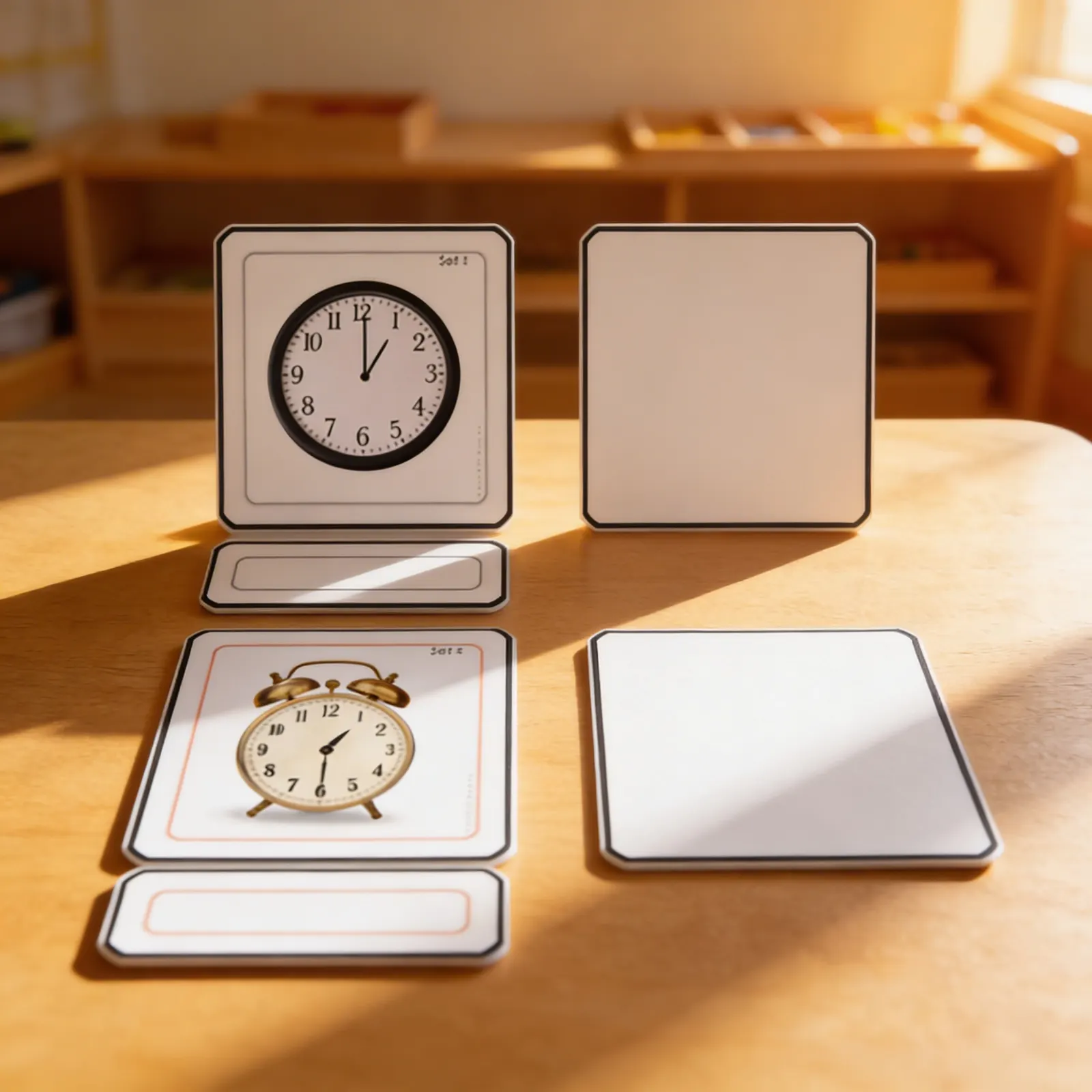
Telling Time (Beginning) in a child's hands
Four sets of real photographs of analogue clocks, twelve faces in each, showing times on the hour and the half hour. Photographs of actual clocks rather than drawings is the choice that matters here, because the clock a child has to read is the one on the wall, and a drawn clock quietly removes the glare, the angle and the second hand that make a real one harder. Durable plastic with rounded corners. In English.
Mathematical Understanding
Builds foundational concepts of time measurement and numerical relationships through concrete visual representations.
Visual Discrimination
Develops ability to distinguish between clock positions and associate them with numerical time expressions.
Sequential Thinking
Supports understanding of time progression and the cyclical nature of daily routines.
Independence Skills
Color-coding system enables self-directed learning and autonomous error correction.
How to present it
Arrange the analog clock cards in a row on the work mat. Place the digital time cards in a mixed pile to the side. Ensure the workspace allows for clear viewing of all clock faces.
- 1Select one digital time card from the pile and examine it carefully
- 2Compare the digital time to each analog clock face in the row
- 3Place the digital card below its matching analog clock
- 4Continue matching until all pairs are complete
3 tips for parents
- Reference real clocks at home when your child shows interest in time
- Create a simple daily schedule using the same analog/digital format
- Allow your child to work at their own pace without correcting errors immediately

If you are not sure it suits your child, we answer in person.
Norbert Kovalčín, founder of Faborino · write to him
There is no review here yet. We will ask you for one after you buy. Write the first review
What's in the Box
- Time Matching Cards: Approx. 6 pairs of analog/digital cards
- Storage: Cards may include organizing system
Size and material
| Product size | 9.5 × 10.2 cm |
| Packaging | 15 × 15 × 1 cm |
| Material | Durable plastic |
| Finish | Pre-cut with rounded corners |
| Recommended Age | 3-6 years |
Care
Wipe with slightly damp cloth, dry immediately
Frequently Asked Questions
What age is appropriate for this Beginning Telling Time activity?
This material is designed for children ages 3-6 who are ready to begin exploring time concepts. Children should have basic number recognition 1-12 and be able to match identical images before starting this activity.
How does the color-coding system help children learn to tell time?
The color-coded cards create visual associations between analog clock faces and digital displays. This systematic approach helps children recognize patterns and build connections between the two time formats without feeling overwhelmed by complex time-reading skills.
What time increments are included in this beginning set?
This beginning set typically focuses on hour times (o'clock) and possibly half-hours, providing a solid foundation before introducing more complex concepts like quarter-hours or five-minute intervals in advanced materials.
Can children work with this material independently?
Yes, once introduced to the material, children can work independently with the self-correcting matching system. The color-coding provides immediate feedback, allowing children to check their own work and build confidence in time-telling skills.
How does this material prepare children for advanced time-telling concepts?
This material establishes fundamental understanding of clock face structure, number positions, and the relationship between analog and digital time. These concepts create the foundation needed for learning minutes, quarter-hours, and more complex time calculations later.
Product safety
Manufacturer: Nienhuis Montessori, Anders Celsiusstraat 15, 7442 PB Nijverdal, Netherlands
Telling Time (Beginning)