
Tens Bead Box: Individual Nylon Beads for Decimal System
Made by Nienhuis Montessori · shipped by Heutink International (Netherlands) About the maker
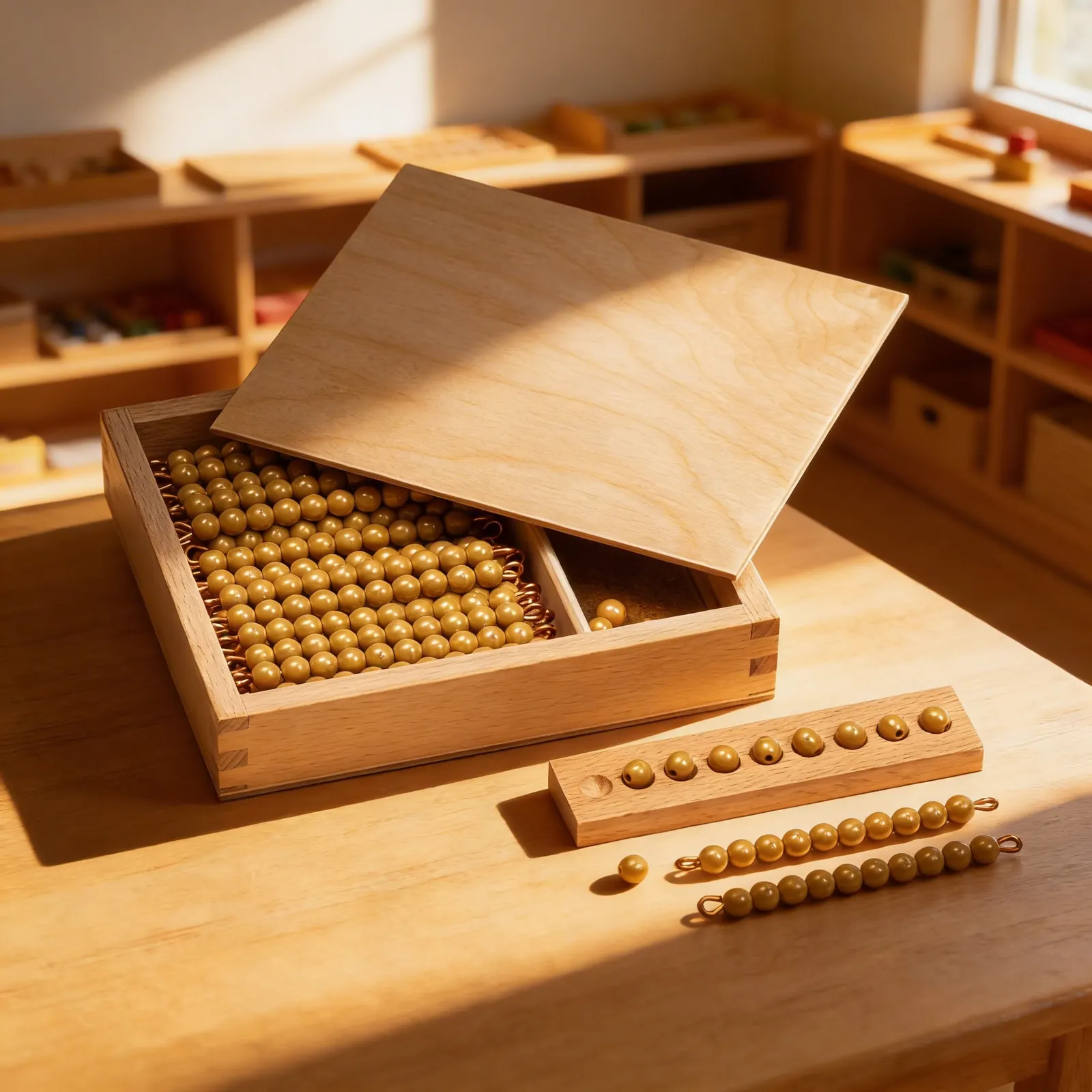
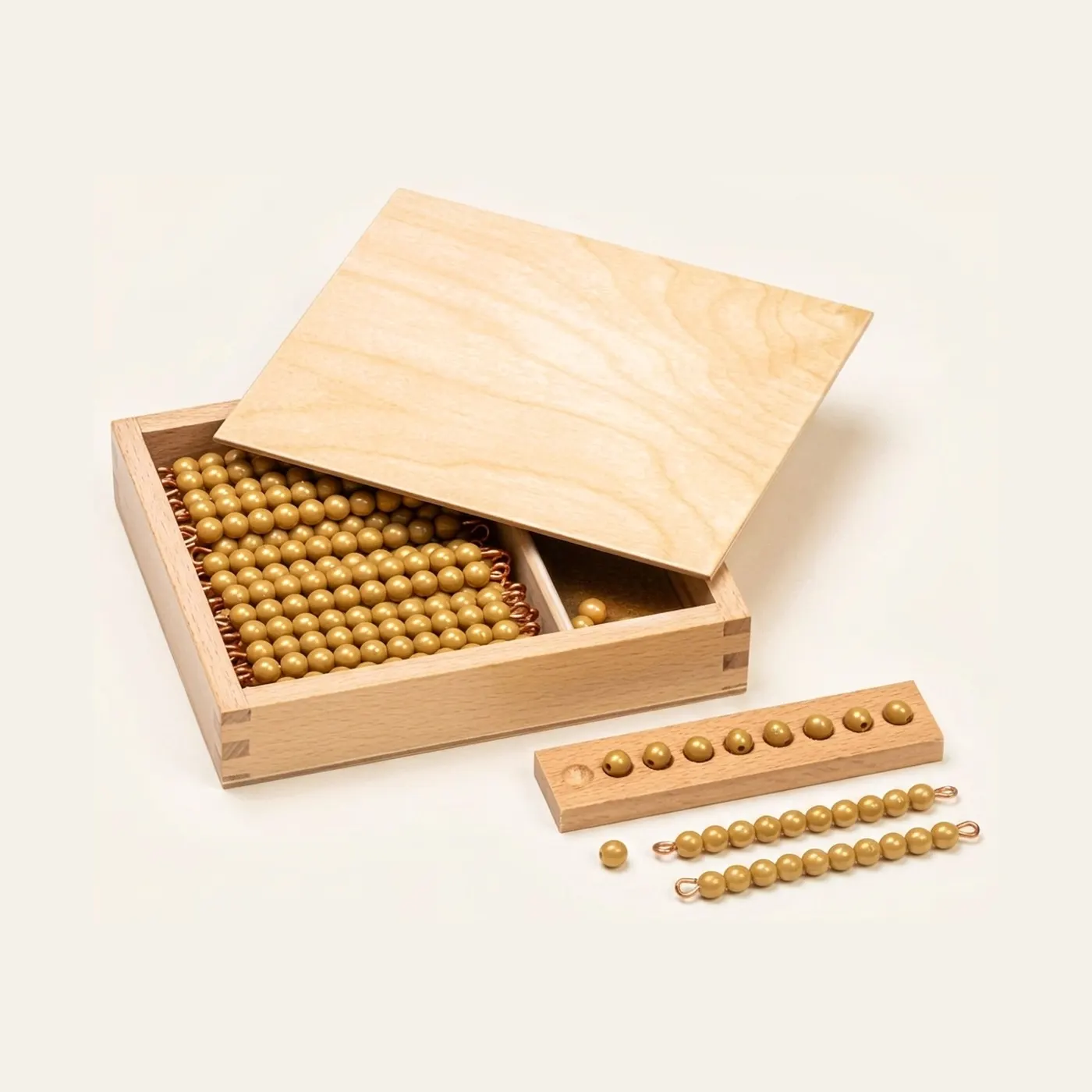
Forty five golden ten bars, eighteen golden unit beads and a wooden holder for the units, the quantity side of the tens work. Forty five bars is not a round number by accident: it is what you need to lay out every ten from ten to ninety in turn, one to nine bars at a time, without ever taking the previous one apart. A child who has to dismantle to continue never sees the sequence whole. Nylon beads, wood and wire, for ages 3 to 6.
“The greatest sign of success for a teacher is to be able to say, 'The children are now working as if I did not exist.'”
The Tens Bead Box embodies Montessori's principle of materialized abstractions, transforming the abstract concept of the decimal system into tangible, manipulable objects. Through the sensorial experience of handling golden beads, children internalize mathematical relationships naturally.
- Understanding of decimal system hierarchy (units, tens, hundreds, thousands)
- Development of place value concept through concrete manipulation
- Recognition of mathematical patterns in base-ten system
- Ability to compose and decompose numbers using physical quantities
Read More
The material's precise organization in hundred squares and ten-bars reflects the base-ten structure of our number system, allowing children to physically construct quantities and discover mathematical patterns independently. This concrete-to-abstract progression respects the child's developmental needs, as identified by Dr. Montessori, where sensorial exploration precedes intellectual understanding. The golden beads serve as a bridge between the child's concrete operational thinking and emerging capacity for abstraction, making visible the hierarchical nature of numbers while satisfying the mathematical mind's need for order and precision.
How to present it
Follow the Montessori method of presentation for optimal child development.
Place the Tens Bead Box on a large work mat. Open the sliding lid carefully. Arrange a tray with number cards 1-9000. Ensure adequate workspace for building quantities.
- 1
Introduce the unit bead, saying 'This is one unit.' Place it on the mat and match with card '1'
Hold the bead delicately between thumb and index finger to model careful handling - 2
Present the ten-bar: 'This is ten.' Count each bead slowly, emphasizing it equals ten units
Run your finger along the bar while counting to reinforce the linear nature of ten - 3
Show the hundred-square: 'This is one hundred.' Demonstrate it contains ten ten-bars
Trace the square's outline to emphasize its two-dimensional nature - 4
Build quantities like 234: 2 hundred-squares, 3 ten-bars, 4 unit beads, matching with number cards
Arrange hierarchically from left to right, leaving space between categories - 5
Invite the child to form their own numbers, gradually increasing complexity
Start with numbers under 100, then progress to hundreds and thousands
Every Child Is a Little Creator

Heritage
Since 1929

In classrooms
Around the world

European brands
Nienhuis, GAM, Educo

AMI approved
To the association standard
Tens Bead Box: Individual Nylon Beads for Decimal System
