
Tens BoardsInternational Version (Nienhuis)
The first photo is the maker's own. The other shots are illustrative.
Inv. no. NIE-003120
- Maker
- Nienhuis Montessori, since 1929
- Approval
- AMI
- Primary Material
- Natural wood
- Number Markings
- Black paint or ink
- EAN
- 8719924001735
Final price incl. VAT. Delivery €5.90, €50.10 to go for free delivery.
Advice, warranty and returns are handled by us.
Why it costs €98.90
Behind the price of the original are things you can check yourself.
AMI approval
The material is approved by the Association Montessori Internationale (AMI). Nienhuis has made Montessori materials since 1929.
A verifiable original
The EAN 8719924001735 is on the box. It is the maker's number, not ours.
Tens Boards in a child's hands
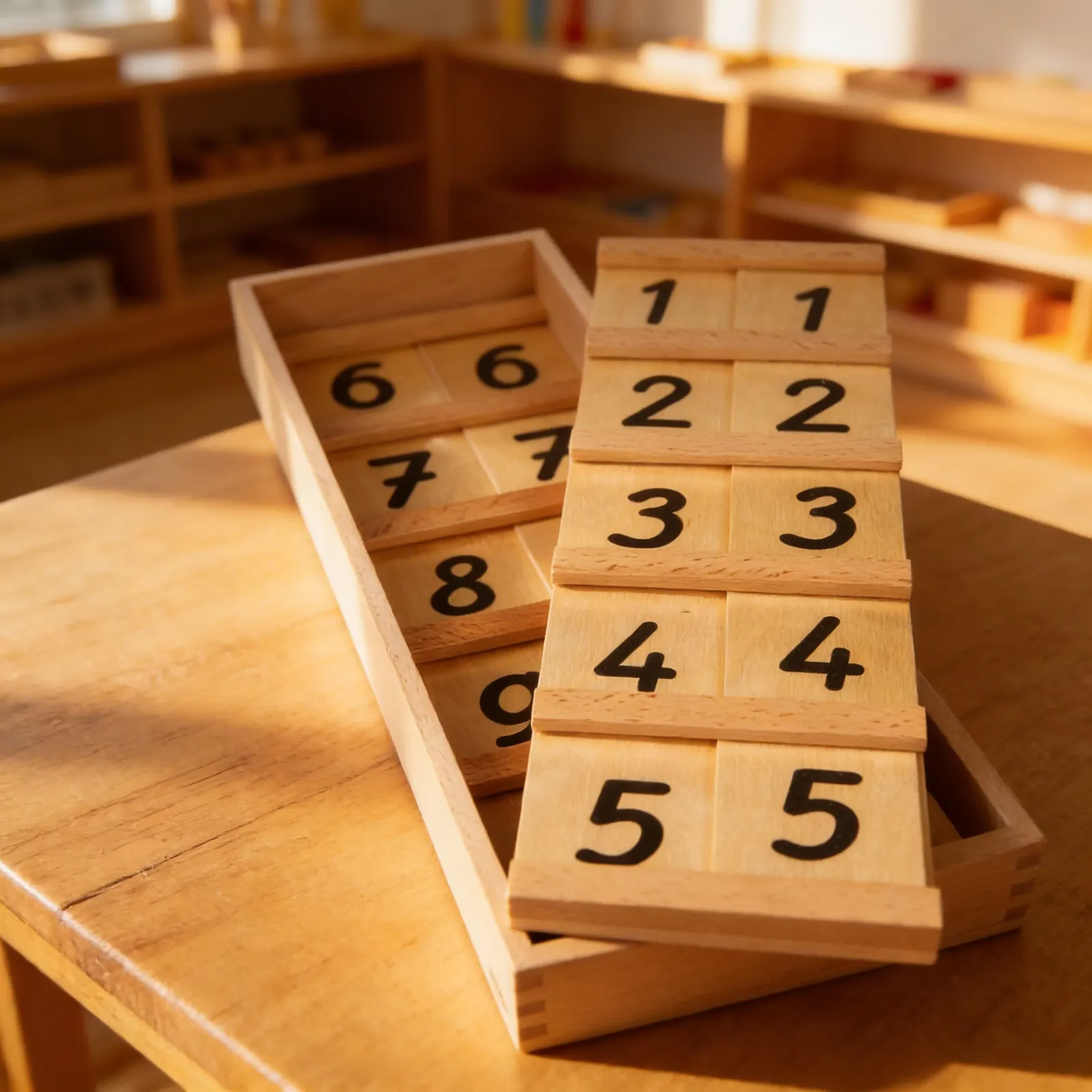
The boards that follow the teens, taking a child through the names of the tens and the whole sequence from eleven to ninety nine. Where the teen boards hold the ten still, these change it, so a child slides from twenty to thirty and hears the pattern in the names at the same time as seeing it in the quantity. Bead quantities are built from ten bars and unit beads in the tens bead box. Two boards come with it, one holding five number slots from ten to fifty and one holding four from sixty to ninety, plus nine cards printed one to nine. Ninety nine is the last number before the decimal system needs a new category. Wood with paint, for ages 3 to 6.
Decimal System Understanding
Children physically construct numbers 10-99, internalizing the pattern and structure of our base-ten number system.
Place Value Mastery
The sliding mechanism demonstrates how tens remain constant while units change, making abstract concepts concrete.
Sequential Thinking
Working through numbers systematically develops logical progression and pattern recognition skills.
Fine Motor Refinement
Precise sliding movements strengthen finger control and hand-eye coordination essential for writing.
How to present it
Place both Tens Boards horizontally on a mat. Ensure all sliding number tiles are positioned to show blank spaces (slid to the left). Have a container nearby for storing tiles when not in use.
- 1Begin with the first board. Show how to slide the first tile to reveal '1', creating '11' when combined with the printed '10'
- 2Continue sliding tiles sequentially to build 12, 13, 14 through 19
- 3When reaching 19, demonstrate sliding all tiles back to blank, then moving to the '20' row
- 4Build 20-29, then continue through all decades up to 99
- 5Practice building specific numbers randomly: 'Can you make 47?'
3 tips for parents
- Practice reading two-digit numbers in everyday life, house numbers, prices, page numbers
- Play 'number building' games: 'I'm thinking of a number with 4 tens and 7 ones'
- Avoid rushing to three-digit numbers; mastery of two-digit numbers is essential first

If you are not sure it suits your child, we answer in person.
Norbert Kovalčín, founder of Faborino · write to him
There is no review here yet. We will ask you for one after you buy. Write the first review
What's in the Box
- Tens Boards: 2 wooden boards with sliding compartments
- Number Tiles: Complete set 1-9 in storage compartments
Size and material
| Packaging | 45 × 16 × 5 cm |
| Primary Material | Natural wood |
| Number Markings | Black paint or ink |
| Recommended Age | 3-6 years |
Care
Wipe with dry or slightly damp cloth; avoid excess moisture
Frequently Asked Questions
What age is appropriate for introducing the Tens Boards?
The Tens Boards are designed for children ages 4-6 who have mastered counting 1-10 and are ready to explore two-digit numbers. Children should be familiar with the golden bead material and have a solid understanding of quantities before beginning work with the Tens Boards.
How do the sliding number tiles work on the Tens Boards?
Each board contains compartments with movable number panels (1-9) that slide horizontally to reveal or cover numbers. Children slide the tiles to create numbers from 10-99, physically manipulating the units place while the tens place remains constant, reinforcing the concept of place value through tactile experience.
What's the difference between the Tens Boards and the Hundred Board?
The Tens Boards focus specifically on constructing numbers 10-99 using sliding tiles that emphasize place value, while the Hundred Board displays all numbers 1-100 simultaneously. The Tens Boards provide a more focused, sequential approach to understanding how two-digit numbers are composed, making them ideal for initial decimal system work.
What materials should children work with before using the Tens Boards?
Children should have experience with the number rods, sandpaper numerals, spindle boxes, and golden bead material. They should confidently recognize numerals 1-9, understand quantity relationships, and have been introduced to the concept of ten through the golden bead material before beginning Tens Board work.
How do the Tens Boards support mathematical development?
The Tens Boards develop place value understanding, number composition skills, and pattern recognition. Children physically construct each number from 10-99, internalizing the decimal system's structure while preparing for addition, skip counting, and more advanced mathematical concepts through concrete manipulation.
Product safety
Manufacturer: Nienhuis Montessori, Anders Celsiusstraat 15, 7442 PB Nijverdal, Netherlands
Tens Boards