
Tens BoardsUS Version
The first photo is the maker's own. The other shots are illustrative.
Inv. no. NIE-003103
- Maker
- Nienhuis Montessori, since 1929
- Approval
- AMI
- Primary Material
- Natural wood
- Number Display
- Printed numerals
- EAN
- 8719924001711
Final price incl. VAT. Delivery €5.90, €47.10 to go for free delivery.
Advice, warranty and returns are handled by us.
Why it costs €101.90
Behind the price of the original are things you can check yourself.
AMI approval
The material is approved by the Association Montessori Internationale (AMI). Nienhuis has made Montessori materials since 1929.
A verifiable original
The EAN 8719924001711 is on the box. It is the maker's number, not ours.
Tens Boards in a child's hands
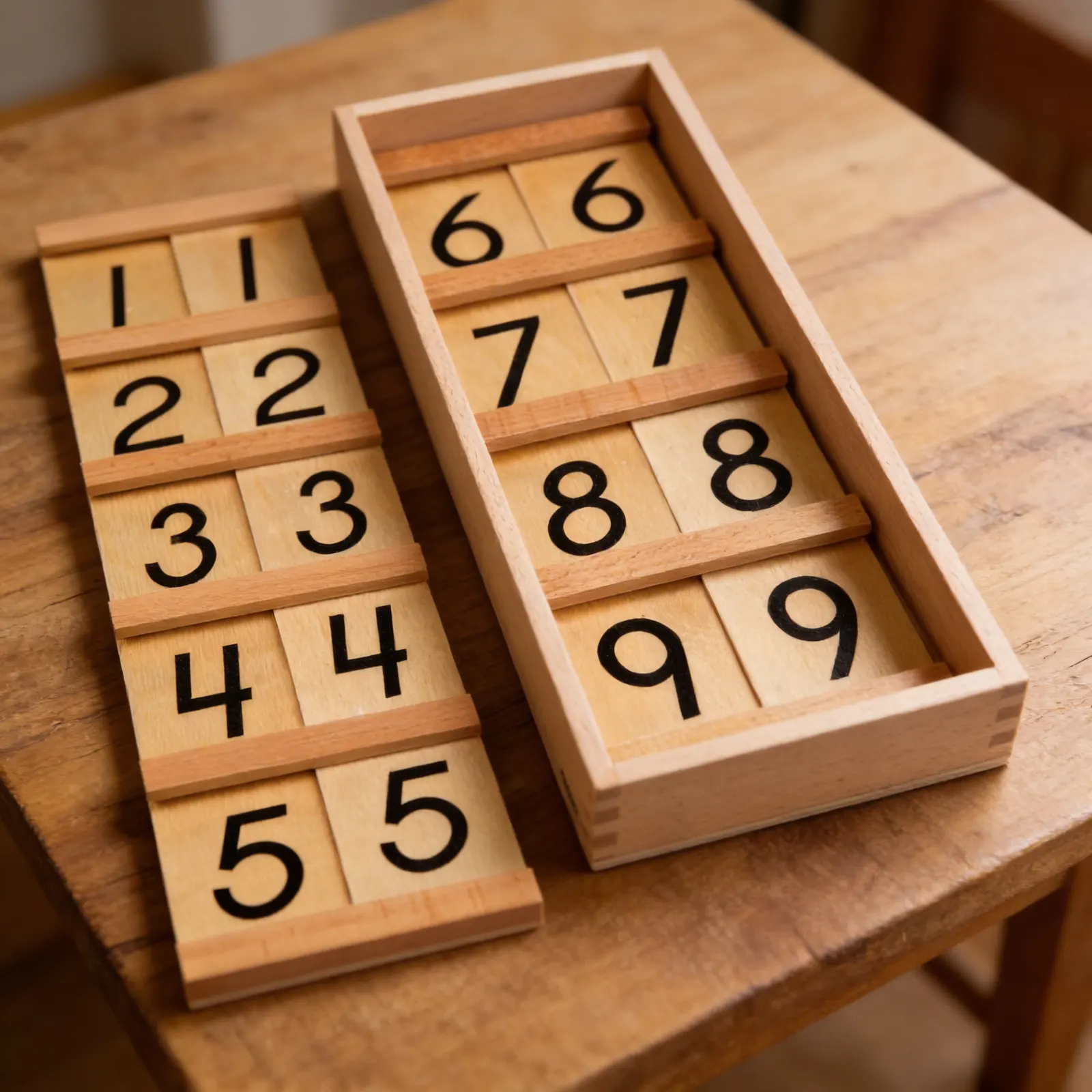
The Tens Boards introduce children to the decimal system through hands-on manipulation of sliding number panels that reveal sequential numbers from 10 to 99. This essential Montessori mathematics material builds concrete understanding of two-digit numbers and place value through visual and tactile exploration. The wooden construction and precision-printed numbers create a durable learning tool that supports the transition from physical to theoretical mathematical thinking.
Decimal System Understanding
Builds concrete foundation for place value and the base-ten system through visual and tactile exploration.
Sequential Number Recognition
Develops ability to recognize and order two-digit numbers through systematic revelation of number sequences.
Fine Motor Coordination
Sliding panels require precise finger movements, strengthening pincer grip and hand control.
Mathematical Order
Introduces patterns in number sequences and prepares for skip counting and mental mathematics.
How to present it
Place the Tens Boards on a table mat with the first board showing 10-19 and the second board nearby. Ensure all sliding panels move smoothly and numbers are clearly visible.
- 1Begin with the first board set to show '10'. Point to each digit and name: 'One ten and zero units makes ten.'
- 2Slide the units panel to reveal '11'. Say: 'One ten and one unit makes eleven.'
- 3Continue sliding to reveal each number sequentially, naming each: '12, 13, 14...'
- 4At '19', demonstrate moving to the second board: 'Now we have two tens.'
- 5Continue through all boards systematically, allowing the child to predict the next number
3 tips for parents
- Notice two-digit numbers in daily life: house numbers, calendar dates, page numbers in books
- Count objects in groups of ten at home: blocks, crayons, or snacks to reinforce tens grouping
- Play 'number detective' games finding specific two-digit numbers in your environment

If you are not sure it suits your child, we answer in person.
Norbert Kovalčín, founder of Faborino · write to him
There is no review here yet. We will ask you for one after you buy. Write the first review
What's in the Box
- Wooden number boards: 2 boards with sliding panels
- Sliding number panels: Covers for numbers 10-99
- Wooden storage box: For organized storage
Size and material
| Packaging | 45 × 16 × 6 cm |
| Primary Material | Natural wood |
| Number Display | Printed numerals |
| Finish | Smooth sanded surface |
| Recommended Age | 3-6 years |
Care
| Cleaning | Wipe with slightly damp cloth, dry immediately |
| Storage | Keep in provided wooden box in dry environment |
Frequently Asked Questions
What exactly are the Tens Boards and how do they work?
The Tens Boards are two wooden boards with printed numbers 10-90 in the left column and sliding wooden strips numbered 1-9 that slide over to create all numbers from 10-99. Children physically slide the number strips to reveal and create two-digit numbers, providing a hands-on way to understand place value and the decimal system.
At what age should children begin using the Tens Boards?
Children typically begin using the Tens Boards around age 4-5, after mastering numbers 1-10 and showing readiness for larger numbers. The material is designed for ages 3-6, but the exact timing depends on each child's individual development and prior experience with Montessori math materials like the Number Rods and Spindle Boxes.
What mathematical concepts do children learn from this material?
The Tens Boards teach place value, the decimal system, number sequencing from 10-99, skip counting by tens, and the relationship between tens and units. Children develop a concrete understanding of how two-digit numbers are formed and learn to recognize number patterns, preparing them for more advanced mathematical concepts.
How does this material differ from traditional number charts?
Unlike static number charts, the Tens Boards provide interactive, hands-on learning through moveable number strips that children physically manipulate. This tactile experience creates deeper understanding as children construct numbers themselves rather than simply viewing them, following Montessori's principle of learning through movement and sensorial exploration.
What activities can children do with the Tens Boards beyond basic counting?
Children can practice skip counting by tens, find specific numbers when asked, identify number patterns, match quantity with symbols using golden beads, play number sequence games, and create their own number combinations. Advanced activities include using the boards with other Montessori math materials for operations like addition and subtraction.
Product safety
Manufacturer: Nienhuis Montessori, Anders Celsiusstraat 15, 7442 PB Nijverdal, Netherlands
Tens Boards