
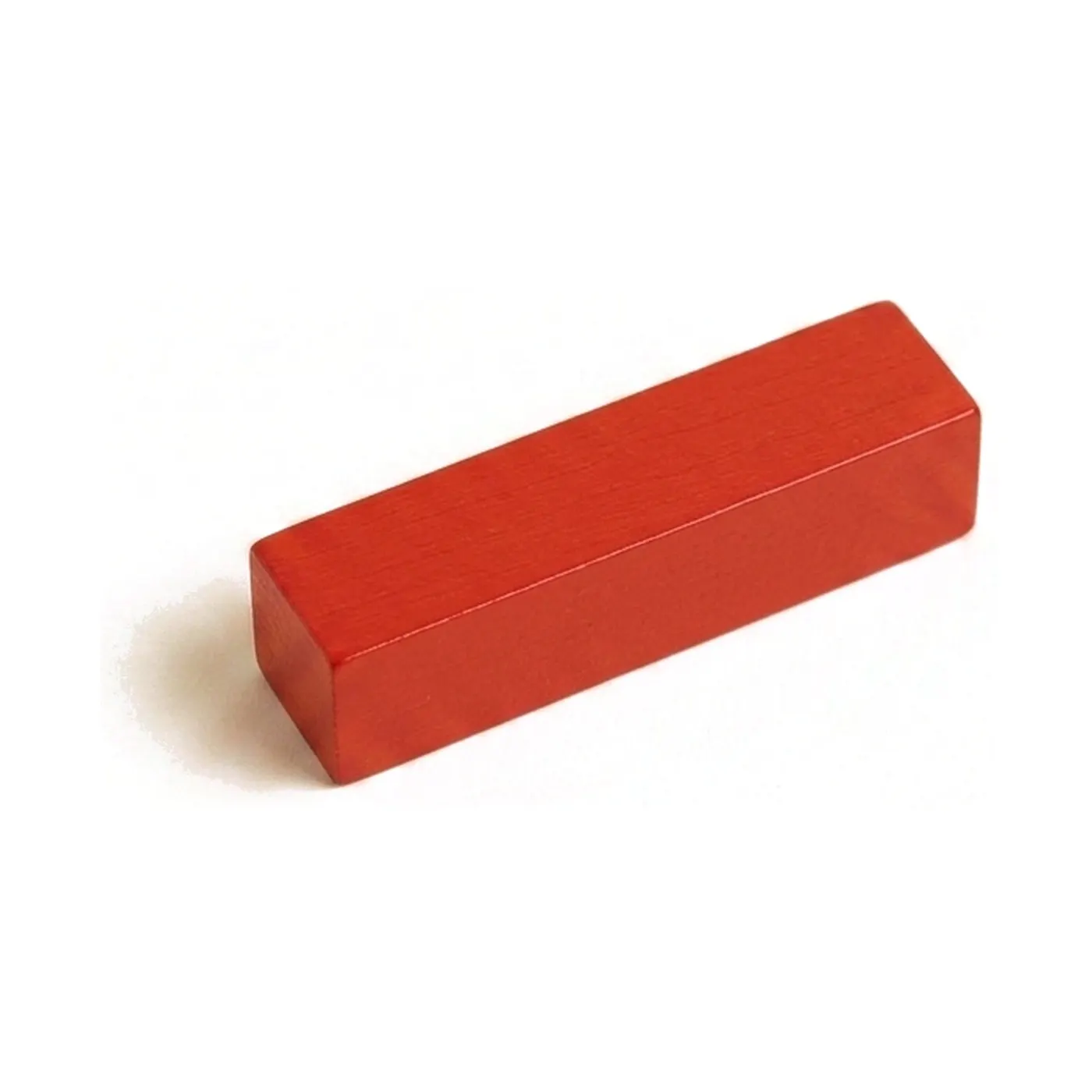
The Red RodsSensorial Length Material
The first photo is the maker's own. The other shots are illustrative.
Inv. no. NIE-002600
- Maker
- Nienhuis Montessori, since 1929
- Approval
- AMI
- Primary Material
- Solid wood
- Finish
- Red painted surface
- EAN
- 8719924001339
€164.90
Final price incl. VAT. Free delivery.
✓ In Stock. Delivery in 5 to 9 working days.
1
30 daysto return
Advicebefore and after
Invoicefor companies
Advice, warranty and returns are handled by us.
The original
Why it costs €164.90
Behind the price of the original are things you can check yourself.
AMI approval
The material is approved by the Association Montessori Internationale (AMI). Nienhuis has made Montessori materials since 1929.
A verifiable original
The EAN 8719924001339 is on the box. It is the maker's number, not ours.
What the child does
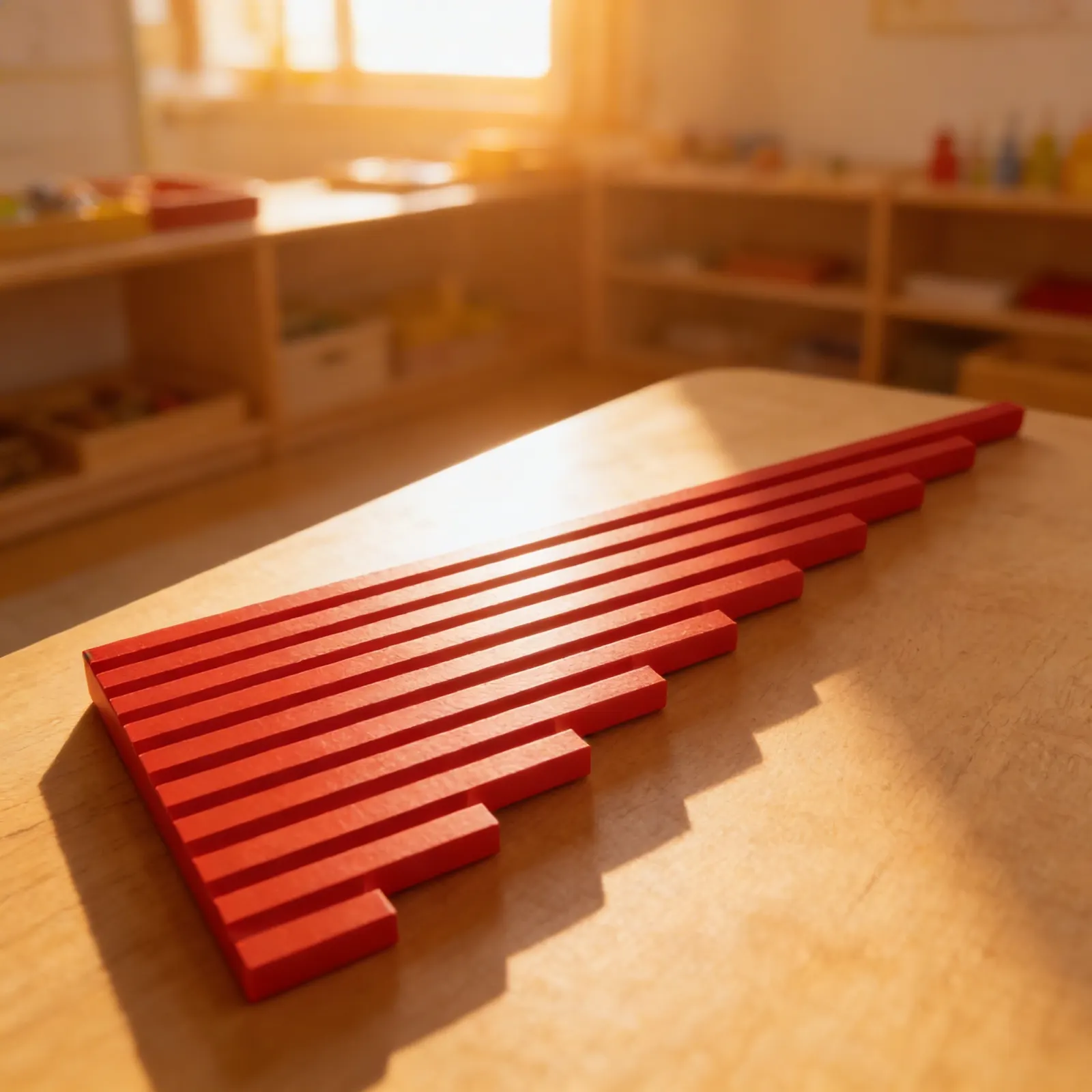
The Red Rods in a child's hands
Ten rods that grow in equal steps from 10 cm to a full metre, identical in height, width and colour so that only length changes. That single-variable design is the reason the material works: a child comparing two rods has nothing to weigh up except how long they are. The longest rod is a metre, which is bigger than the child, and carrying it takes both arms and a plan. Length stops being a word and becomes something the body has measured itself against. Wood with paint, for ages 3 to 6.
Visual Discrimination
Children refine their ability to perceive and compare lengths, developing the visual acuity needed for reading and mathematical work.
Mathematical Preparation
The 10cm increments introduce the decimal system concretely, preparing for later work with number rods and mathematical operations.
Concentration & Order
The precise work of arranging rods from shortest to longest develops sustained focus and appreciation for sequential order.
Movement & Coordination
Carrying and positioning the longer rods requires careful body awareness and gross motor control, integrating physical and cognitive development.
Activity Guide
How to present it
Clear a large floor space. Retrieve rods individually from the stand, carrying horizontally with both hands. Mix randomly on the work mat.
- 1Identify the shortest rod (10cm) by visual comparison
- 2Place the shortest rod at the top left of the mat
- 3Find the next shortest rod by comparing remaining rods
- 4Continue building the stair, aligning all left edges
- 5Verify by running hand along the diagonal created by right edges
3 tips for parents
- Practice comparing lengths at home using safe household items like spoons or books
- Use measurement language naturally: 'Which stick is longer for reaching that toy?'
- Support concentration by not interrupting when your child is working with similar materials
From the same makerNienhuis
Spare parts
Why it is in our selection
If you are not sure it suits your child, we answer in person.
Norbert Kovalčín, founder of Faborino · write to him
There is no review here yet. We will ask you for one after you buy. Write the first review
Details
What's in the Box
- Red Rods: Set of 10 graduated rods (10cm to 100cm)
Size and material
| Packaging | 106 × 9 × 6 cm |
| Primary Material | Solid wood |
| Finish | Red painted surface |
| Recommended Age | 3-6 years |
Care
Wipe with damp cloth, dry immediately
Frequently Asked Questions
What age is appropriate for introducing the Red Rods?
The Red Rods are designed for children ages 3-6 years. Most children are ready around age 3 when they can carry the longest rod carefully and have developed sufficient visual discrimination skills through preliminary Sensorial work.
How do the Red Rods prepare children for mathematics?
The Red Rods provide a concrete, visual representation of the base-10 system, preparing children to understand units of measurement. They develop concepts of comparison (longer/shorter), seriation, and the relationship between numbers 1-10, which directly prepares them for the Number Rods.
What is the difference between Red Rods and Number Rods?
Red Rods are solid red and focus purely on length discrimination without numerical association. Number Rods are painted in alternating red and blue segments to represent quantities 1-10. Children typically work with Red Rods first to isolate the concept of length before adding the mathematical component.
Why are the rods painted red specifically?
The solid red color isolates the single concept of length without distraction. The uniform color allows children to focus solely on the dimension being explored. Red was chosen as it provides good visual contrast against most backgrounds while maintaining consistency across Montessori materials.
What skills do children develop through Red Rods activities?
Children develop visual discrimination of length, gross motor coordination when carrying the rods, concentration through precise arrangement, mathematical preparation for measurement concepts, vocabulary (long, longer, longest, short, shorter, shortest), and problem-solving skills through self-correction.
Product safety
Manufacturer: Nienhuis Montessori, Anders Celsiusstraat 15, 7442 PB Nijverdal, Netherlands
The Red Rods
€164.90