
The Rolling Calendar
The first photo is the maker's own. The other shots are illustrative.
Inv. no. NIE-085500
- Maker
- Nienhuis Montessori, since 1929
- Approval
- AMI
- Product size
- 95 × 13 cm
- Frame
- Natural wood construction
- Scrolling Surface
- Paper
- EAN
- 8719924015206
Final price incl. VAT. Free delivery.
Advice, warranty and returns are handled by us.
Why it costs €204.90
Behind the price of the original are things you can check yourself.
AMI approval
The material is approved by the Association Montessori Internationale (AMI). Nienhuis has made Montessori materials since 1929.
A verifiable original
The EAN 8719924015206 is on the box. It is the maker's number, not ours.
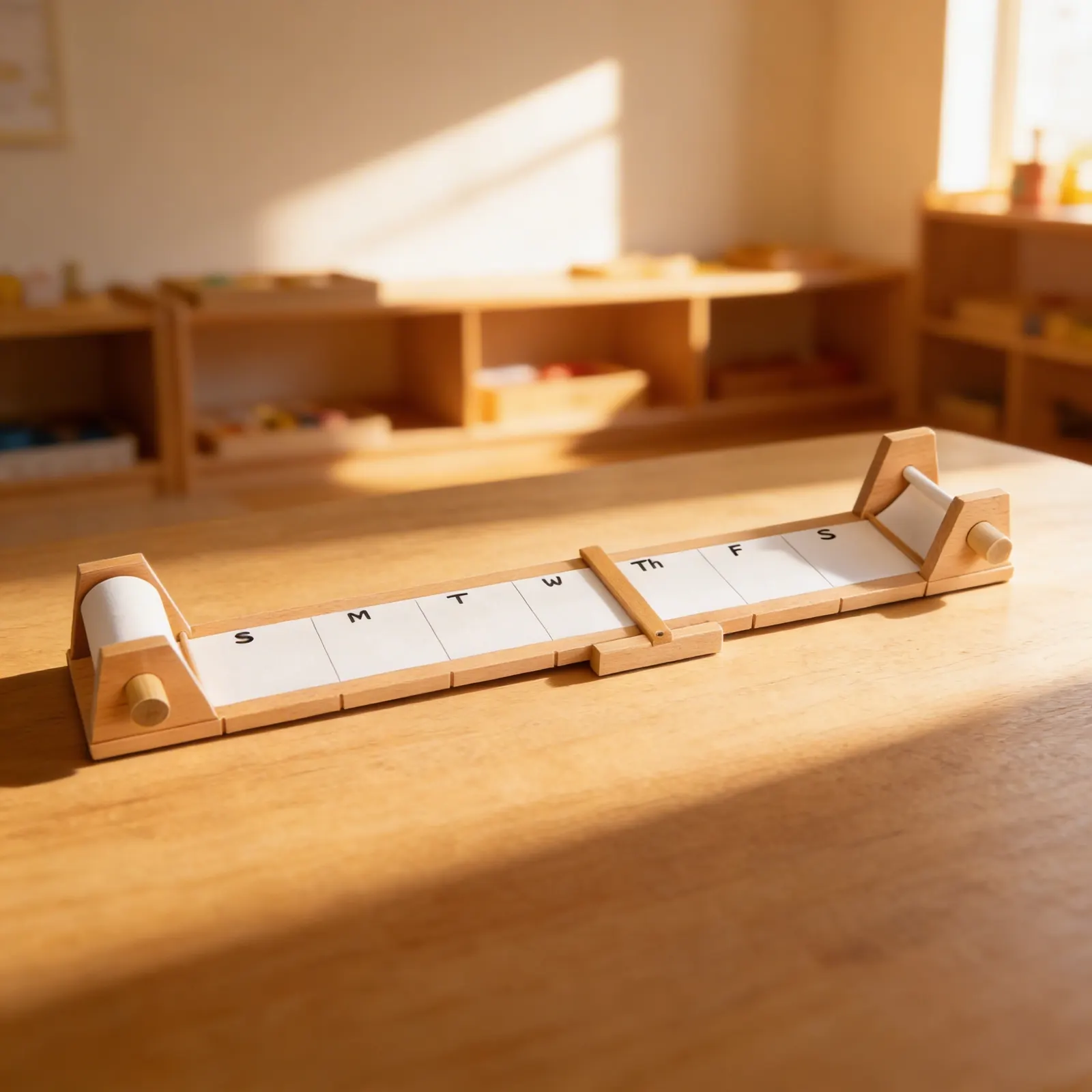
The Rolling Calendar in a child's hands
A beechwood base with two spindles and a paper roll that a child winds forward, one day at a time. The sliding guide sits between what has happened and what has not, so past and future are a position on a roll rather than an abstraction. Words like yesterday and next week are genuinely hard before about six, because they describe nothing a child can see; making time into a length that moves under the hand is how the material solves that. Includes a wall bracket and one roll of paper. Beechwood, guide 95 x 13 cm, for ages 3 to 6.
Mathematical Understanding
Scrolling through numbered sequences builds number recognition and understanding of numerical order from 0-6.
Time Conceptualization
The rolling mechanism helps children grasp the cyclical and continuous nature of calendar time.
Fine Motor Refinement
Turning the knobs to precisely position numbers develops hand strength and coordination.
Executive Function
Planning which direction to turn and how far to scroll builds cognitive planning skills.
How to present it
Place the Rolling Calendar at child's eye level on a low shelf. Ensure both rollers are set to '1' initially. Have a small basket nearby with cards showing special dates or events.
- 1Demonstrate slow, deliberate turning of the left knob to advance from 1 to 2
- 2Count aloud as you turn: 'One, two, three...' matching voice to number appearance
- 3Show how to scroll backward by turning the knob in reverse direction
- 4Advance to today's date and mark it with a small clip or pointer
- 5Demonstrate coordinating both rollers for two-digit numbers like 15 or 28
3 tips for parents
- Practice counting to 31 during daily activities before introducing the rolling calendar concept
- Point out calendars in your environment - on phones, walls, or computers - to build familiarity
- Use consistent time language: 'yesterday we...', 'today we will...', 'tomorrow we can...'

If you are not sure it suits your child, we answer in person.
Norbert Kovalčín, founder of Faborino · write to him
There is no review here yet. We will ask you for one after you buy. Write the first review
What's in the Box
- Rolling Calendar Unit: Complete assembled unit with dual rollers
- Center Position Marker: Movable indicator for current date/number
- Turning Knobs: Two wooden knobs for scroll control
Size and material
| Product size | 95 × 13 cm |
| Packaging | 94 × 22 × 14 cm |
| Frame | Natural wood construction |
| Scrolling Surface | Paper |
| Hardware | Wooden knobs and rollers |
| Recommended Age | 6-12 years |
Care
| Cleaning | Wipe wooden frame with damp cloth; avoid moisture on scrolling surface |
| Storage | Store in dry area to prevent warping |
Frequently Asked Questions
What age group is the Rolling Calendar designed for?
The Rolling Calendar is designed for children ages 3-6 years old, aligning with the Montessori primary classroom age range when children are developing their understanding of time concepts and numerical order.
How does the Rolling Calendar help children learn about time?
Children manipulate wooden knobs to scroll through numbered sequences on dual rollers, physically experiencing how days, weeks, and months flow continuously. This hands-on approach helps them understand the cyclical nature of time and develop calendar awareness through concrete manipulation.
What skills does this material develop besides calendar concepts?
Beyond time awareness, the Rolling Calendar develops fine motor control through knob turning, numerical sequencing skills, visual tracking abilities, and concentration. It also introduces mathematical concepts like counting, number recognition, and understanding patterns.
How is this different from a traditional wall calendar?
Unlike static wall calendars, the Rolling Calendar allows children to physically manipulate time sequences, making abstract concepts concrete. The rolling mechanism demonstrates the continuous flow of time rather than discrete pages, helping children understand that time is cyclical and ongoing.
Can this material be used for teaching different time concepts?
Yes, the Rolling Calendar is versatile and can be adapted to teach days of the week, months of the year, or counting sequences. Teachers can guide children to explore different time cycles, making it a valuable material for various lessons about temporal concepts and numerical order.
Product safety
Manufacturer: Nienhuis Montessori, Anders Celsiusstraat 15, 7442 PB Nijverdal, Netherlands
The Rolling Calendar