
The Roman ArchArchitecture Activity
The first photos are the maker's own. The other shots are illustrative.
Inv. no. NIE-035000
- Maker
- Nienhuis Montessori, since 1929
- Approval
- AMI
- Block Material
- Natural wood
- Base Material
- Plywood
- EAN
- 8719924012366
Final price incl. VAT. Delivery €5.90, €17.10 to go for free delivery.
Advice, warranty and returns are handled by us.
Why it costs €131.90
Behind the price of the original are things you can check yourself.
AMI approval
The material is approved by the Association Montessori Internationale (AMI). Nienhuis has made Montessori materials since 1929.
A verifiable original
The EAN 8719924012366 is on the box. It is the maker's number, not ours.
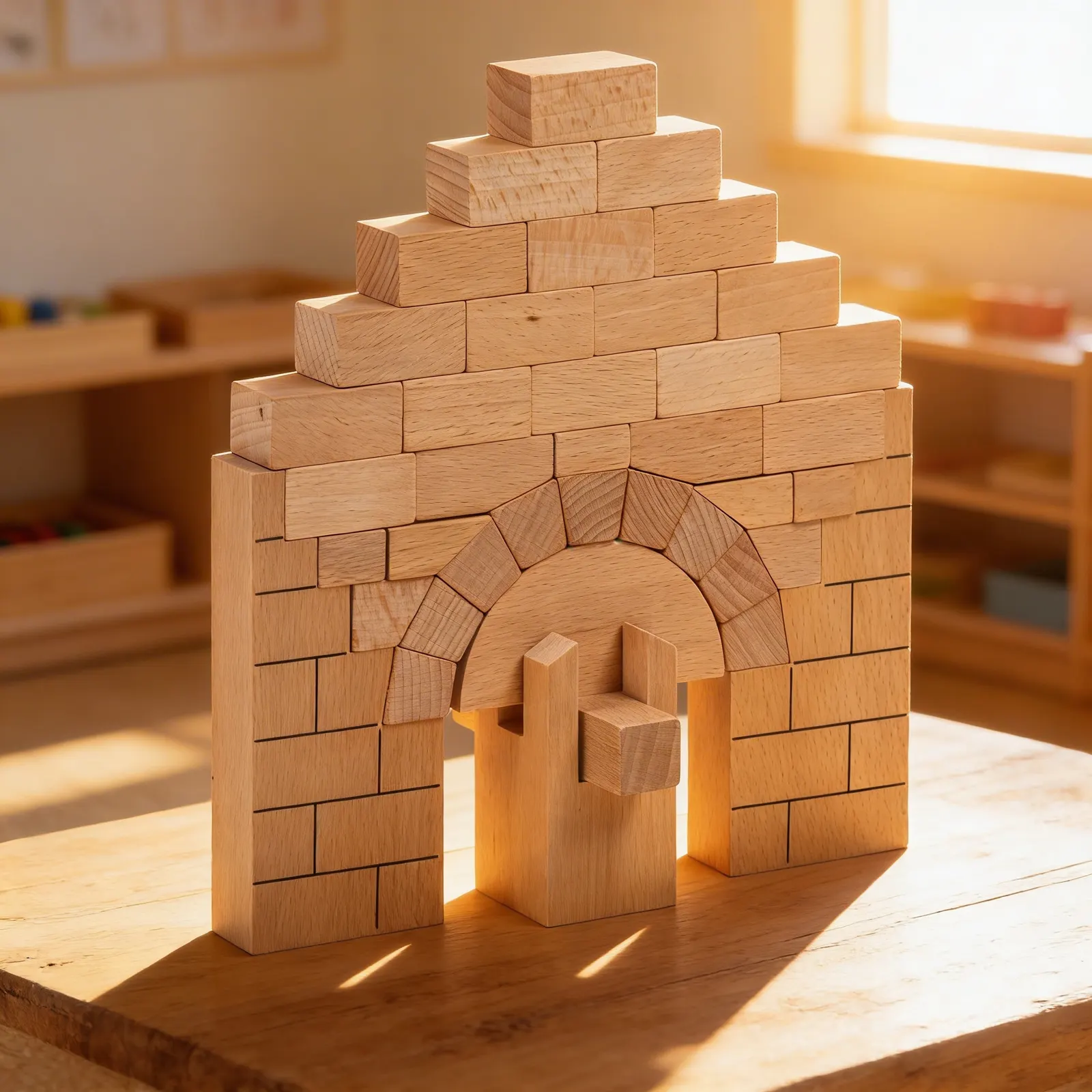
The Roman Arch in a child's hands
A beechwood arch a child builds block by block, and which will not stand until the last stone goes in. That last stone is the keystone, and discovering that the whole arch depends on it is a piece of engineering understood by hand in about ten minutes. Until it is placed, everything leans; once it is, the structure carries itself. Few materials make a principle this abstract this obvious, and children rebuild it far more often than an adult expects. Beechwood, for ages 3 to 6.
Engineering Concepts
Children discover how compression and weight distribution create stability through hands-on experimentation with arch construction.
Spatial Intelligence
Building the three-dimensional structure develops understanding of geometric relationships and architectural principles.
Problem-Solving Skills
Constructing the arch requires sequential thinking and planning to achieve the stable final structure.
Cultural Understanding
Introduces historical architectural achievements, connecting children to human innovation and cultural heritage.
How to present it
Place The Roman Arch materials on a work mat. Arrange the base blocks, column pieces, arch segments, and keystone separately. Include the wooden support structure that holds the arch during construction.
- 1Position the two base blocks at an appropriate distance apart
- 2Build the vertical columns on each base, ensuring they are perfectly upright
- 3Place the curved support structure between the columns
- 4Arrange the arch blocks one by one on the support, working from both sides toward center
- 5Insert the keystone at the top center of the arch
- 6Slowly remove the support structure from beneath
3 tips for parents
- Visit local buildings with arch architecture to connect the material to real structures
- Allow multiple attempts when the arch falls, persistence builds problem-solving skills
- Ask 'What do you think will happen if...' questions during construction

If you are not sure it suits your child, we answer in person.
Norbert Kovalčín, founder of Faborino · write to him
There is no review here yet. We will ask you for one after you buy. Write the first review
What's in the Box
- Wooden blocks: Approx. 45 pieces including keystones
- Plywood base: Branded platform for construction
- Arch components: Rectangular and wedge-shaped blocks
- Roof section blocks: Triangular peak assembly pieces
Size and material
| Packaging | 29 × 18 × 11 cm |
| Block Material | Natural wood |
| Base Material | Plywood |
| Recommended Age | 3-6 years |
Care
Wipe with slightly damp cloth, dry immediately
Frequently Asked Questions
What age group is the Roman Arch suitable for?
The Roman Arch is designed for children ages 3-6 years. The wooden blocks are sized appropriately for small hands, and the activity complexity matches the developmental stage of preschool and kindergarten children who are beginning to understand cause-and-effect relationships and spatial concepts.
What skills does building the Roman Arch develop?
This material develops spatial reasoning, problem-solving abilities, fine motor coordination, and engineering concepts. Children learn about balance, structural stability, and the interdependence of architectural elements while gaining hands-on experience with gravity, weight distribution, and the keystone principle.
How many pieces are included and what are they made of?
The Roman Arch set includes precision-crafted wooden blocks specifically designed to create a stable arch structure. Each piece is made from high-quality, smooth-sanded wood with exact dimensions that allow the arch to stand without adhesives, teaching children about structural engineering through direct manipulation.
Do children need adult supervision to use the Roman Arch?
While the material is designed for independent exploration, initial demonstrations by an adult or trained guide help children understand the proper sequence of construction. Once familiar with the process, most children ages 4-6 can build the arch independently, promoting confidence and self-directed learning.
How does this relate to the Montessori curriculum?
The Roman Arch aligns with Montessori sensorial and cultural studies areas, offering concrete experiences with abstract concepts. It supports the Montessori principle of learning through manipulation of materials, allowing children to discover architectural principles through their own exploration and repeated practice with immediate visual feedback.
Product safety
Manufacturer: Nienhuis Montessori, Anders Celsiusstraat 15, 7442 PB Nijverdal, Netherlands
The Roman Arch