
The Story Of The Three Kings
The first photo is the maker's own. The other shots are illustrative.
Inv. no. NIE-068401
- Maker
- Nienhuis Montessori, since 1929
- Primary Material
- Solid wood
- Finish
- Paint or lacquer
- EAN
- 8719924014407
Final price incl. VAT. Delivery €5.90, €129.10 to go for free delivery.
Advice, warranty and returns are handled by us.
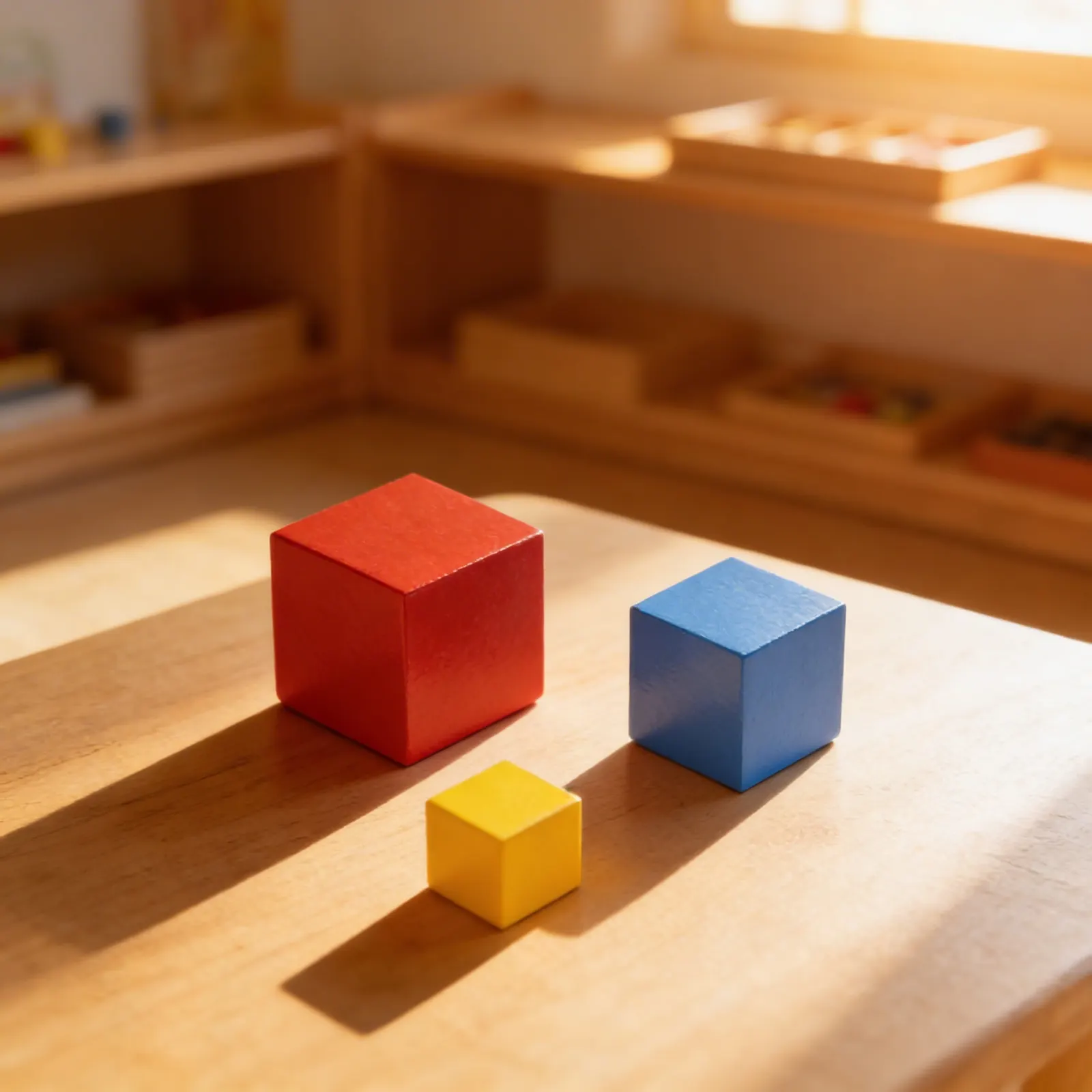
The Story Of The Three Kings in a child's hands
A story that ends in the invention of the decimal system: three kingdoms parade, a revolution follows, and what comes out of it is the way we write numbers. It is written to prepare a child for the Arithmetic Trinomial Cube, which is the material the story is really about and which is sold separately. Stories do a particular job in the elementary years, since they give a child a reason to want the material before it is ever presented. Paper.
Mathematical Foundations
Introduces concepts of size gradation, comparison, and seriation essential for later mathematical work.
Visual Discrimination
Develops the ability to perceive differences in dimension through hands-on manipulation of graduated objects.
Language Development
Enriches vocabulary with comparative terms (small, smaller, smallest) and supports storytelling activities.
Spatial Intelligence
Builds understanding of three-dimensional relationships and geometric concepts through concrete exploration.
How to present it
Place the three wooden cubes on a mat, arranged randomly. Sit beside the child, ensuring both of you can easily reach the materials.
- 1Introduce each cube as a 'king,' starting with the largest: 'This is the Great King'
- 2Present the medium cube: 'This is the Middle King,' then the smallest: 'This is the Little King'
- 3Tell a simple story involving the three kings going on a journey, using size-appropriate language
- 4Invite the child to arrange the kings from smallest to largest for their 'royal procession'
- 5Encourage the child to create their own story using the three kings
3 tips for parents
- At home, compare three similar objects (spoons, boxes, books) using the same size vocabulary
- When reading stories, identify characters or objects that come in three sizes
- During daily routines, ask your child to arrange items from smallest to largest

If you are not sure it suits your child, we answer in person.
Norbert Kovalčín, founder of Faborino · write to him
There is no review here yet. We will ask you for one after you buy. Write the first review
What's in the Box
- Large wooden cube: Red painted finish
- Medium wooden cube: Blue painted finish
- Small wooden cube: Yellow painted finish
Size and material
| Packaging | 22 × 21 × 1 cm |
| Primary Material | Solid wood |
| Finish | Paint or lacquer |
| Recommended Age | 6-12 years |
Care
Wipe with slightly damp cloth, dry immediately
Frequently Asked Questions
What mathematical concepts does The Story of The Three Kings teach?
This material introduces size comparison, seriation, visual discrimination, and spatial relationships. Children learn to order objects by size, understand concepts of small/medium/large, and develop mathematical language while exploring the three graduated wooden cubes.
How do children use this material in a Montessori classroom?
Children begin by exploring the cubes freely, then learn to order them by size. They can stack, nest, or line them up while developing stories about three kings of different sizes. The material supports both sensorial exploration and creative storytelling.
What are the dimensions and materials of the three cubes?
The set includes three solid wooden cubes in graduated sizes, typically ranging from approximately 2cm to 6cm. They are crafted from smooth, natural wood with rounded edges for safety and painted in attractive colors to engage young learners.
Can this material be used for activities beyond the traditional presentation?
Yes! Children can use the cubes for building, pattern-making, counting, and creative play. They serve as props for storytelling, can be traced for art activities, and help with vocabulary development using comparative language like bigger, smaller, and equal.
Why is this material particularly suitable for ages 3-6?
This age group is in the sensitive period for order and sensorial exploration. The material's concrete nature appeals to young children who learn through manipulation, while the storytelling aspect engages their growing imagination and language development.
Product safety
Manufacturer: Nienhuis Montessori, Anders Celsiusstraat 15, 7442 PB Nijverdal, Netherlands
The Story Of The Three Kings