
Theorem Of Pythagoras
The first photo is the maker's own. The other shots are illustrative.
Inv. no. NIE-012300
- Maker
- Nienhuis Montessori, since 1929
- Approval
- AMI
- Plates
- Metal, green
- Inset Pieces
- Metal; blue, red, yellow and white
- EAN
- 8719924006914
Final price incl. VAT. Free delivery.
Advice, warranty and returns are handled by us.
Why it costs €475.90
Behind the price of the original are things you can check yourself.
AMI approval
The material is approved by the Association Montessori Internationale (AMI). Nienhuis has made Montessori materials since 1929.
A verifiable original
The EAN 8719924006914 is on the box. It is the maker's number, not ours.
Theorem Of Pythagoras in a child's hands
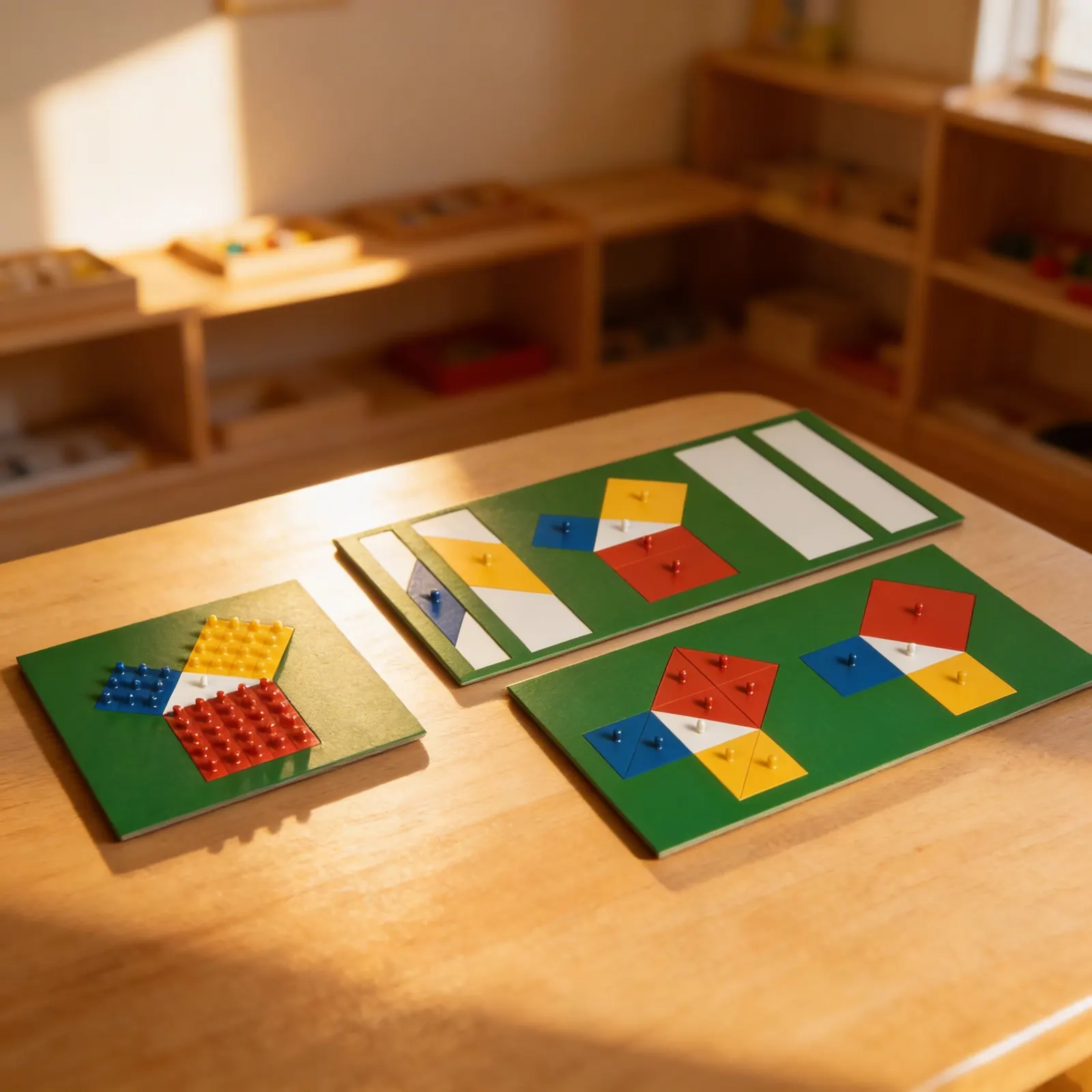
Three plates, three proofs. The first shows the theorem where two sides of the triangle are equal, the second where the sides stand in the proportion 3:4:5, and the third gives the general Euclidean demonstration. A child lifts the coloured inset pieces out of one square and finds they fill the other two exactly, which is a proof done with the hands before it is done with algebra. Working through all three cases in order is what turns a formula into something the child has verified rather than accepted. Metal plates with coloured insets, for ages 6 to 12.
Abstract Reasoning
Transforms algebraic concepts into concrete visual and tactile experiences, building deep mathematical intuition.
Geometric Visualization
Develops spatial reasoning through hands-on manipulation of area relationships and geometric proofs.
Mathematical Discovery
Encourages independent exploration and verification of mathematical theorems through self-directed investigation.
Problem-Solving Skills
Strengthens analytical thinking by allowing children to physically construct and deconstruct mathematical proofs.
How to present it
Place the three green metal plates on a large work mat. Ensure adequate space for the child to lift out and move the inset pieces.
- 1Introduce the right triangle on the first plate, identifying the legs and hypotenuse
- 2Fill the square on the first leg completely with its inset pieces
- 3Fill the square on the second leg with its inset pieces
- 4Transfer all inset pieces from both leg squares to the hypotenuse square
- 5Verify that all pieces fit exactly, proving a² + b² = c²
3 tips for parents
- Look for right triangles in everyday life (roof lines, ladder placement) to connect the theorem to practical applications
- Support mathematical language at home by using terms like 'square' as both a shape and an operation
- Celebrate the 'aha' moment when your child discovers the relationship independently

If you are not sure it suits your child, we answer in person.
Norbert Kovalčín, founder of Faborino · write to him
There is no review here yet. We will ask you for one after you buy. Write the first review
What's in the Box
- Green metal plates with bottoms: 3 pieces, one for each case of the theorem
- Metal inset pieces: Blue, red, yellow and white
Size and material
| Packaging | 43 × 20 × 7 cm |
| Plates | Metal, green |
| Inset Pieces | Metal; blue, red, yellow and white |
| Recommended Age | 6-12 years |
Care
Wipe the plates and inset pieces with a damp cloth
Frequently Asked Questions
What age is this Pythagorean theorem material most suitable for?
This material is designed for children ages 6-12, though it's most effectively introduced around age 9-10 when children have developed strong spatial reasoning and are ready for more abstract mathematical concepts. Younger children can explore the material concretely, while older children can delve into the mathematical proofs.
How does this material help children understand the Pythagorean theorem?
The three metal plates with coloured inset pieces allow children to physically manipulate and arrange pieces to see that the area of squares on the two shorter sides of a right triangle equals the area of the square on the longest side. This concrete representation transforms the abstract formula a² + b² = c² into a tangible, visual proof.
What skills does this Pythagorean theorem material develop?
This material develops spatial reasoning, geometric thinking, mathematical proof concepts, area calculation, algebraic thinking, and problem-solving skills. It also strengthens the connection between concrete manipulation and abstract mathematical formulas, preparing children for advanced geometry.
Do children need prior knowledge before using this material?
Children should have a solid understanding of squares, area concepts, and basic multiplication before using this material effectively. Familiarity with right triangles and the concept of sides of a triangle is helpful. The material works best when introduced after children have worked with geometry materials like the geometric cabinet.
Why is this Pythagorean theorem material so expensive?
The cost reflects the precision manufacturing of three separate metal plates, coloured metal inset pieces that fit exactly, durable materials designed for years of classroom use, and the design that shows three cases of the theorem. This is an advanced mathematical material that provides concrete understanding of a fundamental geometric principle.
Product safety
Manufacturer: Nienhuis Montessori, Anders Celsiusstraat 15, 7442 PB Nijverdal, Netherlands
Theorem Of Pythagoras