
Three Discs On A Vertical Dowel
The first photo is the maker's own. The other shots are illustrative.
Inv. no. NIE-045800
- Maker
- Nienhuis Montessori, since 1929
- Approval
- AMI
- Primary Material
- Birch plywood and beech
- Finish
- Paint on discs
- EAN
- 8719924012809
Final price incl. VAT. Delivery €5.90, €113.10 to go for free delivery.
Advice, warranty and returns are handled by us.
Why it costs €35.90
Behind the price of the original are things you can check yourself.
AMI approval
The material is approved by the Association Montessori Internationale (AMI). Nienhuis has made Montessori materials since 1929.
A verifiable original
The EAN 8719924012809 is on the box. It is the maker's number, not ours.
Three Discs On A Vertical Dowel in a child's hands
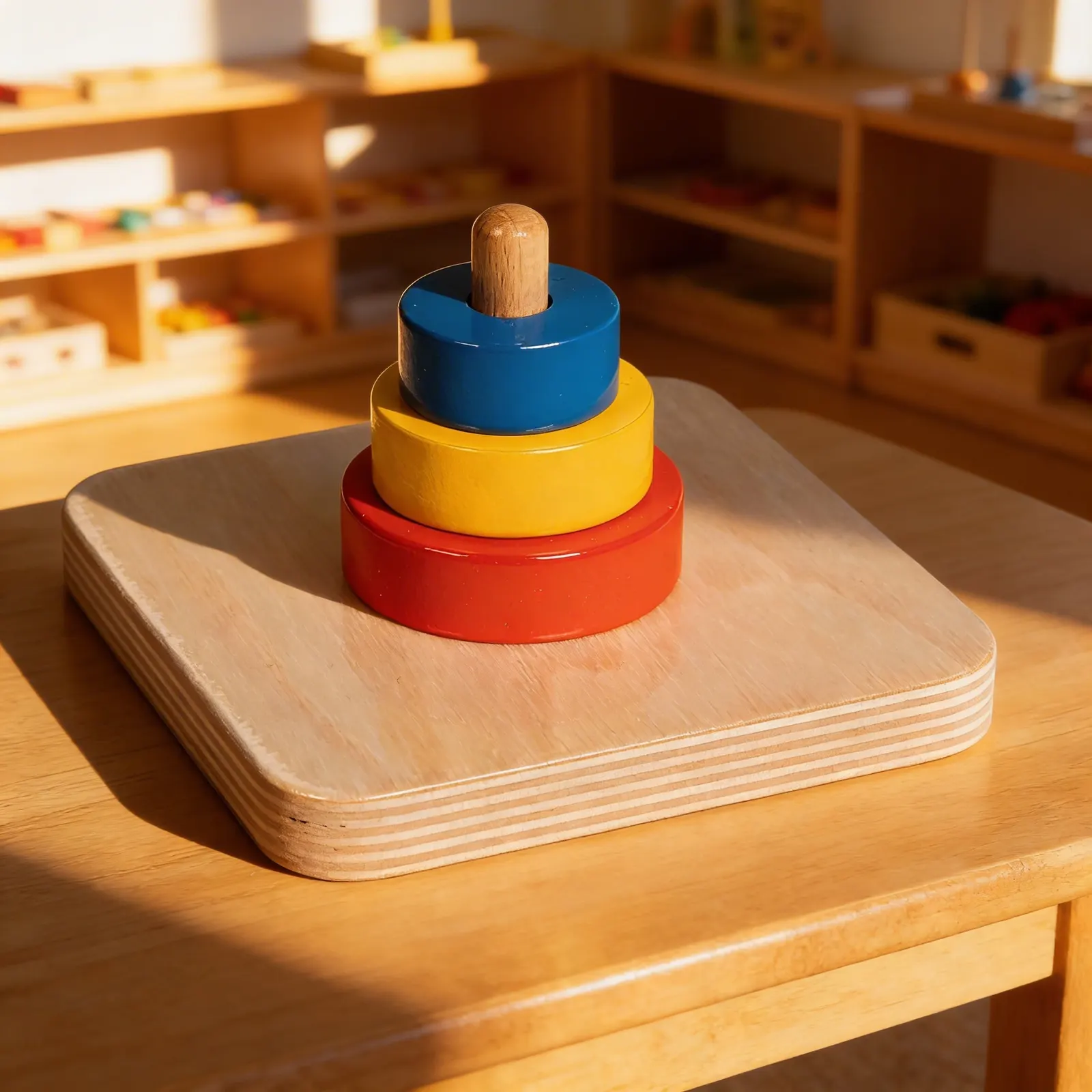
The Three Discs on a Vertical Dowel are a Montessori material from Nienhuis. The child takes the discs one at a time in the hand, lifts each one off the dowel and puts it back, until all three are on the dowel again. According to Nienhuis, the material is made of birch plywood and beech and is meant for indoor use. The colours given are blue and red. The whole set weighs 250 g. A damp cloth is enough for cleaning, after which the material is left to dry completely in the air. It is intended for children aged 0 to 3.
Hand-Eye Coordination
Placing discs on the dowel requires precise visual-motor integration, building neural pathways essential for later writing and tool use.
Size Discrimination
Graduated disc sizes introduce mathematical concepts of dimension and sequence through hands-on exploration.
Concentration Development
The focused attention required to complete this activity strengthens the child's capacity for sustained concentration.
Pincer Grasp Refinement
Grasping and manipulating the discs develops the thumb-finger opposition needed for pencil holding and fine motor tasks.
How to present it
Place the base with dowel on a low table or mat at child's seated eye level. Arrange all three discs beside the base, largest to smallest from left to right.
- 1Sit beside the child and slowly grasp the largest disc with thumb and fingers on opposite edges
- 2Lift the disc horizontally and position it directly above the dowel, pausing to ensure alignment
- 3Lower the disc onto the dowel, releasing when it reaches the base
- 4Repeat with medium and small discs, maintaining the same deliberate pace
- 5Once stacked, pause to observe the completed tower before lifting all discs off together
3 tips for parents
- Resist helping even when your child struggles, the effort builds essential neural pathways
- Create a consistent spot for this work to help establish routine and concentration
- When child succeeds, share their joy quietly without excessive praise that interrupts focus

If you are not sure it suits your child, we answer in person.
Norbert Kovalčín, founder of Faborino · write to him
There is no review here yet. We will ask you for one after you buy. Write the first review
What's in the Box
- Three discs on a vertical dowel: birch plywood and beech, colours blue and red
Size and material
| Packaging | 15 × 13 × 9 cm |
| Primary Material | Birch plywood and beech |
| Finish | Paint on discs |
| Recommended Age | 6 months - 3 years |
Care
Wipe with damp cloth, air dry completely
Frequently Asked Questions
What age is the Three Discs on a Vertical Dowel appropriate for?
This material is designed for infants and toddlers from approximately 8 months to 3 years old. Children typically begin using it once they can sit independently and grasp objects with control.
What skills does this stacking toy develop?
This material develops hand-eye coordination, fine motor control, size discrimination, concentration, and problem-solving skills. It also introduces concepts of order, sequence, and spatial relationships through hands-on exploration.
How is this different from regular stacking toys?
Unlike conventional stacking toys, this Montessori material features a single vertical dowel (rather than a tapered post) and uniform disc holes, allowing only one correct orientation. This isolation of difficulty helps children focus on size discrimination and precise movements.
What are the dimensions and materials used?
The toy features three smooth wooden discs in graduated sizes on a vertical dowel mounted to a stable square base. All components are made from high-quality, child-safe wood with smooth, splinter-free surfaces suitable for infant exploration.
How should I present this material to my child?
Sit with your child and slowly demonstrate removing all discs, then replacing them one at a time from largest to smallest. Use deliberate, careful movements and minimal language. Allow your child to explore and repeat the activity at their own pace.
Product safety
Manufacturer: Nienhuis Montessori, Anders Celsiusstraat 15, 7442 PB Nijverdal, Netherlands
Three Discs On A Vertical Dowel