
Timeline American History (Large Display)
The first photo is the maker's own. The other shots are illustrative.
Inv. no. NIE-TL029
- Maker
- Nienhuis Montessori, since 1929
- Primary Material
- Paper with laminate coating
- Finish
- Protective lamination
- EAN
- 8719924044688
Final price incl. VAT. Free delivery.
Advice, warranty and returns are handled by us.
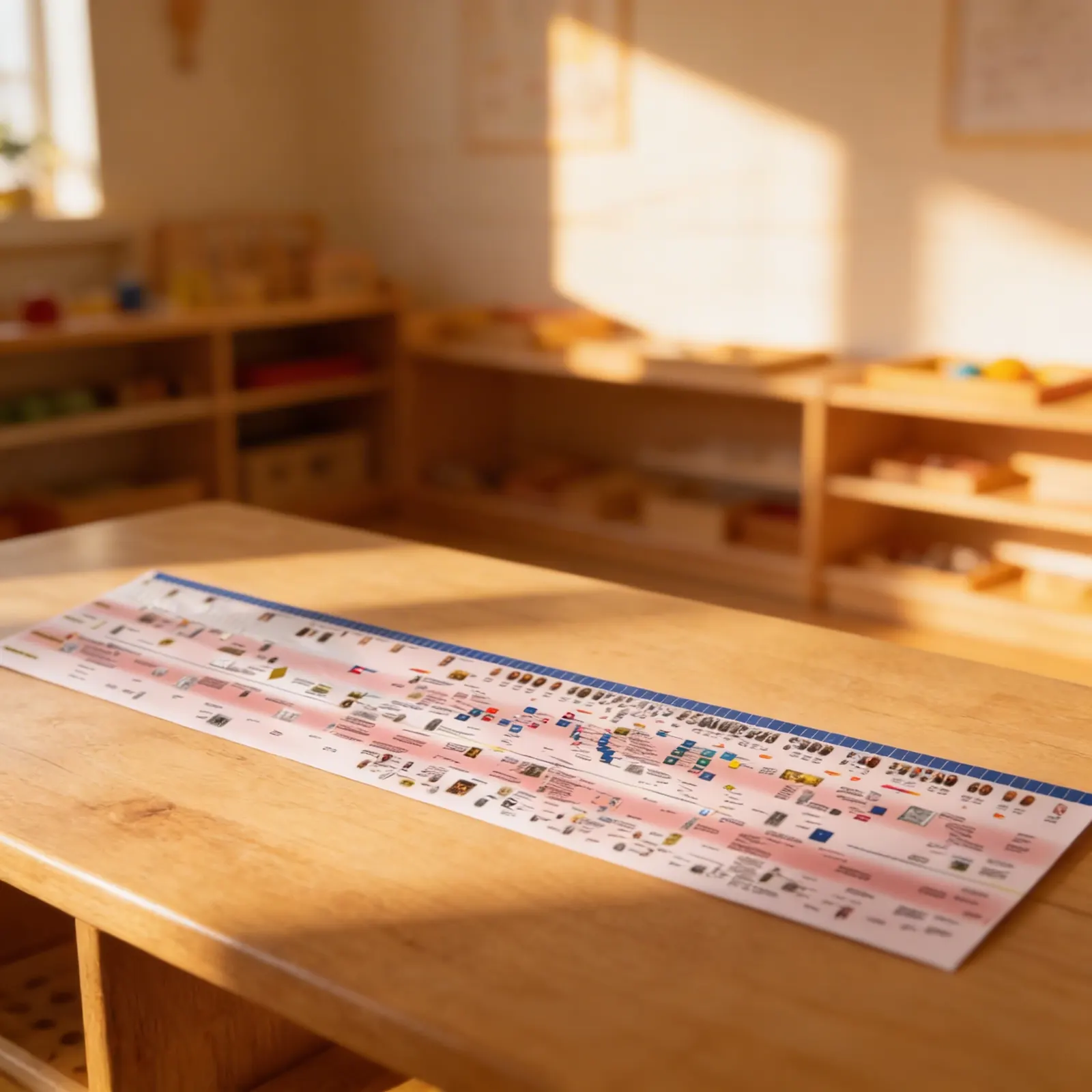
Timeline American History (Large Display) in a child's hands
Geography comes alive through touch, this expansive Timeline of American History transforms abstract historical concepts into a visual journey that Elementary children can explore and understand. The large-format display presents key events, figures, and developments in American history through carefully curated images and text, letting young learners build a concrete understanding of temporal relationships and historical progression.
Historical Understanding
Builds concrete comprehension of temporal relationships and the sequence of historical events through visual representation.
Cultural Awareness
Develops appreciation for American heritage and understanding of how past events shape present society.
Research Skills
Encourages independent exploration and research as children investigate events and figures that capture their interest.
Visual-Spatial Learning
Supports different learning styles by presenting information through images, text, and spatial arrangement.
How to present it
Mount the timeline at child eye level along a wall where children can walk its entire length. Place a basket nearby with blank cards, pencils, and research materials. Ensure adequate lighting for examining details in images and text.
- 1Introduce the timeline by walking its length with a small group, noting how events flow from left to right
- 2Select one historical figure or event and create a three-period lesson using the timeline's images and text
- 3Invite children to choose an event that interests them and research one additional fact not shown on the timeline
- 4Have children create their own timeline cards for events in their family or community history to add below
3 tips for parents
- When visiting historical sites or museums, help your child locate these places and events on their classroom timeline
- Share family immigration stories or historical connections to help personalize the timeline's content
- Support timeline interest by reading historical fiction set in periods your child is exploring

If you are not sure it suits your child, we answer in person.
Norbert Kovalčín, founder of Faborino · write to him
There is no review here yet. We will ask you for one after you buy. Write the first review
What's in the Box
- American History Timeline: Large format display (300 × 40 cm)
Size and material
| Packaging | 34 × 7 × 7 cm |
| Primary Material | Paper with laminate coating |
| Finish | Protective lamination |
| Recommended Age | 6-12 years |
Care
Wipe with slightly damp cloth, avoid excessive moisture
Frequently Asked Questions
What age range is this American History Timeline appropriate for?
While labeled for ages 3-6, this timeline is actually designed for Elementary students (6-12 years) who are developmentally ready to understand historical concepts and chronological thinking. The visual format makes it accessible to younger Elementary students while providing depth for older children.
How large is this timeline display and how should it be mounted?
This is a large-format educational display designed to be mounted at child height along a classroom wall. The expansive size allows children to walk along the timeline, physically experiencing the progression of historical events while having clear visibility of all images and text.
What historical events and figures are included in this timeline?
The timeline features carefully curated key events, important historical figures, and major developments in American history. Content is selected to be age-appropriate while providing a comprehensive overview that supports Elementary social studies curriculum and encourages further exploration.
How does this timeline support Montessori learning principles?
This material transforms abstract temporal concepts into concrete visual learning, allowing children to physically interact with history. It supports the Montessori approach to cosmic education, helping children understand their place in the continuum of human civilization through hands-on exploration.
Can this timeline be used for group lessons or individual study?
The large display format makes it ideal for both group presentations and individual exploration. Teachers can use it for whole-class lessons about specific periods, while children can independently study the timeline, make connections between events, and develop their understanding of cause and effect in history.
Product safety
Manufacturer: Nienhuis Montessori, Anders Celsiusstraat 15, 7442 PB Nijverdal, Netherlands
Timeline American History (Large Display)