
Timeline Of Ancient Civilizations (Large Display)
The first photo is the maker's own. The other shots are illustrative.
Inv. no. NIE-TL027
- Maker
- Nienhuis Montessori, since 1929
- Surface
- Laminated paper
- Backing
- Rigid cardboard
- EAN
- 8719924044664
Final price incl. VAT.
This material is no longer made
The manufacturer has withdrawn it, so we cannot order it in. The page stays here because the material itself is still worth knowing about.
Would you buy it if we could source it or make it ourselves? Enough people saying yes is what makes the attempt worth it.
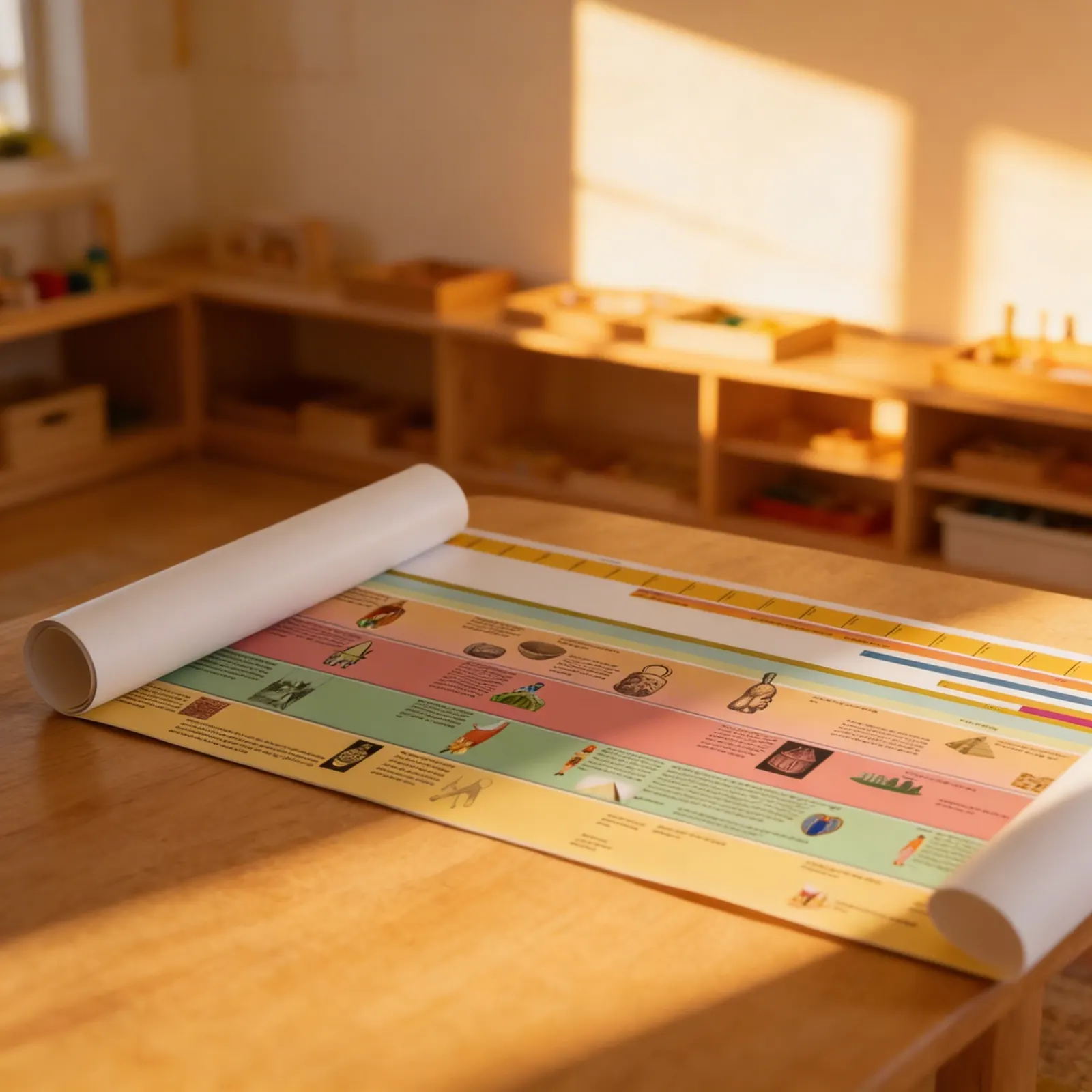
Timeline Of Ancient Civilizations (Large Display) in a child's hands
This large-format Timeline of Ancient Civilizations transforms abstract historical concepts into a visual journey through time. The 150cm-wide display features color-coded bands representing major civilizations, with a chronological ruler and beautifully illustrated artifacts that help children grasp the flow of human history. A good match for classroom walls, this educational chart supports the Montessori cultural curriculum by presenting complex temporal relationships in an accessible, visually engaging format.
Historical Understanding
Develops awareness of chronological relationships and the progression of human civilizations through visual representation.
Cultural Awareness
Introduces diverse civilizations and their contributions, fostering respect for different cultures and historical periods.
Visual Learning
Supports visual learners by presenting complex temporal concepts through color-coding and illustrated symbols.
Time Concept Development
Helps children understand abstract time concepts by providing a concrete visual reference for 'before' and 'after' relationships.
How to present it
Mount the timeline at child's eye level on a wall where children can approach closely. Ensure good lighting highlights the color bands and illustrations. Place a pointer or ruler nearby for tracing along the timeline.
- 1Begin at the far left of the timeline, explaining this represents the oldest time
- 2Introduce one civilization band at a time, naming it and tracing its length
- 3Point out where civilizations overlap on the timeline
- 4Examine the illustrated artifacts for one civilization together
- 5Practice 'time travel' by moving along the ruler from past to present
3 tips for parents
- When visiting museums, help your child identify which timeline band the artifacts belong to
- Create a family timeline at home using the same left-to-right format to reinforce temporal understanding
- Use the civilization colors when reading history books - 'This story is from the blue band time'

If you are not sure it suits your child, we answer in person.
Norbert Kovalčín, founder of Faborino · write to him
There is no review here yet. We will ask you for one after you buy. Write the first review
What's in the Box
- Timeline Chart: Large laminated display (150 × 100 cm)
Size and material
| Packaging | 38 × 7 × 7 cm |
| Surface | Laminated paper |
| Backing | Rigid cardboard |
| Recommended Age | 6-12 years |
Care
Wipe with damp cloth, avoid harsh cleaners
Frequently Asked Questions
What specific ancient civilizations are featured on this timeline display?
The timeline includes color-coded bands for major civilizations including Ancient Egypt, Mesopotamia, Greece, Rome, China, and the Indus Valley. Each civilization is represented with authentic illustrated artifacts and key historical markers along the chronological ruler.
How is this timeline appropriate for children ages 3-6 when ancient history seems advanced?
In Montessori education, young children are introduced to broad concepts through visual and concrete materials. This timeline uses colors, images, and simple visual relationships to help children understand that people lived long ago, preparing them for more detailed historical study in elementary years.
What are the exact dimensions and mounting requirements for this display?
The timeline measures 150cm wide and is designed as a large-format wall display. It comes with mounting instructions and can be hung using standard classroom display methods. The height varies depending on the specific model but is typically between 60-80cm.
How does this timeline support the Montessori cultural curriculum?
This material aligns with Montessori's cosmic education approach by giving children a visual impression of human history's vastness. It supports lessons on the fundamental needs of humans, introduces the concept of time, and provides a foundation for understanding cultural diversity and human achievement.
What activities can teachers do with this timeline beyond wall display?
Teachers can use the timeline for group lessons on sequencing, matching artifact cards to civilizations, creating simple timelines of children's own lives in comparison, discussing basic needs across civilizations, and introducing vocabulary related to time (before/after, long ago, ancient).
Product safety
Manufacturer: Nienhuis Montessori, Anders Celsiusstraat 15, 7442 PB Nijverdal, Netherlands
Timeline Of Ancient Civilizations (Large Display)