
Timeline Of Communication (Large Display)
The first photo is the maker's own. The other shots are illustrative.
Inv. no. NIE-TL025
- Maker
- Nienhuis Montessori, since 1929
- Base Material
- Heavy-duty paper
- Surface
- Laminated coating
- EAN
- 8719924044640
Final price incl. VAT. Free delivery.
Advice, warranty and returns are handled by us.
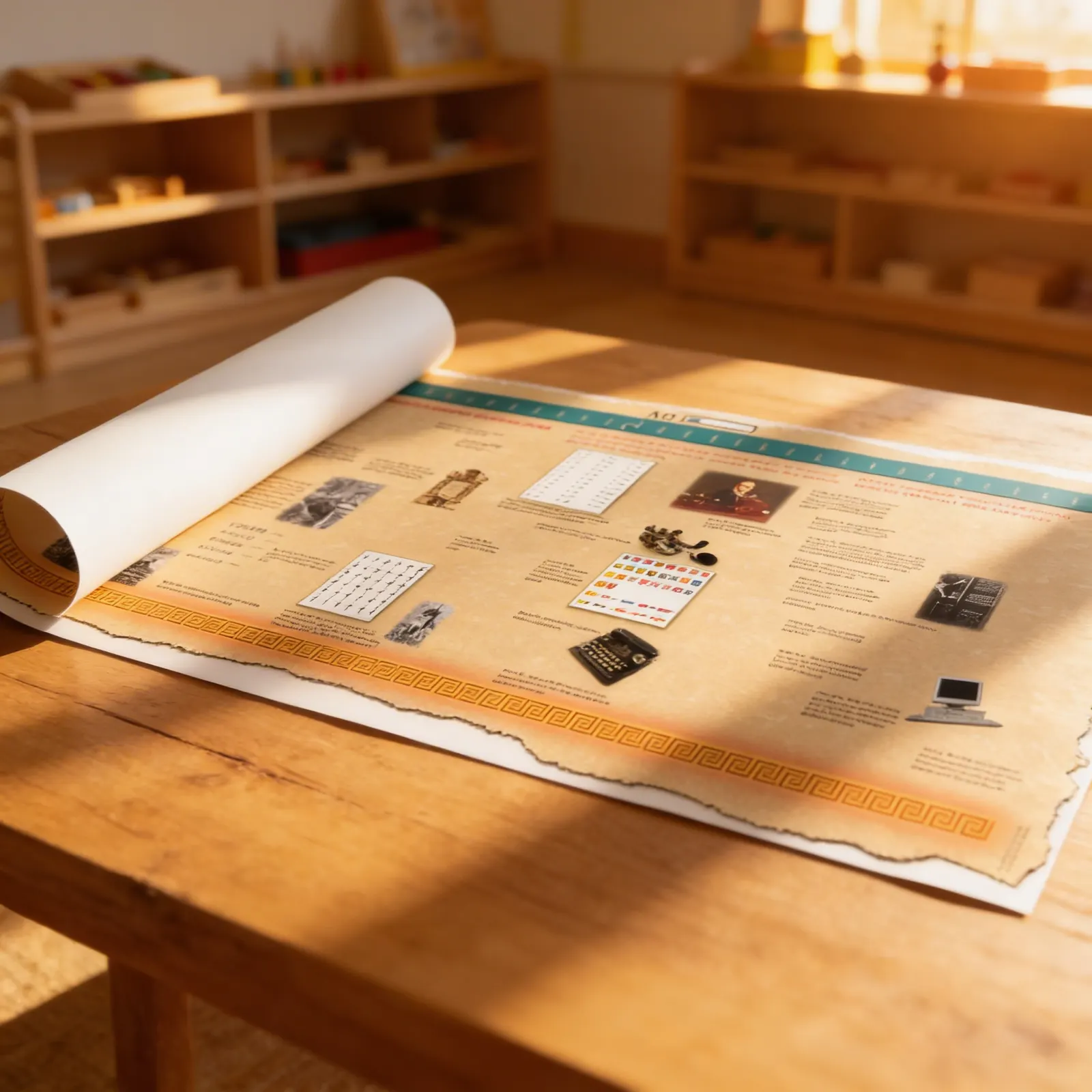
Timeline Of Communication (Large Display) in a child's hands
The Timeline of Communication, from the earliest marks people made to the way messages travel now. It belongs with the great lesson of language, and it does something a lesson cannot: it shows how recent writing is. A child who has walked the timeline of life and then finds writing crammed into the last fraction of this one has understood the scale without being told it. Large display, durable plastic. The other timelines are separate items.
Historical Understanding
Develops awareness of human progress and technological advancement through visual timeline representation.
Cultural Awareness
Introduces diverse communication methods across different civilizations and time periods.
Sequential Thinking
Strengthens understanding of chronological order and cause-and-effect relationships in human development.
Language Development
Enriches vocabulary with historical and technological terminology while discussing communication evolution.
How to present it
Mount the timeline at child's eye level on a wall where children can approach closely. Place a small basket nearby containing objects or replica items that match some timeline images (toy telephone, paper and pencil, small drum).
- 1Invite the child to explore the timeline, starting at the beginning with cave paintings
- 2Point to specific images and ask the child what they notice about how people communicated
- 3Connect timeline images to the child's own experiences with communication
- 4Encourage the child to find patterns or similarities between different time periods
3 tips for parents
- Point out communication methods you use at home that appear on the timeline, making history relevant to daily life
- Visit museums or historical sites where children can see actual artifacts from the timeline
- Create simple communication experiments at home, like making paper telephones or writing with different tools

If you are not sure it suits your child, we answer in person.
Norbert Kovalčín, founder of Faborino · write to him
There is no review here yet. We will ask you for one after you buy. Write the first review
What's in the Box
- Timeline poster: Large format educational display
Size and material
| Packaging | 46 × 6 × 6 cm |
| Base Material | Heavy-duty paper |
| Surface | Laminated coating |
| Recommended Age | 6-12 years |
Care
Wipe with damp cloth, avoid abrasive cleaners
Frequently Asked Questions
What size is this Timeline of Communication display and how is it mounted?
This is a large-format poster designed for classroom wall display. The laminated surface makes it durable and easy to clean. Most teachers mount it at child eye level using poster strips or in a frame, allowing children to examine the images closely during lessons or independent exploration.
How does this timeline support Montessori cultural studies for ages 3-6?
The timeline introduces fundamental concepts of human progress and technological development through visual storytelling. It connects to Montessori's cosmic education by showing how humans have solved communication challenges throughout history, fostering appreciation for human creativity and cultural achievements while developing sequential thinking skills.
What specific communication methods are depicted on this timeline?
The timeline features chronologically arranged images including cave paintings, hieroglyphics, early writing systems, printing press, telegraph, telephone, radio, television, and modern digital devices. Each image is clearly labeled and positioned to show the progression of communication technology through different historical periods.
How can teachers effectively present this material to young children?
Begin with simple three-period lessons focusing on a few communication methods at a time. Use concrete objects or replicas when possible to complement the images. Encourage children to relate historical methods to their own experiences with communication, and create extension activities like making their own cave paintings or writing with different tools.
What related materials work well with this timeline display?
This timeline pairs excellently with fundamental needs of humans materials, timeline of life, and other cultural studies resources. Consider adding books about communication history, writing materials from different cultures, replica artifacts, and hands-on activities that allow children to experience historical communication methods firsthand.
Product safety
Manufacturer: Nienhuis Montessori, Anders Celsiusstraat 15, 7442 PB Nijverdal, Netherlands
Timeline Of Communication (Large Display)