
Timeline Of Early Humans (Large Display)
The first photo is the maker's own. The other shots are illustrative.
Inv. no. NIE-TL026
- Maker
- Nienhuis Montessori, since 1929
- Surface
- Laminated paper
- Base Material
- Heavy-duty poster stock
- EAN
- 8719924044657
Final price incl. VAT. Free delivery.
Advice, warranty and returns are handled by us.
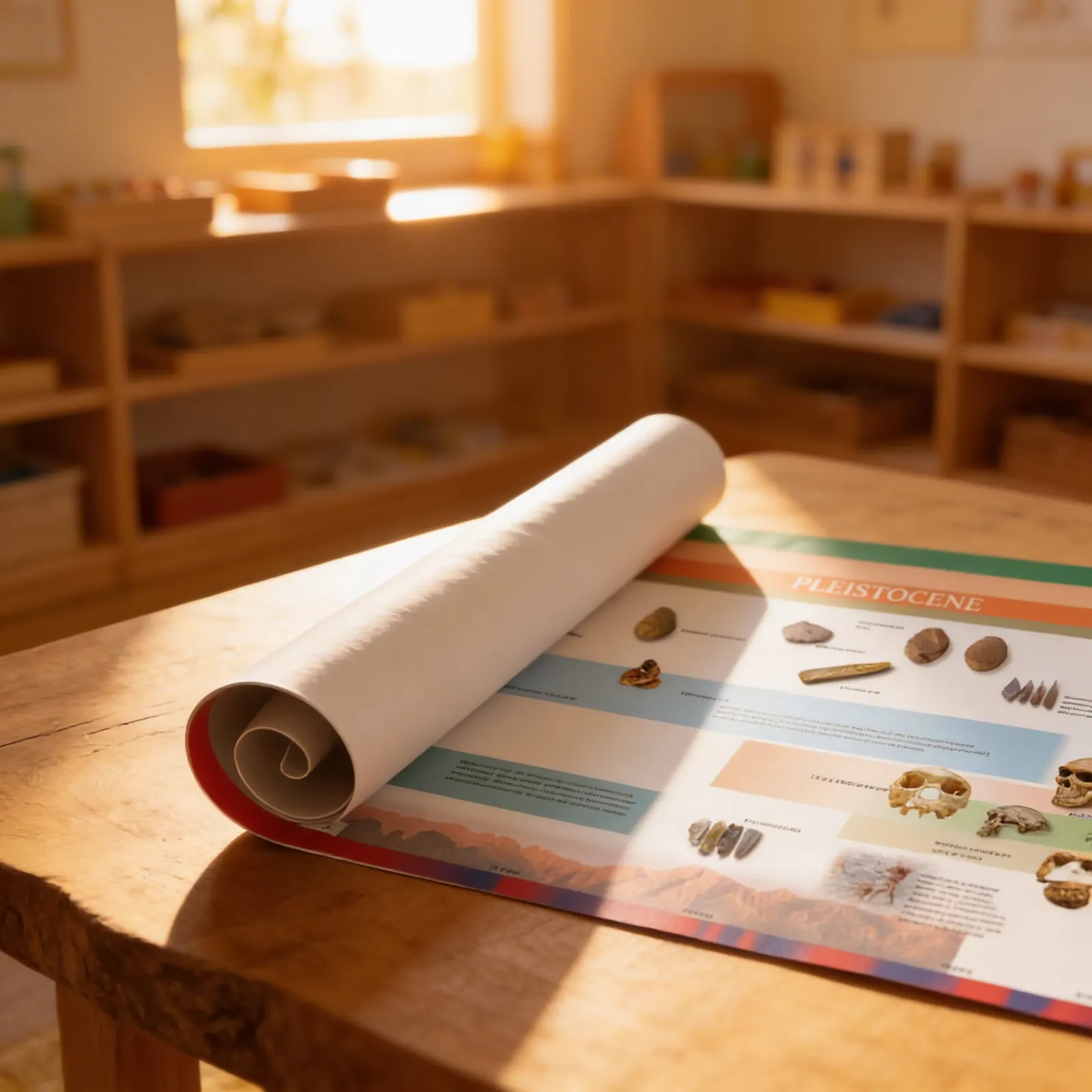
Timeline Of Early Humans (Large Display) in a child's hands
The Timeline of Early Humans, following the line from the early Australopithecines to modern humans, and built on current research rather than the version most adults were taught. That matters here more than on any other timeline: this is the part of the story that has changed most in the last thirty years, and a chart printed from memory would be wrong in specific, checkable ways. Large display, durable plastic. The other timelines are separate items.
Historical Understanding
Introduces concepts of time, sequence, and human prehistory through visual timeline representation.
Scientific Thinking
Develops observation skills through detailed study of fossils, tools, and evolutionary changes.
Cultural Awareness
Builds foundation for understanding human origins and the development of early civilizations.
Visual Discrimination
Enhances ability to notice details and differences in skull structures and tool developments.
How to present it
Mount the timeline at child eye level along a wall or lay flat on a large work mat. Ensure adequate lighting for examining detailed fossil illustrations and skull representations.
- 1Begin at the earliest geological period band, inviting children to observe the first stone tools
- 2Move chronologically through each period, pausing to examine skull representations
- 3Compare stone tool artifacts across different time periods
- 4Trace the timeline with finger from past to present
3 tips for parents
- Visit natural history museums to see real fossils and stone tools that match timeline images
- Collect stones during nature walks to explore how early humans selected materials for tools
- Share family photos spanning generations to reinforce timeline concepts at a personal scale

If you are not sure it suits your child, we answer in person.
Norbert Kovalčín, founder of Faborino · write to him
There is no review here yet. We will ask you for one after you buy. Write the first review
What's in the Box
- Timeline Display: Large format laminated poster
Size and material
| Packaging | 43 × 6 × 6 cm |
| Surface | Laminated paper |
| Base Material | Heavy-duty poster stock |
| Recommended Age | 6-12 years |
Care
Wipe with damp cloth, dry immediately
Frequently Asked Questions
Is this timeline appropriate for 3-6 year olds given its complex subject matter?
Yes, this timeline is specifically designed for early learners. It uses visual representations like fossil illustrations and simple educational text blocks that make prehistoric concepts accessible to young children. The large format and laminated surface also make it perfect for hands-on exploration typical of this age group.
What specific time periods and early humans are featured on this timeline?
The timeline focuses on the Pleistocene era and includes representations of various early human species through fossil illustrations and prehistoric human skull representations. It also features stone tool artifacts that help children understand the progression of early human development.
How large is this display and how should it be mounted?
This is a large-format display designed to be prominently featured in your learning environment. The laminated surface makes it durable for wall mounting or floor use. Its size allows multiple children to gather around and explore the timeline together, promoting collaborative learning.
How does this timeline support Montessori learning principles?
This timeline aligns with Montessori's cosmic education approach by presenting human history in a visual, concrete way. It helps children develop a sense of time, understand their place in history, and satisfies their natural curiosity about human origins through hands-on, self-directed exploration.
What complementary materials work well with this timeline?
This timeline pairs excellently with the Timeline of Life, fossil collections, early human figurines, and books about prehistory. It can also be used alongside geography materials to show where early humans lived and migrated, creating an integrated learning experience.
Product safety
Manufacturer: Nienhuis Montessori, Anders Celsiusstraat 15, 7442 PB Nijverdal, Netherlands
Timeline Of Early Humans (Large Display)