
Timeline Of History Of Numbers (Large Display)
The first photo is the maker's own. The other shots are illustrative.
Inv. no. NIE-TL023
- Maker
- Nienhuis Montessori, since 1929
- Base Material
- Heavy-duty paper
- Finish
- Laminated coating
- EAN
- 8719924044619
Final price incl. VAT. Free delivery.
Advice, warranty and returns are handled by us.
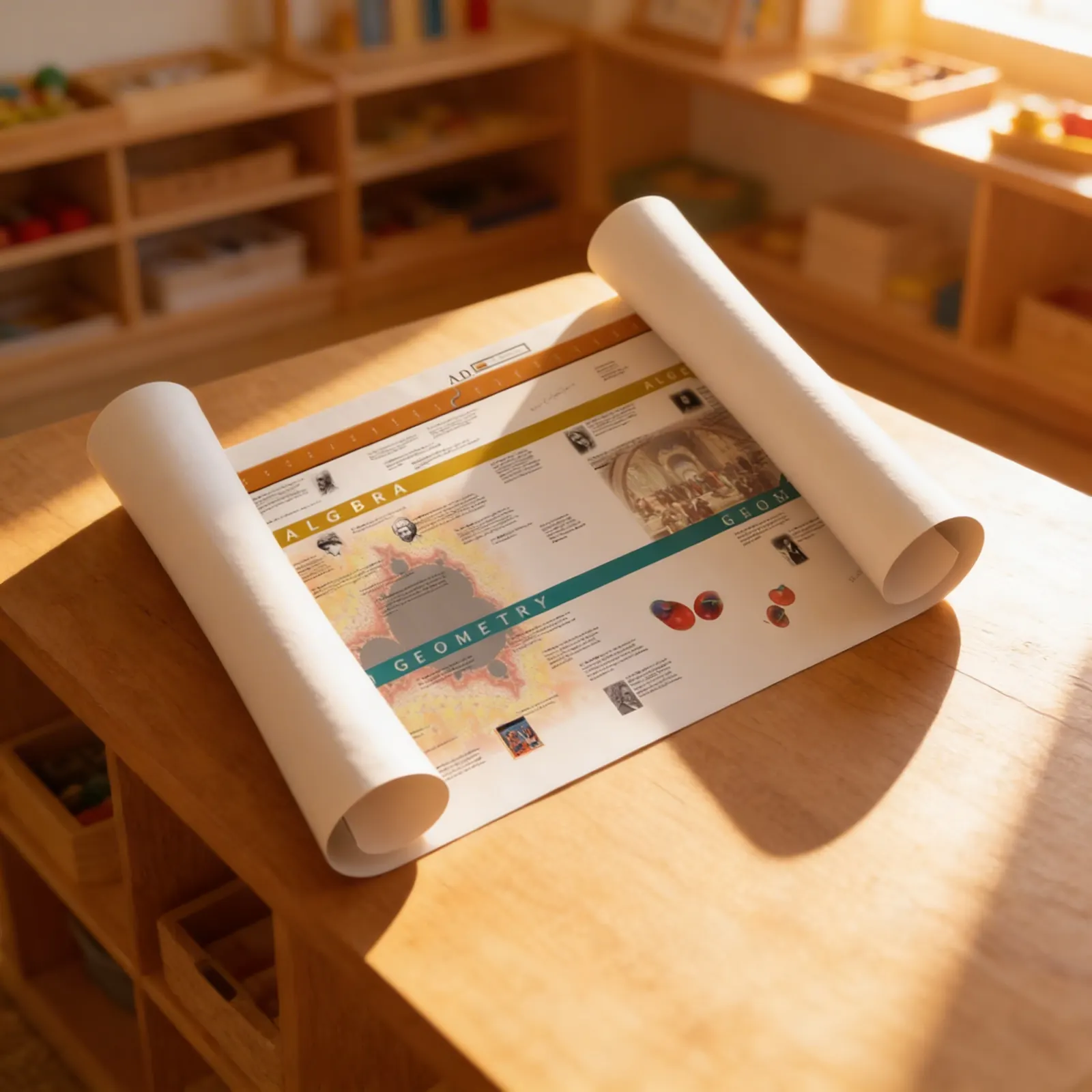
Timeline Of History Of Numbers (Large Display) in a child's hands
For hands-on mathematics, this large-format Timeline of History of Numbers presents a comprehensive visual journey through the development of numerical systems across civilizations. The color-coded timeline features historical images and text organized in chronological bands, helping children understand how different cultures contributed to our modern number system. A good match for classroom walls, this laminated poster serves as a constant reference for exploring mathematical history.
Historical Understanding
Introduces children to the concept that mathematics has evolved over thousands of years across different cultures.
Visual Learning
Large format with images and color coding supports visual learners in grasping abstract historical concepts.
Cultural Awareness
Shows contributions from various civilizations, fostering appreciation for global mathematical heritage.
Sequential Thinking
Timeline format develops understanding of chronological order and historical progression.
How to present it
Mount the timeline at child eye-level on a prominent classroom wall. Ensure adequate lighting and clear access for small groups. Place a small rug or cushions nearby for seated observation sessions.
- 1Introduce the timeline by pointing to familiar numbers in the modern section, then trace backwards to show their origins
- 2Focus on one civilization's band, examining their unique symbols and discussing what made their system special
- 3Create matching games where children find the same quantity represented in different number systems across the timeline
- 4Encourage children to copy historical number symbols on paper or chalkboards during free exploration
3 tips for parents
- Ask your child to show you different ways people wrote numbers throughout history during school visits
- Look for numbers in everyday life and discuss which system they come from (Roman numerals on clocks, for example)
- Support interest by finding library books about ancient civilizations and their counting methods

If you are not sure it suits your child, we answer in person.
Norbert Kovalčín, founder of Faborino · write to him
There is no review here yet. We will ask you for one after you buy. Write the first review
What's in the Box
- Timeline Poster: Rolled format for shipping
Size and material
| Packaging | 46 × 6 × 6 cm |
| Base Material | Heavy-duty paper |
| Finish | Laminated coating |
| Recommended Age | 6-12 years |
Care
Wipe with damp cloth, avoid harsh chemicals
Frequently Asked Questions
What age group is this Timeline of History of Numbers designed for?
This timeline is specifically designed for children ages 3-6 years old. It presents mathematical history in a visual, accessible way that young children can understand and explore, making it ideal for Casa/Children's House environments.
What are the dimensions and materials of this timeline?
This is a large-format display poster that's laminated for durability. The lamination protects it from daily classroom use and allows for easy cleaning. The large size makes it perfect for wall mounting where children can easily see and reference it.
How does this timeline support Montessori mathematics curriculum?
The timeline provides cultural and historical context for mathematical concepts, helping children understand that numbers were developed by real people across different civilizations. This connects mathematics to human history and cultural studies, supporting the Montessori approach of integrated learning.
What civilizations and number systems are included?
The timeline features multiple civilizations and their contributions to number systems, presented in color-coded chronological bands. It shows how different cultures developed and used numbers, from ancient systems to our modern numerals, with historical images and explanatory text.
How can teachers use this timeline in daily lessons?
Teachers can reference the timeline during number work, cultural studies, and history lessons. Children can explore which civilization created specific number symbols, compare different counting systems, and understand how mathematical knowledge evolved over time. It serves as a constant visual reference that enriches mathematical discussions.
Product safety
Manufacturer: Nienhuis Montessori, Anders Celsiusstraat 15, 7442 PB Nijverdal, Netherlands
Timeline Of History Of Numbers (Large Display)