
Timeline Of Life
The first photos are the maker's own. The other shots are illustrative.
Inv. no. NIE-523121
- Maker
- Nienhuis Montessori, since 1929
- Material
- Polymer
- EAN
- 8719924026394
Final price incl. VAT. Delivery €5.90, €135.80 to go for free delivery.
Advice, warranty and returns are handled by us.
Timeline Of Life in a child's hands
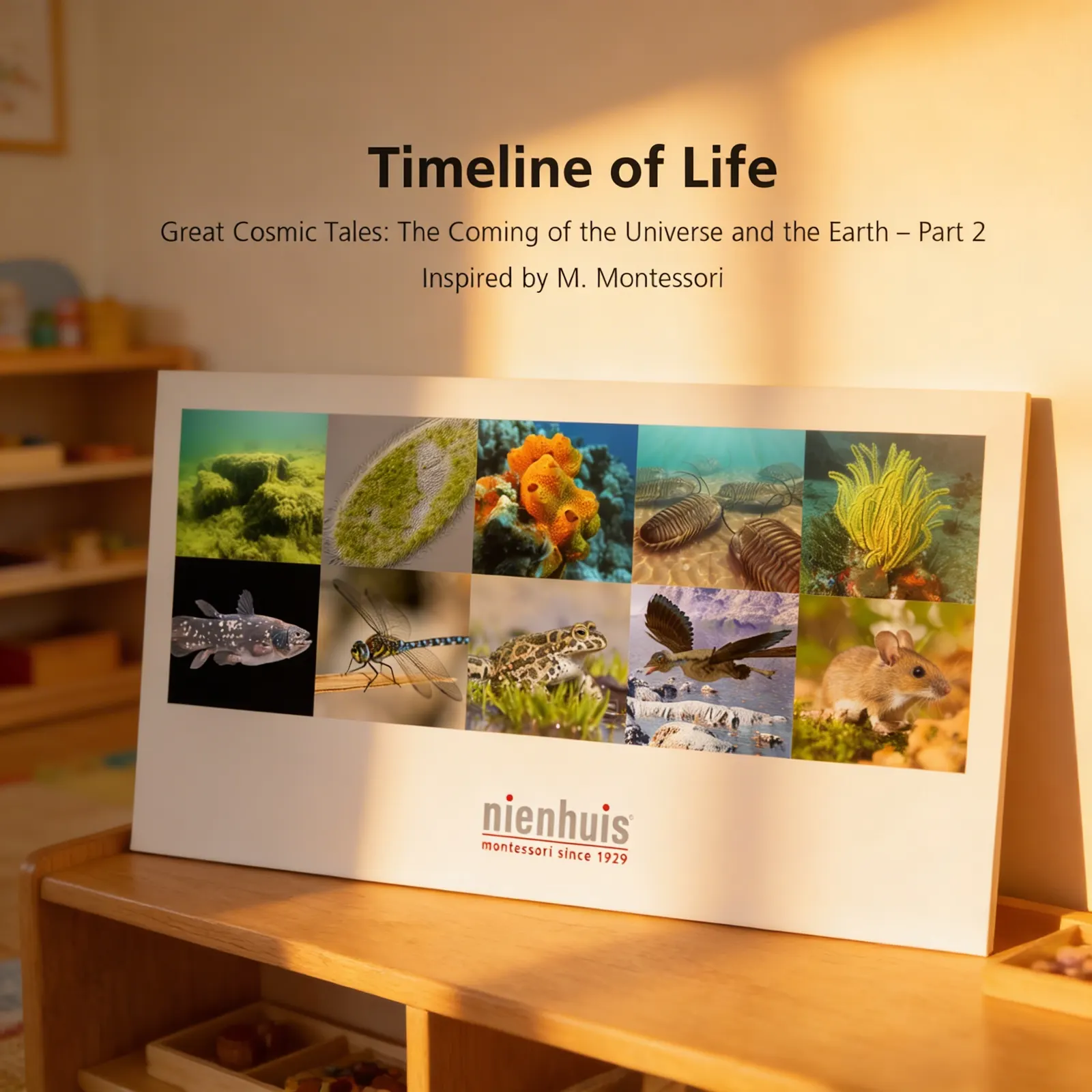
Opening windows to the wider world, this large-format Timeline of Life poster puts children in direct contact with the evolution of organisms through carefully selected photographic images. Designed for the Montessori Cultural curriculum, it presents ten key life forms arranged chronologically, helping children understand the progression from simple to complex organisms while developing their sense of time and biological relationships.
Scientific Understanding
Introduces fundamental concepts of evolution and biological development through visual representation
Temporal Awareness
Develops understanding of chronological progression and the concept of deep time
Classification Skills
Supports categorization of living things and recognition of relationships between organisms
Visual Learning
Photographic images provide concrete representations for abstract evolutionary concepts
How to present it
Unroll the Timeline of Life poster on a large floor mat or low table where children can walk around all sides. Ensure adequate lighting to see photographic details clearly.
- 1Begin at the timeline's starting point, inviting the child to observe the first life form photograph
- 2Move slowly along the timeline, pausing at each photograph to name the organism
- 3Point out visible differences between consecutive life forms
- 4When reaching familiar animals, connect them to the child's experience
- 5Conclude by showing how the timeline leads to present day
3 tips for parents
- Visit natural history museums to see real fossils and specimens from the timeline periods
- Look for picture books about prehistoric life that complement the timeline's images
- During nature walks, discuss how plants and animals have changed over time

If you are not sure it suits your child, we answer in person.
Norbert Kovalčín, founder of Faborino · write to him
There is no review here yet. We will ask you for one after you buy. Write the first review
What's in the Box
- Timeline of Life Poster: Plastic educational poster
Size and material
| Packaging | 15 × 14 × 1 cm |
| Material | Polymer |
| Recommended Age | 6-12 years |
Care
Wipe with damp cloth, avoid harsh chemicals
Frequently Asked Questions
What material is the Timeline of Life poster made from?
The Timeline of Life is a large-format poster designed for classroom wall display. It features high-quality photographic images printed on plastic and is intended for children aged 6-12.
Which organisms are featured on the timeline and how are they arranged?
The timeline presents ten carefully selected life forms arranged chronologically from simple to complex organisms. Each organism is represented by a clear photographic image, showing the progression of life from early single-celled organisms to more complex life forms.
How does this material support the Montessori Cultural curriculum?
This timeline directly supports Montessori Cultural studies by providing a visual representation of evolutionary history. It helps children develop understanding of time, sequence, and biological relationships while introducing fundamental concepts about the development of life on Earth.
What age group is this timeline designed for and how is it used?
Designed for children ages 6-12, the timeline can be used for group presentations, individual exploration, and as a reference during other cultural activities. Teachers typically present it as part of the Great Lessons or when introducing concepts of time and evolution.
How does this timeline help children understand complex scientific concepts?
By presenting evolution through simple visual progression, children can grasp the concept of change over time without requiring advanced reading skills. The photographic images make abstract concepts concrete, allowing young learners to see relationships between different life forms.
Product safety
Manufacturer: Nienhuis Montessori, Anders Celsiusstraat 15, 7442 PB Nijverdal, Netherlands
Timeline Of Life