
Timeline Of Life (Working)
The first photo is the maker's own. The other shots are illustrative.
Inv. no. NIE-TL024W
- Maker
- Nienhuis Montessori, since 1929
- Primary Material
- Paper
- Finish
- Laminated surface
- EAN
- 8719924044633
Final price incl. VAT. Free delivery.
Advice, warranty and returns are handled by us.
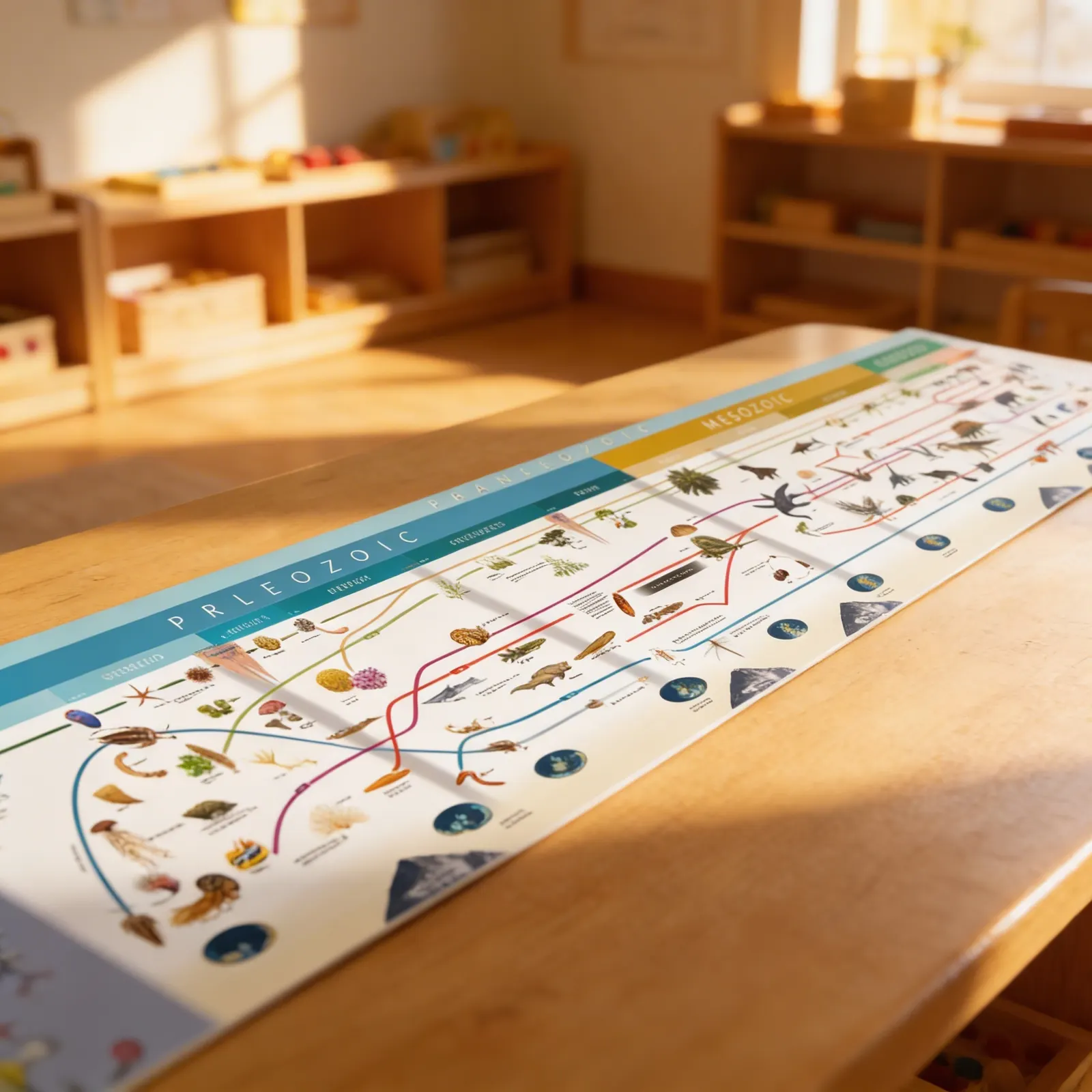
Timeline Of Life (Working) in a child's hands
The working Timeline of Life, the version a child builds rather than reads. It comes with a control timeline, a mute timeline, movable pieces and labels, which is the whole method in four parts: the child lays pieces on the blank one, checks against the filled one and corrects without being told. Life on earth is too long to be understood as a story, so it is laid out as a length instead. The eras and history timelines are separate items.
Cosmic Education
Introduces children to the grand narrative of life on Earth, fostering wonder about natural history and our place in the universe.
Time Comprehension
Develops understanding of vast time scales and sequential thinking through visual representation of geological periods.
Scientific Classification
Builds foundation for understanding evolution, adaptation, and the interconnectedness of all living things.
Historical Perspective
Connects abstract concepts of time to concrete illustrations, supporting the child's developing sense of history and change.
How to present it
Unroll the timeline on a large floor space or mount on wall at child height. Ensure good lighting for examining detailed illustrations. Have reference books about prehistoric life nearby.
- 1Begin at the timeline's start, examining the first life forms in the Paleozoic era
- 2Follow the progression arrows to trace how life moved from water to land
- 3Compare creatures from different periods, noting similarities and differences
- 4Create impression drawings of favorite prehistoric creatures from specific eras
3 tips for parents
- Visit natural history museums to see fossils from periods shown on the timeline
- Watch nature documentaries focusing on one geological era at a time
- Collect rocks and discuss which timeline period they might be from

If you are not sure it suits your child, we answer in person.
Norbert Kovalčín, founder of Faborino · write to him
There is no review here yet. We will ask you for one after you buy. Write the first review
What's in the Box
- Timeline of Life poster: 150×40 cm laminated educational chart
Size and material
| Packaging | 42 × 29 × 14 cm |
| Primary Material | Paper |
| Finish | Laminated surface |
| Recommended Age | 6-12 years |
Care
Wipe with damp cloth, avoid excessive moisture
Frequently Asked Questions
What are the dimensions and format of the Timeline of Life?
The Timeline of Life is typically presented as a long, rolled chart measuring approximately 5-7 meters in length, allowing children to unroll it on the floor for full visual impact. The working version includes durable laminated material suitable for repeated classroom use.
How does this material support the Montessori cosmic education curriculum?
This timeline is a cornerstone of cosmic education, presenting the second great lesson about the coming of life. It helps children visualize the progression of life forms across millions of years, connecting to lessons in biology, geology, and natural history while fostering a sense of wonder about Earth's development.
What specific geological periods and life forms are illustrated?
The timeline covers all major geological eras from the Paleozoic (including Cambrian, Ordovician, Silurian, Devonian, Carboniferous, and Permian), through the Mesozoic (Triassic, Jurassic, Cretaceous), to the Cenozoic era. Each period features accurate illustrations of representative life forms, from early marine organisms to dinosaurs to mammals.
What extension activities can be done with this timeline?
Children can create their own timelines focusing on specific periods, research individual prehistoric creatures, make fossil impressions, create dioramas of different eras, write stories about prehistoric life, and connect the timeline to studies of evolution, extinction events, and environmental changes throughout Earth's history.
How is the 'working' version different from display versions?
The working version is designed for hands-on student use with durable, wipeable surfaces that can withstand frequent handling. It may include blank sections for children to add their own research, removable labels for matching activities, and supplementary cards for sorting exercises, making it an interactive learning tool rather than just a visual reference.
Product safety
Manufacturer: Nienhuis Montessori, Anders Celsiusstraat 15, 7442 PB Nijverdal, Netherlands
Timeline Of Life (Working)