
Toddler Puzzle3 Melons
The first photo is the maker's own. The other shots are illustrative.
Inv. no. NIE-044570
- Maker
- Nienhuis Montessori, since 1929
- Approval
- AMI
- Product size
- 294 × 120 mm
- Base Material
- Birch plywood
- Surface
- Printed laminate imagery
- EAN
- 8719924046200
Final price incl. VAT. Delivery €5.90, €127.10 to go for free delivery.
Advice, warranty and returns are handled by us.
Why it costs €21.90
Behind the price of the original are things you can check yourself.
AMI approval
The material is approved by the Association Montessori Internationale (AMI). Nienhuis has made Montessori materials since 1929.
A verifiable original
The EAN 8719924046200 is on the box. It is the maker's number, not ours.
Toddler Puzzle in a child's hands
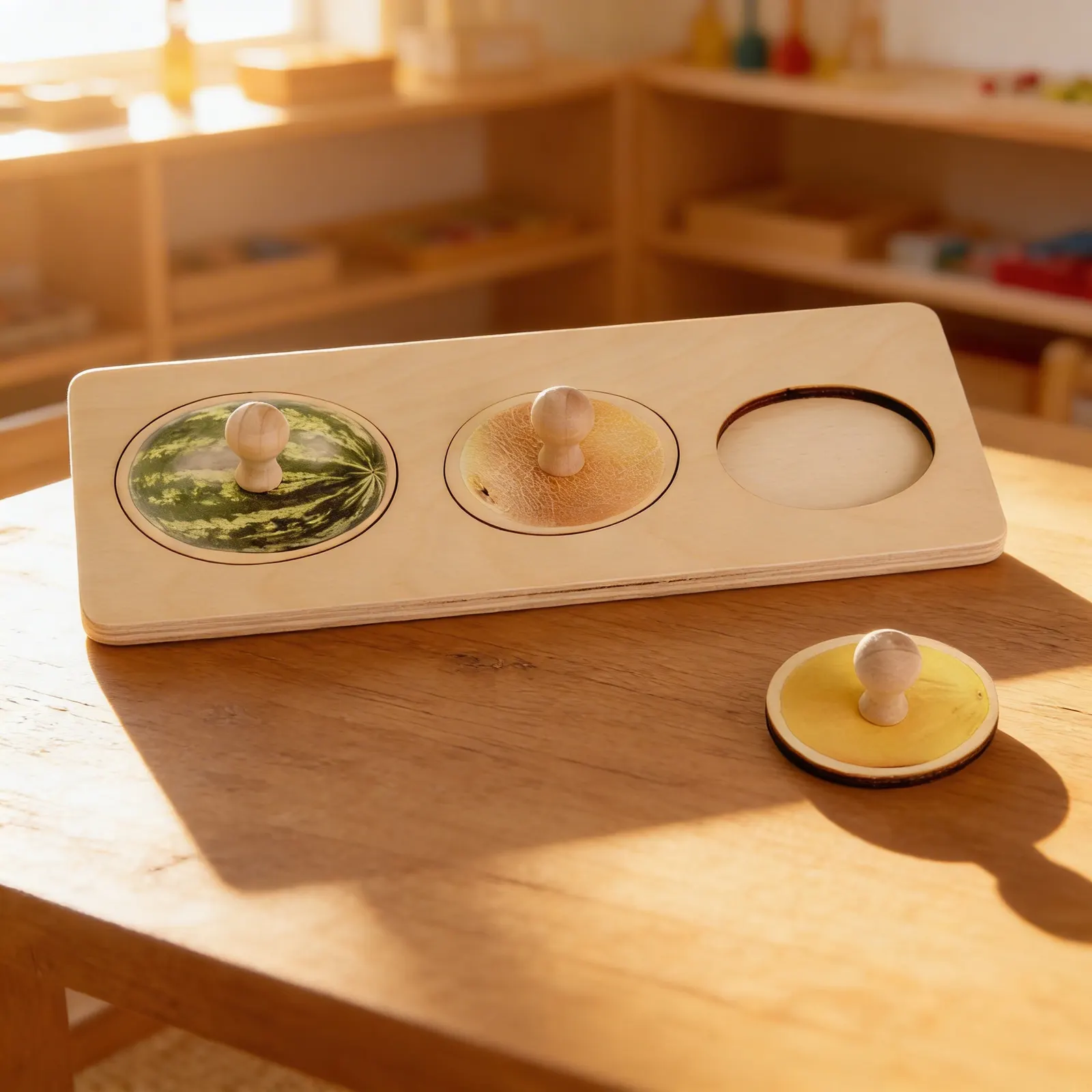
The puzzle with three melons shows realistic images of melons in the right proportions to one another, so a large melon can be told from a small one. It measures 294 × 120 mm and has three pieces. Nienhuis names birch plywood as the material and yellow and green as the colours. The child sets the pieces in one at a time and compares the sizes of the melons as they go. Wipe the puzzle with a slightly damp cloth and dry it at once. It weighs 300 g, is for indoor use and is for children aged 0 to 3.
Pincer Grasp Refinement
Large knob handles support the transition from palmer to pincer grasp, preparing the hand for later writing activities.
Visual Discrimination
Realistic melon imagery helps children distinguish between similar objects, developing observation skills essential for reading readiness.
Hand-Eye Coordination
Placing pieces in corresponding slots strengthens the connection between visual perception and controlled hand movements.
Concentration Development
The focused work of completing the puzzle builds attention span and persistence in young toddlers.
How to present it
Place the puzzle on a low shelf at child's eye level. Ensure all three melon pieces are correctly placed in the frame for initial presentation.
- 1Sit beside the child and slowly remove one melon piece using the knob
- 2Name the melon clearly: 'watermelon' while pointing to its distinctive features
- 3Place the piece beside the puzzle frame and remove the remaining pieces one by one
- 4Pick up the first removed piece and slowly return it to its space
- 5Continue replacing pieces in order, naming each melon
- 6Invite the child to remove and replace the pieces independently
3 tips for parents
- Point out melons during grocery shopping to reinforce puzzle vocabulary
- Let your child help prepare melon snacks to connect the puzzle images to real fruit
- Resist the urge to immediately help when pieces don't fit - allow exploration time

If you are not sure it suits your child, we answer in person.
Norbert Kovalčín, founder of Faborino · write to him
There is no review here yet. We will ask you for one after you buy. Write the first review
What's in the Box
- Wooden puzzle board: With 3 recessed circular slots
- 3 melon puzzle pieces: Each with large knob handle
Size and material
| Product size | 294 × 120 mm |
| Packaging | 30 × 12 × 4 cm |
| Base Material | Birch plywood |
| Surface | Printed laminate imagery |
| Knobs | Wooden handles |
| Recommended Age | 12-36 months |
Care
Wipe with slightly damp cloth, dry immediately
Frequently Asked Questions
What age is this melon puzzle suitable for?
This puzzle is designed for infants and toddlers ages 0-3 years. The oversized knobs make it ideal for babies as young as 8-10 months who are developing their pincer grasp, through age 3 as children refine their fine motor skills.
What skills does this puzzle help develop?
This puzzle supports multiple areas of development including fine motor skills, pincer grasp, hand-eye coordination, visual discrimination, problem-solving abilities, and concentration. It also introduces early concepts of matching and spatial relationships.
How big are the knob handles for small hands?
The knobs are specifically oversized and designed for toddler hands, typically measuring 1-1.5 inches in height. This makes them easy for young children to grasp, even those just beginning to develop their pincer grip.
Is this puzzle safe for babies who still put things in their mouth?
Yes, this puzzle is made of birch plywood. However, adult supervision is always recommended.
What are the three types of melons featured in this puzzle?
While specific varieties may vary, the puzzle typically features three distinct melon types with different colors and patterns, such as watermelon, cantaloupe, and honeydew. This variety helps children learn visual discrimination between similar objects.
Product safety
Manufacturer: Nienhuis Montessori, Anders Celsiusstraat 15, 7442 PB Nijverdal, Netherlands
Toddler Puzzle