
Toddler Puzzle5 Fruits
The first photo is the maker's own. The other shots are illustrative.
Inv. no. NIE-044590
- Maker
- Nienhuis Montessori, since 1929
- Approval
- AMI
- Product size
- 420 × 135 mm
- Base Material
- Plywood
- EAN
- 8719924046224
Final price incl. VAT. Delivery €5.90, €124.10 to go for free delivery.
Advice, warranty and returns are handled by us.
Why it costs €24.90
Behind the price of the original are things you can check yourself.
AMI approval
The material is approved by the Association Montessori Internationale (AMI). Nienhuis has made Montessori materials since 1929.
A verifiable original
The EAN 8719924046224 is on the box. It is the maker's number, not ours.
Toddler Puzzle in a child's hands
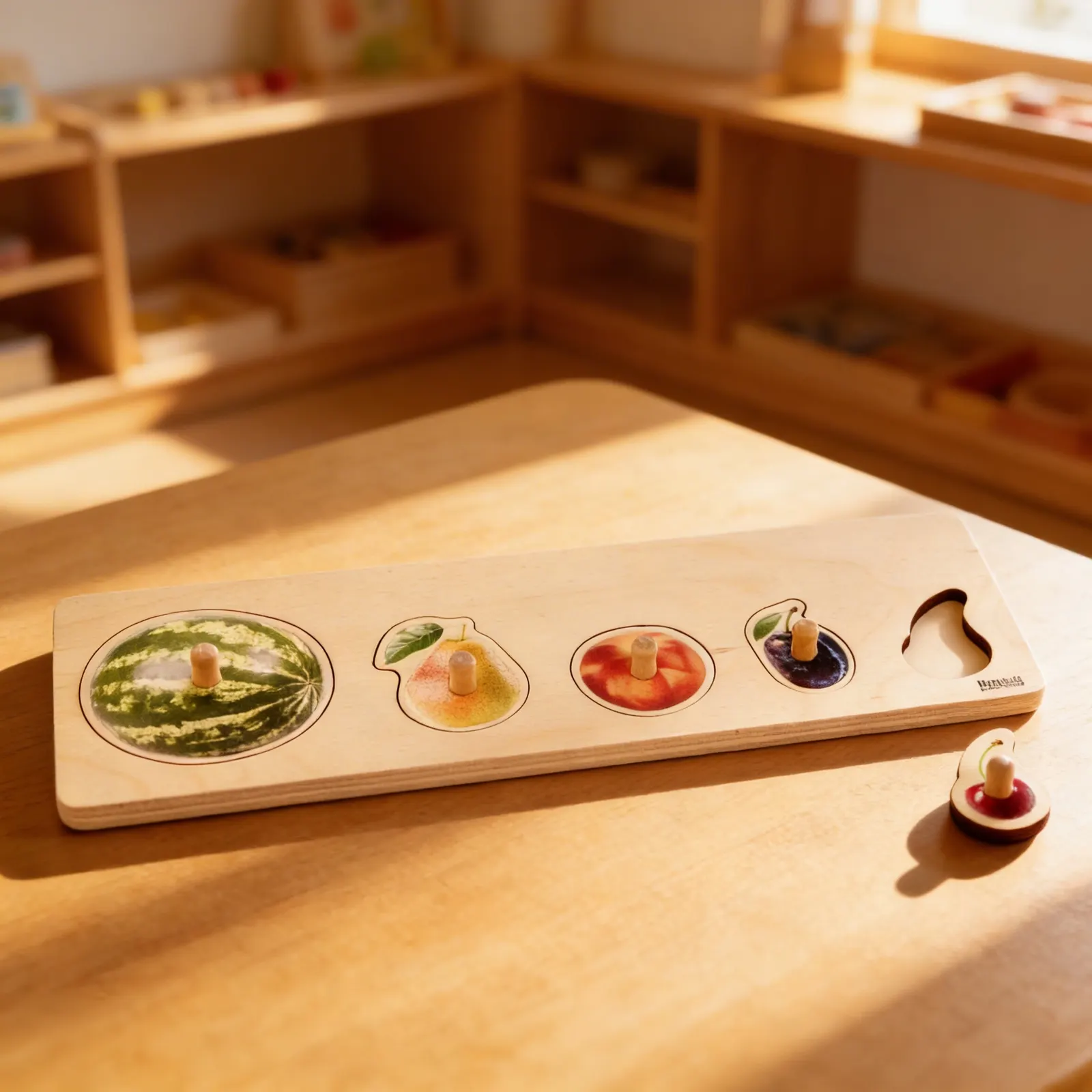
The toddler puzzle with five fruits is a wooden puzzle made of birch plywood. It measures 42 × 13.5 cm and has five pieces, one for each fruit. It shows realistic images of fruit in the right proportions to one another, so a large fruit and a small one can be told apart by size. The child takes a piece out, looks for the place it belongs to and puts it back in. The puzzle is meant for indoor use and weighs 400 g. Wipe it with a slightly damp cloth and dry it straight away. It is intended for children aged 0 to 3.
Fine Motor Control
Grasping the knobs and fitting pieces into their spaces strengthens pincer grip and hand muscles essential for later writing.
Visual Discrimination
Matching fruit shapes to their corresponding outlines develops visual perception and problem-solving abilities.
Language Development
Naming fruits and describing their characteristics enriches vocabulary and supports classification skills.
Concentration Building
The focused work of completing the puzzle helps extend attention span and develops persistence.
How to present it
Place the puzzle on a low shelf at child's eye level. Ensure all five fruit pieces are in their correct spaces initially. Have a small basket nearby for holding removed pieces.
- 1Sit beside the child and slowly remove one fruit piece using the knob, placing it gently in the basket
- 2Point to the empty space, then pick up the fruit piece and return it to its place
- 3Remove all pieces one by one, mixing them in the basket
- 4Invite the child to return one piece at a time to the board
- 5When complete, admire the finished puzzle together
3 tips for parents
- Practice naming these five fruits during grocery shopping or meal preparation
- Allow your child to work with the puzzle repeatedly, mastery comes through repetition
- Avoid praising completion; instead, observe quietly or comment on specific actions like 'You turned the banana to make it fit'

If you are not sure it suits your child, we answer in person.
Norbert Kovalčín, founder of Faborino · write to him
There is no review here yet. We will ask you for one after you buy. Write the first review
What's in the Box
- Wooden puzzle board: With 5 recessed fruit shapes
- 5 fruit puzzle pieces: Each with knob handle
Size and material
| Product size | 420 × 135 mm |
| Packaging | 42 × 14 × 3 cm |
| Base Material | Plywood |
| Recommended Age | 12-36 months |
Care
Wipe with slightly damp cloth, dry immediately
Frequently Asked Questions
What age is this fruit puzzle most appropriate for?
This puzzle is designed for children ages 12-36 months. The large knob handles are perfect for toddlers who are developing their pincer grasp, typically mastered between 12-18 months. The simple 5-piece design makes it an ideal first puzzle.
What are the five fruits included in this puzzle?
While the specific fruits may vary by manufacturer, typical Montessori fruit puzzles include common fruits children encounter daily such as apple, banana, orange, strawberry, and pear. Each piece is painted in realistic colors to support real-world connections.
How does this puzzle support Montessori learning principles?
This puzzle embodies key Montessori principles through its self-correcting design (each piece fits only in its designated space), isolation of difficulty (focusing solely on shape matching), and support for independent work. The realistic fruit representations connect abstract learning to concrete experiences.
What skills does this puzzle help develop?
This puzzle develops fine motor control, hand-eye coordination, shape recognition, and problem-solving skills. It also introduces vocabulary, supports visual discrimination, and builds concentration. The knob grasping motion strengthens the same muscles used for writing preparation.
Is the puzzle made from safe materials?
Quality Montessori puzzles are typically made from solid wood with non-toxic, water-based paints and finishes. The knobs should be firmly attached and sized to prevent choking hazards. Always verify that the product meets safety standards for your region.
Product safety
Manufacturer: Nienhuis Montessori, Anders Celsiusstraat 15, 7442 PB Nijverdal, Netherlands
Toddler Puzzle