
Toddler PuzzleCauliflower
The first photo is the maker's own. The other shots are illustrative.
Inv. no. NIE-044510
- Maker
- Nienhuis Montessori, since 1929
- Approval
- AMI
- Product size
- 245 × 145 mm
- Primary Material
- Plywood
- EAN
- 8719924046149
Final price incl. VAT. Delivery €5.90, €127.10 to go for free delivery.
Advice, warranty and returns are handled by us.
Why it costs €21.90
Behind the price of the original are things you can check yourself.
AMI approval
The material is approved by the Association Montessori Internationale (AMI). Nienhuis has made Montessori materials since 1929.
A verifiable original
The EAN 8719924046149 is on the box. It is the maker's number, not ours.
Toddler Puzzle in a child's hands
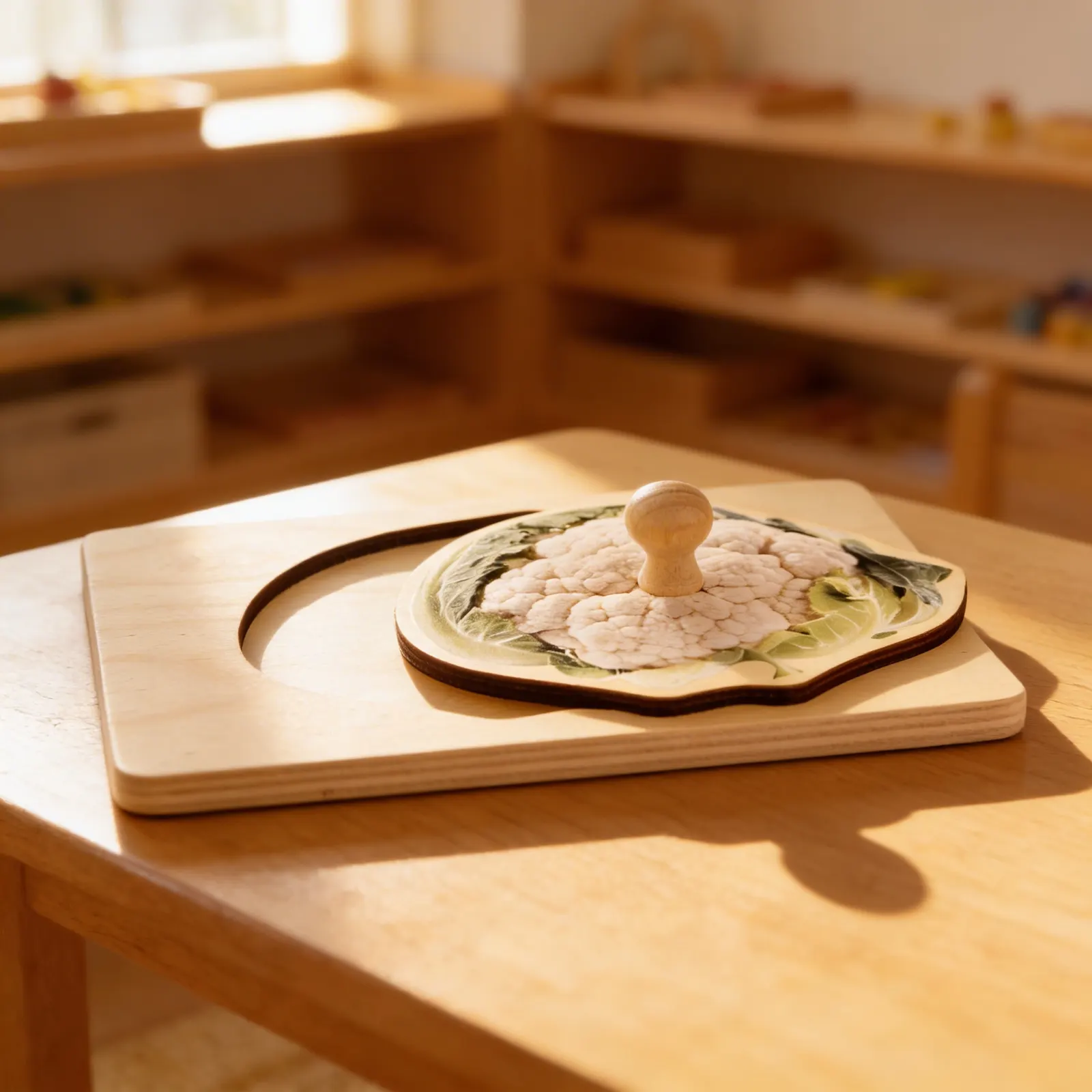
The cauliflower toddler puzzle shows the vegetable on a realistic photograph, not on a drawing, and measures 245 × 145 mm. According to Nienhuis it is made of birch plywood, has one piece and comes in green and white. The child takes the piece in the hand, looks at the picture, turns the piece until the outline fits and sets it into its place. Wipe the puzzle with a slightly damp cloth and dry it at once. It weighs 200 g, is meant for indoor use and is made for children aged 0 to 3.
Fine Motor Control
Grasping and placing puzzle pieces strengthens pincer grip and hand-eye coordination essential for later writing skills.
Visual Discrimination
Matching pieces to their corresponding spaces develops visual perception and spatial awareness.
How to present it
2 tips for parents
- Visit farmers' markets to see whole cauliflowers and connect to puzzle experience
- Allow unhurried exploration time - toddlers may spend 20 minutes on one puzzle

If you are not sure it suits your child, we answer in person.
Norbert Kovalčín, founder of Faborino · write to him
There is no review here yet. We will ask you for one after you buy. Write the first review
What's in the Box
- Puzzle: Cauliflower: 1 piece of birch plywood, 245 × 145 mm
Size and material
| Product size | 245 × 145 mm |
| Packaging | 21 × 14 × 4 cm |
| Primary Material | Plywood |
| Recommended Age | 18 months - 3 years |
Care
Wipe with slightly damp cloth, dry immediately
Frequently Asked Questions
What age is this cauliflower puzzle appropriate for?
This puzzle is designed for ages 0-3 years. Babies 6+ months can explore the smooth wooden pieces with supervision, while toddlers 18+ months can begin removing and replacing layers independently as their fine motor skills develop.
Is this puzzle safe for babies who are still mouthing objects?
Yes, the puzzle is made of birch plywood. However, adult supervision is always recommended for children under 3, especially during the mouthing stage.
How does this puzzle support Montessori learning principles?
This puzzle embodies Montessori principles by providing concrete, hands-on learning about nature. It isolates the concept of plant anatomy, encourages independent exploration, and connects children to real-world objects through beautiful, realistic representations.
What skills does this cauliflower puzzle help develop?
The puzzle develops fine motor control, hand-eye coordination, spatial reasoning, and problem-solving skills. It also introduces early science concepts about plant structure and supports vocabulary development as children learn parts of vegetables.
Product safety
Manufacturer: Nienhuis Montessori, Anders Celsiusstraat 15, 7442 PB Nijverdal, Netherlands
Toddler Puzzle