
Tone Bar / Bell Table
The first photo is the maker's own. The other shots are illustrative.
Inv. no. NIE-191000
- Maker
- Nienhuis Montessori, since 1929
- Approval
- AMI
- Primary Material
- Plywood construction
- Surface Finish
- Laminated wood
- EAN
- 8719924017750
Final price incl. VAT. Delivery €5.90 (heavy item).
Advice, warranty and returns are handled by us.
Why it costs €596.90
Behind the price of the original are things you can check yourself.
AMI approval
The material is approved by the Association Montessori Internationale (AMI). Nienhuis has made Montessori materials since 1929.
A verifiable original
The EAN 8719924017750 is on the box. It is the maker's number, not ours.
Tone Bar / Bell Table in a child's hands
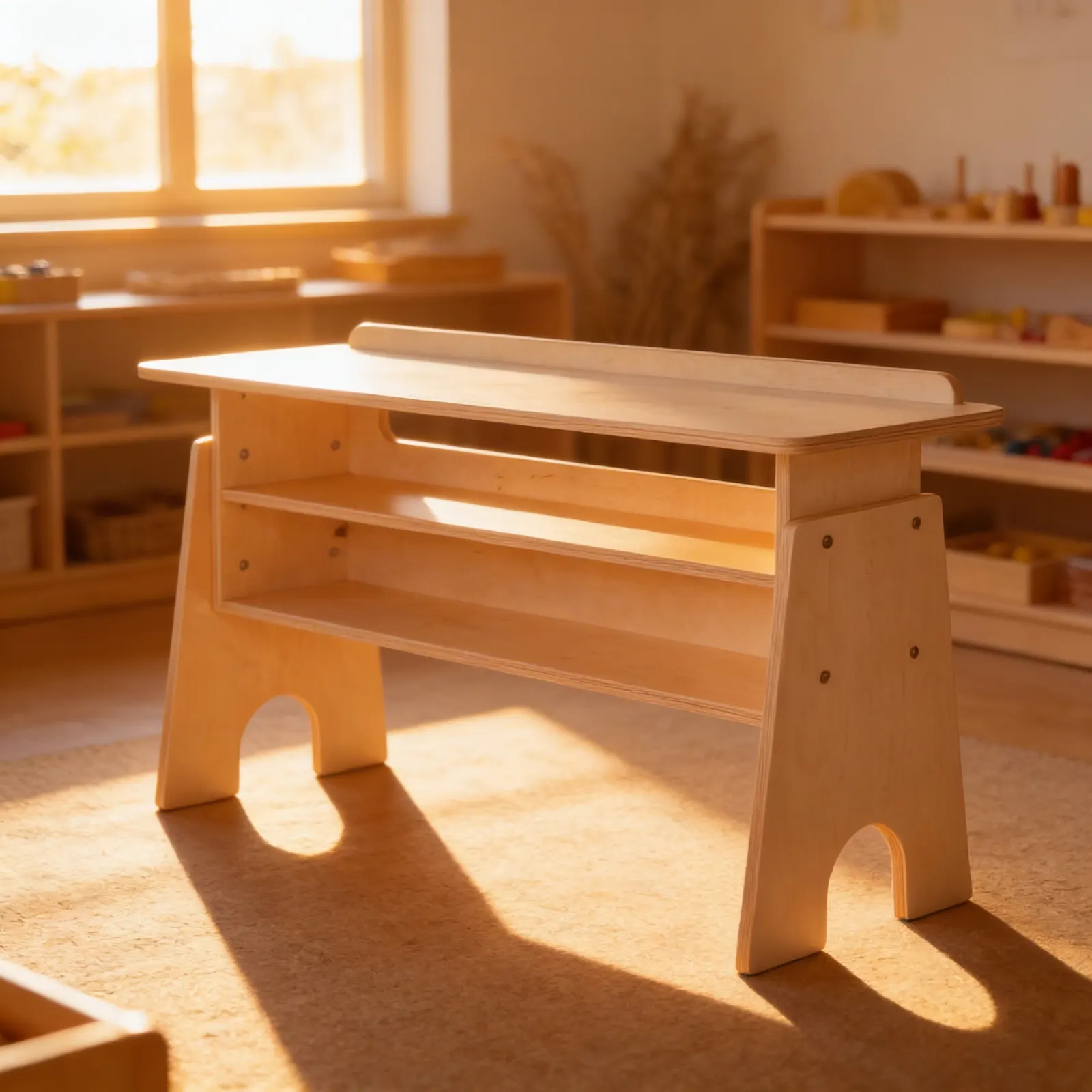
A table built for one job: holding the bells or the tone bars at working height, with a raised back edge so nothing rolls off, and an angled lower shelf that keeps the second set within sight. Auditory work needs a fixed place more than most, because the material has to stay in a known order for the child to hear the difference rather than hunt for the next bar. Two storage levels mean the set can be left mid-work and returned to. Plywood and laminated wood, for ages 3 to 6.
Auditory Discrimination
Dedicated workspace encourages focused exploration of pitch, tone, and musical patterns through hands-on experimentation.
Order and Organization
Specialized storage design teaches children to care for delicate instruments and maintain an organized music area.
Independence
Child-height design allows autonomous selection and use of musical materials without adult assistance.
Concentration
Defined workspace minimizes distractions and supports deep engagement with sound exploration activities.
How to present it
Position the table against a wall in the sensorial area, away from high-traffic zones. Ensure adequate space on all sides for children to move freely while carrying instruments.
- 1Place tone bars or bells in the angled lower compartment, arranging them in order from lowest to highest pitch
- 2Store mallets horizontally on the upper storage level, handles facing outward for easy grasping
- 3Keep pairing or grading work mats rolled and stored on the lower shelf when not in use
- 4Position any control cards or notation materials on the upper shelf for easy visibility
3 tips for parents
- Create a designated music area at home using a low shelf or table near a quiet corner
- Support auditory development by minimizing background noise during musical activities
- Observe which instruments your child gravitates toward and provide similar sound-making opportunities

If you are not sure it suits your child, we answer in person.
Norbert Kovalčín, founder of Faborino · write to him
There is no review here yet. We will ask you for one after you buy. Write the first review
What's in the Box
- Tone Bar Table: Fully assembled furniture unit
- Work Surface: With protective raised back edge
- Storage Shelves: Open middle shelf and angled lower compartment
Size and material
| Packaging | 146 × 51 × 9 cm |
| Primary Material | Plywood construction |
| Surface Finish | Laminated wood |
| Edge Treatment | Raised back edge for safety |
| Recommended Age | 3-6 years |
Care
| Cleaning | Wipe with damp cloth, avoid excess moisture |
| Maintenance | Check joints periodically, tighten if needed |
Frequently Asked Questions
What musical materials can this table store?
This specialized table is designed to store and organize Montessori tone bars, resonator bells, and other sensorial music materials. The angled lower compartment perfectly accommodates tone bar sets, while the upper levels provide space for mallets, bells, and additional musical instruments.
What are the dimensions of this tone bar table?
The table features a child-height work surface with protective raised edges to prevent materials from sliding off. It includes two integrated storage levels, with the lower compartment specifically angled to display and store tone bars or resonator bells at an accessible angle for children aged 3-6.
How does this table support music education in the Montessori classroom?
This furniture creates a dedicated music workspace that encourages independent exploration of pitch, tone, and musical concepts. The organized storage promotes care of materials while the spacious work surface allows children to arrange and play tone bars systematically, supporting sensorial discrimination and musical development.
Is assembly required for this tone bar table?
Please contact us for specific assembly information. The table is constructed with durable materials suitable for classroom use and designed to withstand daily handling by young children while maintaining the precise organization needed for Montessori musical materials.
Can this table be used for other Montessori materials?
While specifically designed for tone bars and bells, the versatile storage compartments and work surface can accommodate other sensorial materials. However, the angled lower shelf and overall dimensions are optimized for musical instruments, making it most effective for its intended purpose in the music area.
Product safety
Manufacturer: Nienhuis Montessori, Anders Celsiusstraat 15, 7442 PB Nijverdal, Netherlands
Tone Bar / Bell Table