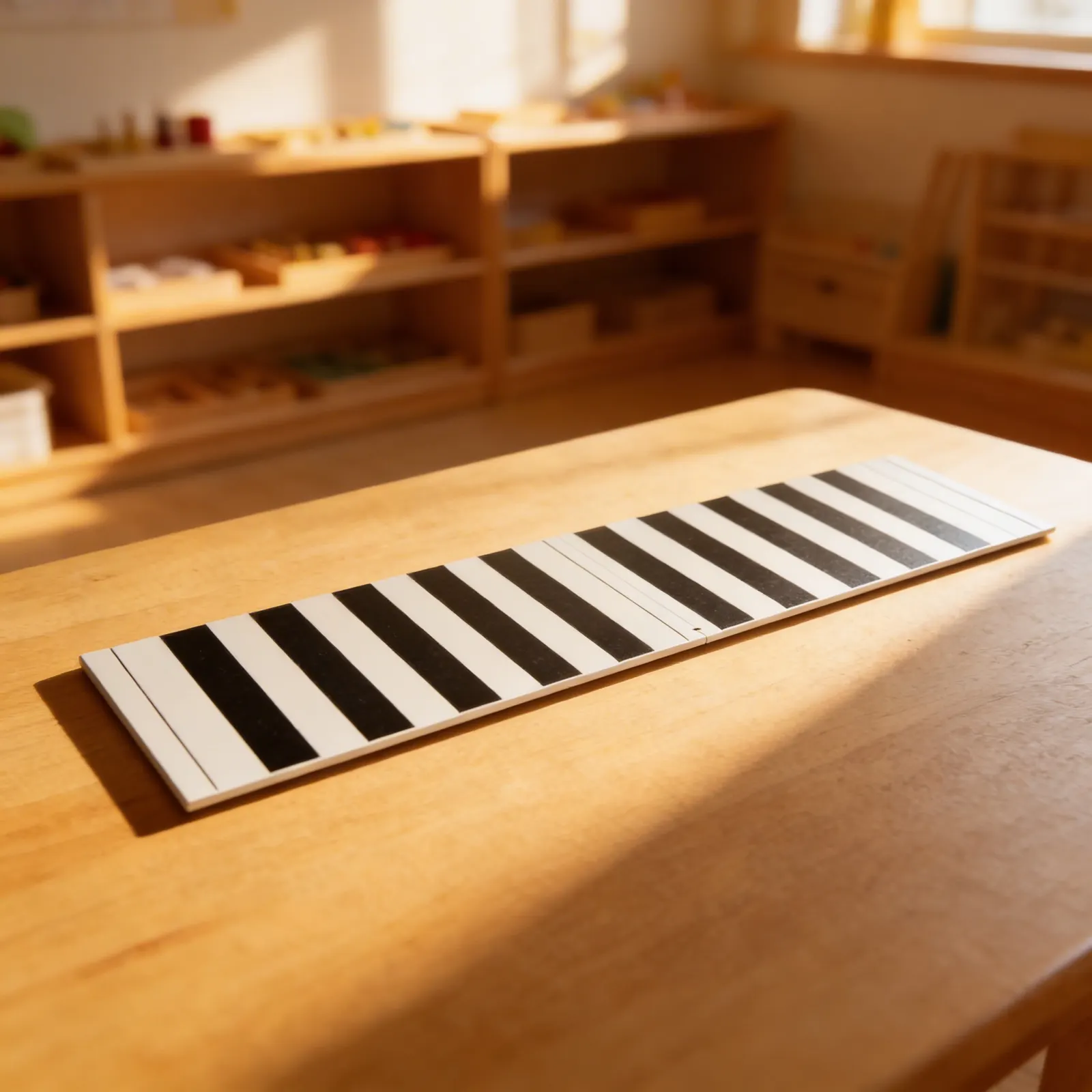
This large-scale piano keyboard mat provides a kinesthetic approach to music education, giving children the chance to physically step on keys while learning musical concepts. The vinyl construction creates a durable surface for active learning, supporting the Montessori principle of movement-based education for elementary students exploring pitch relationships and musical patterns.
“Education is a natural process spontaneously carried out by the human individual, and is acquired not by listening to words but by experiences upon the environment.”— Maria MontessoriEducation for a New World
The Tone Bar Keyboard mat transforms abstract musical concepts into concrete physical experiences through whole-body movement. Elementary children naturally integrate kinesthetic learning with cognitive understanding when they step from key to key, experiencing intervals and scales through their own locomotion. This piano keyboard mat addresses the developmental need for active, embodied learning that characterizes the second plane of development. The large-scale vinyl surface allows multiple children to collaborate in creating melodies, fostering the social learning essential to elementary classrooms. By walking musical patterns, children internalize pitch relationships through proprioceptive feedback - their muscles remember the distance between notes. The keyboard's visual layout provides a concrete representation of the mathematical relationships in music, connecting to elementary students' growing interest in systematic knowledge. This full-body approach to music education aligns with Montessori's observation that movement and cognition are fundamentally interconnected in human learning.

Start with C major scale to establish tonal center before exploring other keys
Use arm gestures to show the 'size' of intervals - small movements for seconds, larger for fifths
Place visual markers on starting notes to help children remember position
Begin with perfect fifths and octaves before attempting more complex harmonies
Start with C major scale to establish tonal center before exploring other keys
Use arm gestures to show the 'size' of intervals - small movements for seconds, larger for fifths
Place visual markers on starting notes to help children remember position
Begin with perfect fifths and octaves before attempting more complex harmonies

Heritage
Since 1929

Trusted by
Schools Worldwide

Handcrafted
in Europe

AMI
Endorsed

Develops understanding of pitch relationships and musical intervals through physical movement and visual recognition.
Enhances balance and spatial awareness as children step from key to key while learning musical concepts.
Reinforces mathematical concepts through the repeating pattern of piano keys and octave structures.
Engages the body in music education, supporting children who learn best through movement and physical activity.
Create movement cards showing different interval patterns for independent practice
Use colored tape to mark specific scales or chord patterns for visual reinforcement
Integrate the keyboard mat with other music materials by having children transcribe their walking patterns
“Position the mat where all children can see the key layout from multiple angles during group lessons”
Everything you need to know about this material.
Contact Our ExpertsThe Tone Bar Keyboard is a large-scale piano keyboard mat designed for full-body movement. While exact dimensions aren't specified, it's sized appropriately for children ages 6-12 to comfortably step on individual keys during music activities.
This mat embodies Montessori's movement-based learning approach by allowing children to physically engage with musical concepts. Students learn pitch relationships, intervals, and patterns through kinesthetic experiences, making abstract musical concepts concrete and memorable.
Yes, the vinyl construction is specifically designed for active classroom use. It's durable enough to withstand daily stepping, jumping, and movement activities while remaining easy to clean and store when not in use.
Children can explore pitch relationships, musical scales, intervals, chord progressions, and melodic patterns. The physical movement helps internalize concepts like high/low notes, steps/skips, and the spatial relationship between musical tones.
Yes, the large-scale design allows for group activities where multiple children can participate together. This encourages collaborative learning, musical games, and ensemble experiences that align with Montessori's emphasis on peer learning.
Share your experience with this material and help other educators and parents.
Trusted Worldwide
Premium educational materials, trusted by Montessori educators and families across Europe.

Faborino quality
Montessori-aligned