
Tone Bar MalletHard
The first photo is the maker's own. The other shots are illustrative.
Inv. no. NIE-0100A2
- Maker
- Nienhuis Montessori, since 1929
- Approval
- AMI
- Construction
- Durable plastic
- Head Type
- Hard rubber compound
- EAN
- 8719924005757
Final price incl. VAT. Delivery €5.90, €136.20 to go for free delivery.
Advice, warranty and returns are handled by us.
Why it costs €12.80
Behind the price of the original are things you can check yourself.
AMI approval
The material is approved by the Association Montessori Internationale (AMI). Nienhuis has made Montessori materials since 1929.
A verifiable original
The EAN 8719924005757 is on the box. It is the maker's number, not ours.
Tone Bar Mallet in a child's hands
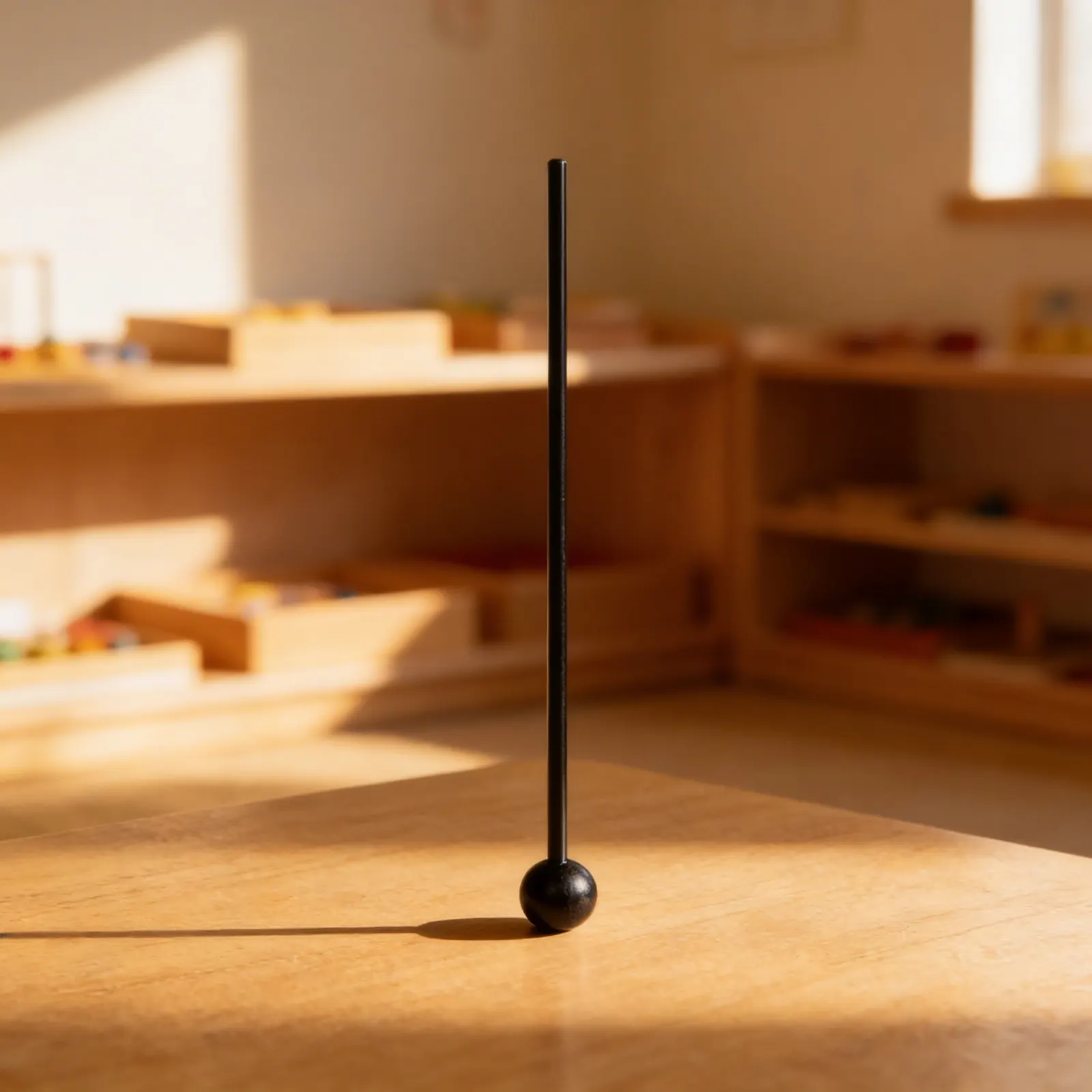
The hard mallet for the tone bars, sold on its own. Hardness decides what a struck bar sounds like: a hard head gives a clear, bright attack with the pitch right at the front of it, which is what matching and grading work needs, while the soft mallet rounds the tone off for playing. A set of tone bars arrives with one of each, so check which of the two you are replacing, because they differ only in the head. The tone bars themselves are a separate item.
Musical Precision
Develops accurate striking technique and control necessary for creating clear, resonant tones from metal tone bars.
Auditory Discrimination
Supports refinement of pitch recognition and tonal memory through consistent sound production.
Fine Motor Control
Enhances hand-eye coordination and wrist flexibility through precise striking movements.
Music Theory Foundation
Essential tool for exploring scales, intervals, and musical notation in the elementary curriculum.
How to present it
Place tone bars on a work mat or table at child's comfortable working height. Position the hard mallet to the right of the bars. Ensure adequate space for arm movement.
- 1Demonstrate proper grip: hold mallet loosely between thumb and first two fingers, about halfway up the handle
- 2Practice striking motion: lift mallet 4-6 inches above bar, strike center with quick wrist motion
- 3Explore tone production: strike same bar with varying force to hear volume changes
- 4Compare tones: strike different bars systematically from low to high
- 5Create patterns: alternate between two bars to hear intervals
3 tips for parents
- Create a quiet environment for practice - competing sounds interfere with pitch discrimination
- Encourage exploration of household items that ring when struck (metal bowls, glasses with water)
- Support rhythmic development through clapping games and movement activities

If you are not sure it suits your child, we answer in person.
Norbert Kovalčín, founder of Faborino · write to him
There is no review here yet. We will ask you for one after you buy. Write the first review
What's in the Box
- Hard Tone Bar Mallet: Single mallet with spherical head
Size and material
| Packaging | 21 × 1 × 1 cm |
| Construction | Durable plastic |
| Head Type | Hard rubber compound |
| Recommended Age | 6-12 years |
Care
Wipe with damp cloth and mild soap
Frequently Asked Questions
What makes this mallet suitable for tone bars and resonator bells?
The hard spherical head is specifically designed to produce clear, resonant tones when striking metal bars. Its firm construction ensures optimal sound quality from Montessori tone bars and resonator bells, allowing children to hear distinct pitches accurately during music activities.
How does this mallet support children's musical development?
The lightweight construction helps children aged 6-12 develop proper striking technique and wrist control. It enables them to produce consistent tones while building fine motor skills and understanding of dynamics, essential for elementary music education and ear training exercises.
What's the difference between hard and soft mallets for tone bars?
Hard mallets produce brighter, more resonant tones with clearer pitch definition, ideal for melodic work and pitch matching activities. Soft mallets create gentler, muted sounds. This hard mallet is recommended for standard tone bar activities where clear pitch recognition is important.
Can this mallet be used with other percussion instruments?
Yes, this mallet works well with various metal percussion instruments including glockenspiels, metallophones, and chime bars. Its design is optimized for instruments with metal bars that require a firm strike to produce clear tones, making it versatile for elementary music programs.
How should children be taught to use this mallet properly?
Teach children to hold the mallet loosely between thumb and first two fingers, about halfway up the handle. Demonstrate a gentle wrist motion, striking the center of each bar and allowing the mallet to bounce naturally. This technique produces the best tone while preventing damage to instruments.
Product safety
Manufacturer: Nienhuis Montessori, Anders Celsiusstraat 15, 7442 PB Nijverdal, Netherlands
Tone Bar Mallet