
Triangle Inscribed In Circle
The first photo is the maker's own. The other shots are illustrative.
Inv. no. NIE-011900
- Maker
- Nienhuis Montessori, since 1929
- Approval
- AMI
- Base Material
- Painted MDF board
- Knobs
- Red painted wood
- EAN
- 8719924006839
Final price incl. VAT. Delivery €5.90, €94.10 to go for free delivery.
Advice, warranty and returns are handled by us.
Why it costs €54.90
Behind the price of the original are things you can check yourself.
AMI approval
The material is approved by the Association Montessori Internationale (AMI). Nienhuis has made Montessori materials since 1929.
A verifiable original
The EAN 8719924006839 is on the box. It is the maker's number, not ours.
Triangle Inscribed In Circle in a child's hands
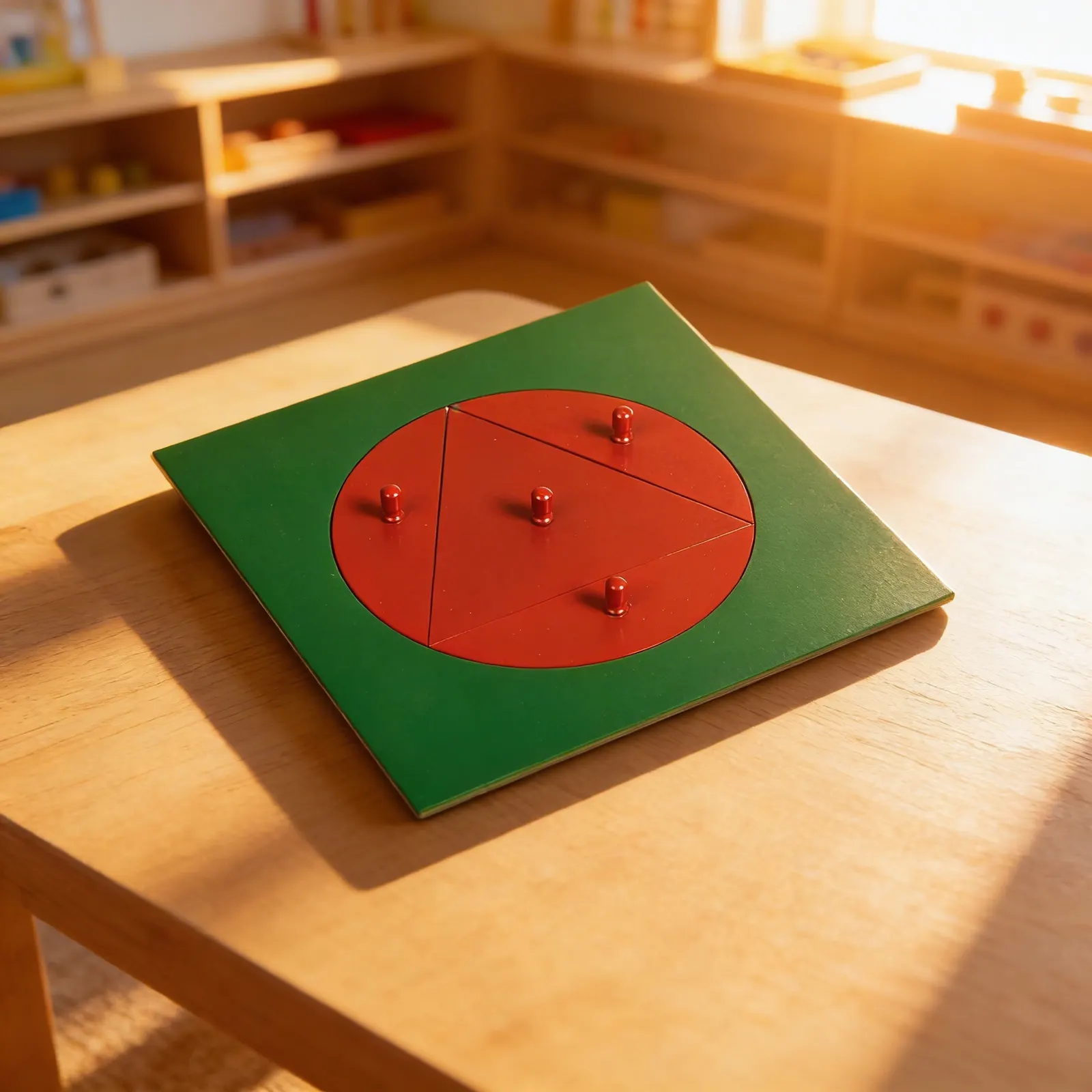
A triangle inscribed in a circle, from the elementary geometry set of plane figures. An inscribed figure is where geometry stops being a list of shapes and becomes a set of relationships: the triangle is not simply sitting in the circle, its corners are on the circle, and that single condition determines everything else about it. Having the two as one object to turn over in the hand is what makes the condition noticeable at all. Painted board and wood, for ages 6 to 12.
Geometric Understanding
Children discover the mathematical relationship between circles and inscribed triangles through hands-on exploration.
Spatial Reasoning
Manipulating the triangular sections develops three-dimensional thinking and spatial awareness.
Mathematical Preparation
Provides concrete foundation for later abstract concepts in geometry, angles, and proportions.
Fine Motor Refinement
The red control knobs encourage proper pincer grip while placing pieces precisely within boundaries.
How to present it
Place the wooden circle frame on a work mat with all triangular pieces assembled inside. Ensure the red control knobs face upward for easy grasping.
- 1Remove one triangular section using the control knob, examining its shape and edges
- 2Continue removing pieces systematically, arranging them outside the circle
- 3Reconstruct the triangle within the circle, noting how pieces fit together
- 4Trace the complete inscribed triangle with your finger, then trace the circle
3 tips for parents
- Look for circular and triangular relationships in architecture and nature to reinforce learning
- Support mathematical vocabulary development by using terms like 'inscribed' in context
- Allow repeated exploration without rushing toward abstract concepts

If you are not sure it suits your child, we answer in person.
Norbert Kovalčín, founder of Faborino · write to him
There is no review here yet. We will ask you for one after you buy. Write the first review
What's in the Box
- Green base board: 20 × 20 cm square frame
- Red circle outline: Fixed boundary piece
- Triangle sections: Approx. 5 removable pieces with red knobs
Size and material
| Packaging | 14 × 14 × 1 cm |
| Base Material | Painted MDF board |
| Knobs | Red painted wood |
| Recommended Age | 6-12 years |
Care
Wipe with slightly damp cloth, dry immediately
Frequently Asked Questions
What geometric concepts does this material teach?
This material helps children understand the relationship between circles and triangles, including concepts like inscribed figures, radius, diameter, angles, and how triangles fit within circular boundaries. It provides hands-on exploration of these fundamental geometric principles.
How do children use the triangle pieces with control knobs?
Children use the red control knobs to lift and manipulate each triangular section, exploring how the pieces fit together to form a complete triangle within the circle. This develops fine motor skills while building spatial awareness and understanding of geometric relationships.
What are the dimensions and materials used?
The material is crafted from high-quality wood with smooth, precisely cut pieces. The circle frame and triangle sections feature durable red paint, and each piece includes a small control knob for easy handling by children aged 6-12.
How does this support Montessori mathematics curriculum?
This material bridges sensorial and mathematical learning by providing concrete exploration of abstract geometric concepts. It prepares children for advanced geometry work including circle theorems, angle relationships, and spatial reasoning found in upper elementary mathematics.
Can this material be used for group lessons?
Yes, this material works well for both individual exploration and small group lessons. Teachers can demonstrate geometric principles while children observe and then practice independently, making it ideal for differentiated instruction in mixed-age classrooms.
Product safety
Manufacturer: Nienhuis Montessori, Anders Celsiusstraat 15, 7442 PB Nijverdal, Netherlands
Triangle Inscribed In Circle