
Triangular Prism: Three-Sided Geometric Solid
Made by Nienhuis Montessori · shipped by Heutink International (Netherlands) About the maker
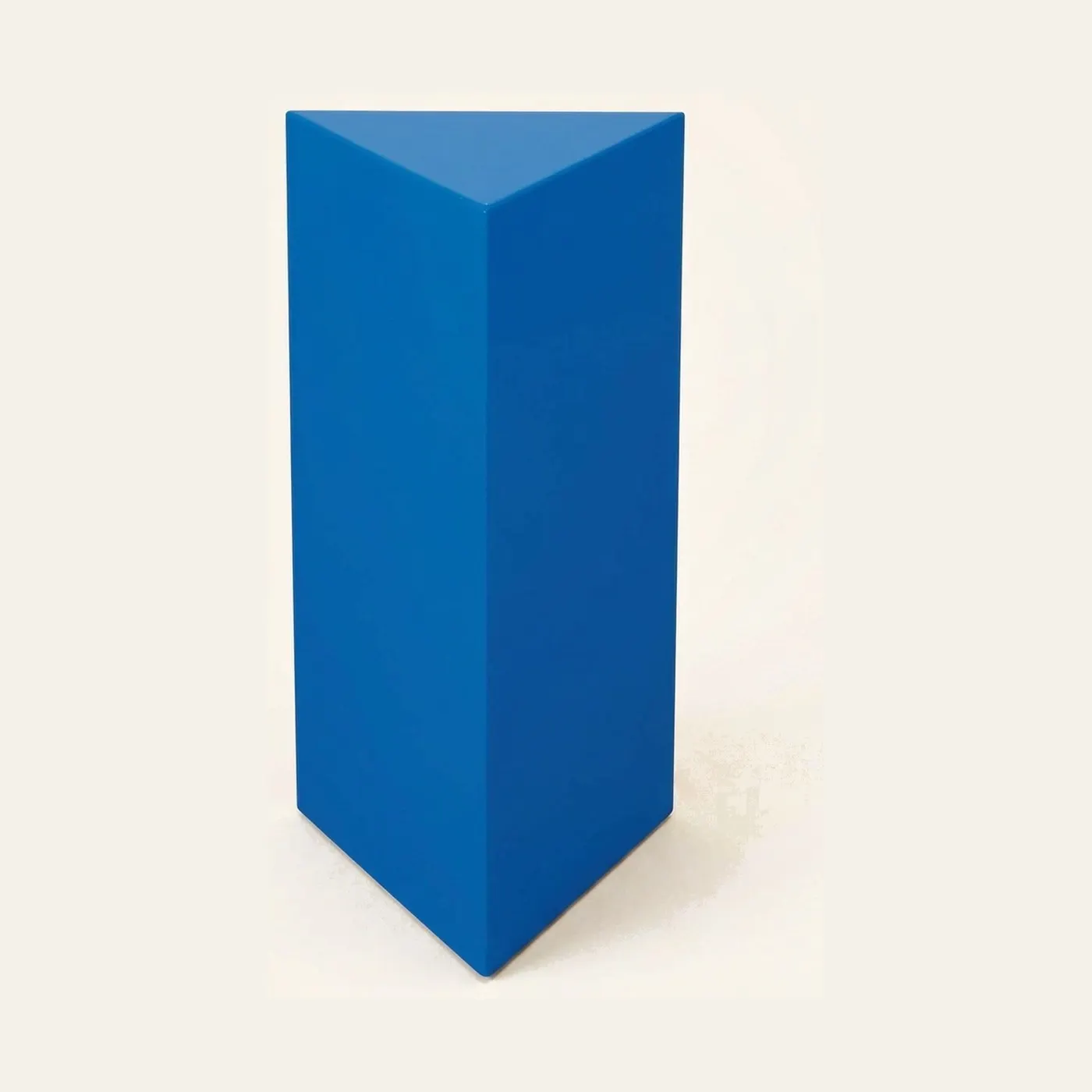
A prism on a triangular base, from the volume set derived from a base of 10 by 10 cm and a height of 20 cm. What a single prism teaches is that the shape of the base does not change the method: a prism has the same cross section the whole way up, so its volume is the area of that cross section carried through the height, whether the base is a square, a triangle or anything else. That one idea covers every prism a child will ever meet. Sold individually, for ages 6 to 12.
“Free the child's potential, and you will transform him into the world.”
The Triangular Based Prism embodies Dr. Montessori's principle of educating the hand as the instrument of intelligence.
- Develops stereognostic sense through handling and exploring the three-dimensional form
- Builds understanding of faces, edges, and vertices specific to triangular prisms
- Establishes foundation for calculating surface area and volume in later mathematics
- Strengthens visual discrimination between various geometric solids
Read More
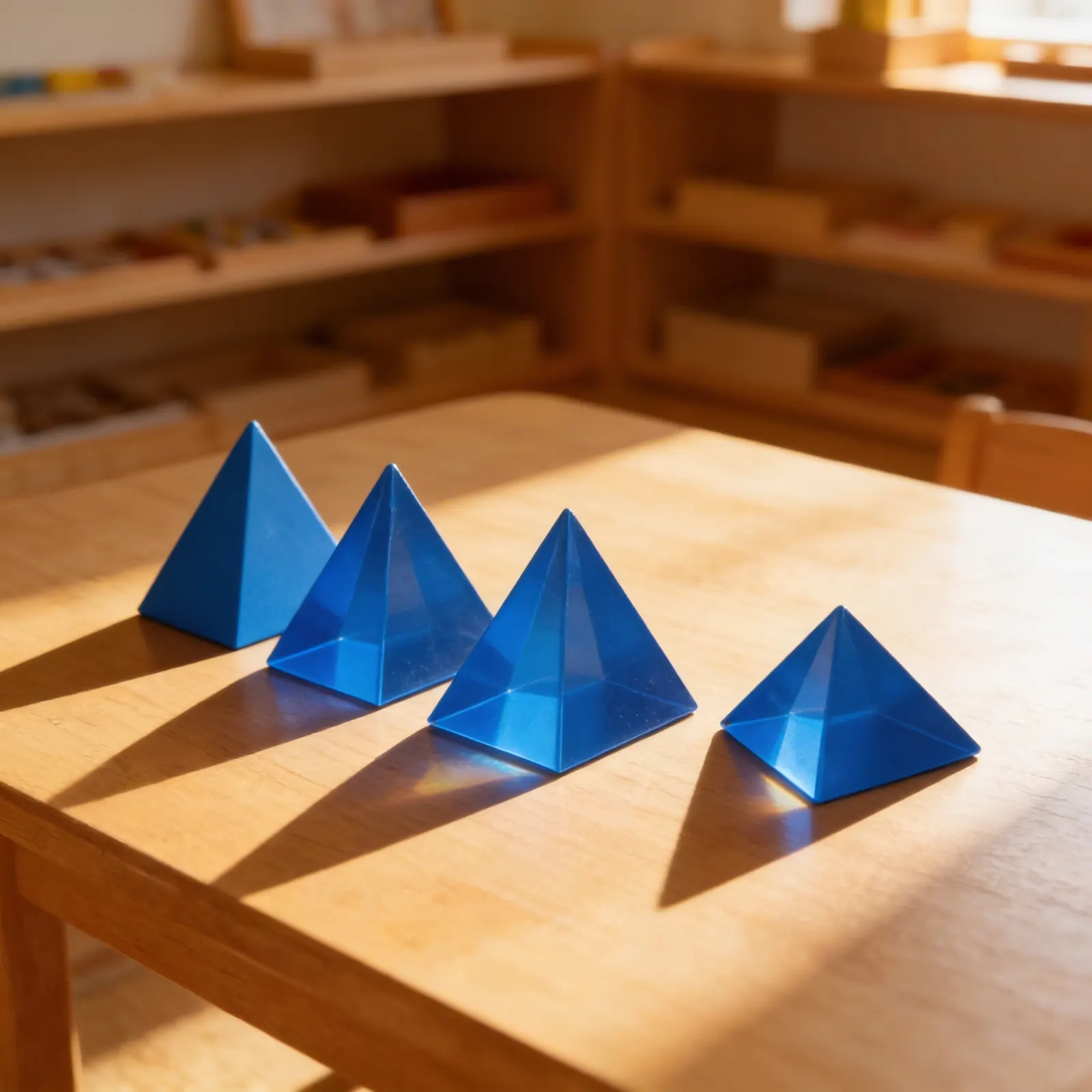
Through concrete manipulation of this geometric solid, children move from sensorial experience to abstract understanding, a cornerstone of Montessori methodology. The material's smooth blue lacquered surface isolates the geometric concept, allowing children to focus purely on form without distraction. This solid represents the transition from the early sensorial work with geometric cabinet to the advanced mathematical understanding of volume, surface area, and spatial relationships. The material serves as a bridge between the concrete geometric solids of the Children's House and the abstract geometric studies of the elementary years, supporting the child's mathematical mind through purposeful, hands-on exploration.
How to present it
Follow the Montessori method of presentation for optimal child development.
Place the triangular prism on a neutral-colored mat. Have the geometric solids basket nearby containing other solids for comparison. Ensure hands are clean and dry for optimal tactile experience.
- 1
Invite the child to explore the prism with both hands, feeling all surfaces
Model slow, deliberate movements to encourage mindful exploration - 2
Introduce vocabulary: 'triangular base,' 'rectangular faces,' 'edges,' 'vertices'
Use the three-period lesson for vocabulary introduction - 3
Compare with rectangular prism, noting similarities and differences
Place both solids side by side for visual comparison - 4
Trace around the bases and faces on paper to create net diagrams
Use different colors for triangular bases and rectangular faces - 5
Roll clay slabs and construct a triangular prism, comparing with the solid
This reinforces understanding of how 2D shapes form 3D objects
Every Child Is a Little Creator

Heritage
Since 1929

In classrooms
Around the world

European brands
Nienhuis, GAM, Educo

AMI approved
To the association standard
Triangular Prism: Three-Sided Geometric Solid
