
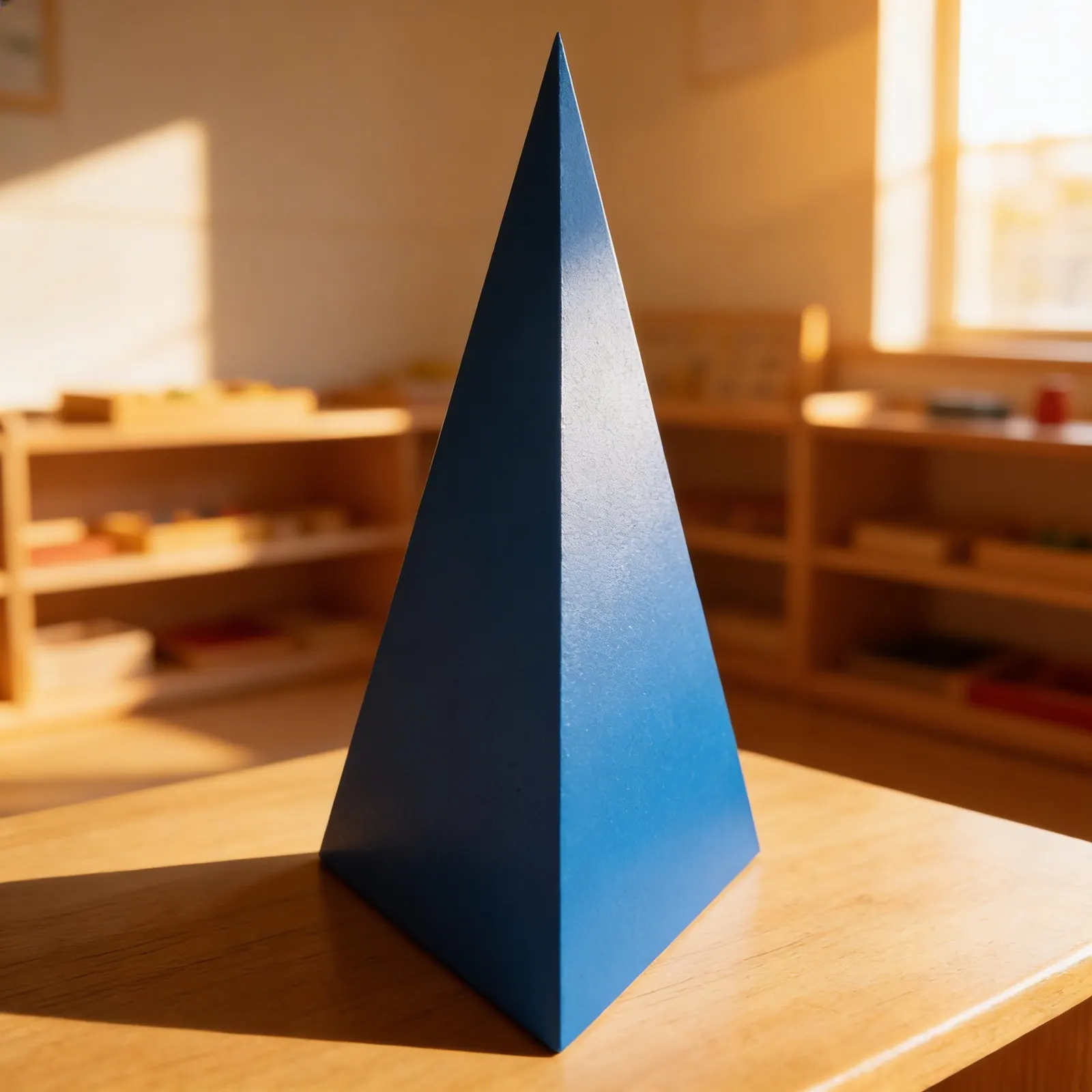
Triangular Based Pyramid
The first photo is the maker's own. The other shots are illustrative.
Inv. no. NIE-018810
- Maker
- Nienhuis Montessori, since 1929
- Approval
- AMI
- Product size
- 10 × 10 cm
- Primary Material
- Plastic
- Finish
- Painted surface
- EAN
- 8719924010003
Final price incl. VAT. Delivery €5.90, €60.10 to go for free delivery.
Advice, warranty and returns are handled by us.
Why it costs €88.90
Behind the price of the original are things you can check yourself.
AMI approval
The material is approved by the Association Montessori Internationale (AMI). Nienhuis has made Montessori materials since 1929.
A verifiable original
The EAN 8719924010003 is on the box. It is the maker's number, not ours.
Triangular Based Pyramid in a child's hands
A blue pyramid on a triangular base, part of the set for calculating volume, all of which is derived from a base of 10 by 10 cm and a height of 20 cm. The set exists so that a child can discover by filling rather than by formula that a pyramid holds a third of the prism standing on the same base at the same height. Reading that in a textbook takes ten seconds and convinces nobody; pouring it takes an afternoon and settles the question. Sold individually, for ages 6 to 12.
Spatial Intelligence
Manipulating the pyramid develops three-dimensional thinking and understanding of how 2D shapes create 3D forms.
Mathematical Concepts
Introduces geometry vocabulary including apex, base, edges, and vertices through concrete exploration.
Abstract Thinking
Bridges concrete geometric forms to abstract mathematical formulas and calculations in upper elementary work.
How to present it
Place the Triangular Based Pyramid on a work mat alongside other geometric solids. Have paper and pencil ready for recording observations.
- 1Invite the child to examine the pyramid by holding it and feeling all surfaces
- 2Count the faces together, tracing each triangular surface with a finger
- 3Identify and count the edges where faces meet
- 4Locate all vertices, paying special attention to the apex
- 5Place the pyramid on different faces to explore stability
3 tips for parents
- Look for triangular pyramid shapes in everyday life like certain roofs or tent structures
- Build pyramids using toothpicks and marshmallows to reinforce edge and vertex concepts
- Compare the triangular pyramid to pyramid-shaped foods like certain chocolates or cheese portions

If you are not sure it suits your child, we answer in person.
Norbert Kovalčín, founder of Faborino · write to him
There is no review here yet. We will ask you for one after you buy. Write the first review
What's in the Box
- Triangular Pyramid: Single geometric solid
Size and material
| Product size | 10 × 10 cm |
| Packaging | 26 × 11 × 11 cm |
| Primary Material | Plastic |
| Finish | Painted surface |
| Recommended Age | 6-12 years |
Care
Wipe with damp cloth, dry immediately
Frequently Asked Questions
What are the educational benefits of the Triangular Based Pyramid?
This geometric solid helps children develop spatial reasoning, understand 3D shapes, learn about vertices, edges, and faces, and explore the relationship between 2D triangular bases and 3D forms. It's essential for geometry lessons on pyramids, surface area, and volume calculations.
How is this pyramid used in Montessori elementary classrooms?
Children use it alongside other geometric solids for comparison activities, tracing exercises to create nets, exploring mathematical properties, and understanding real-world applications. It supports lessons on Egyptian pyramids, architecture, and advanced geometry concepts.
What material is the pyramid made from and what size is it?
The pyramid features a smooth-finished surface ideal for handling and tracing. While specific dimensions aren't listed, Montessori geometric solids are typically sized for comfortable manipulation by children aged 6-12, usually around 5-10cm in height.
What activities can children do with this pyramid?
Children can trace faces to create geometric nets, compare it with other solids, calculate surface area and volume, explore symmetry, build 3D structures, match it with real-world objects, and use it in geometry nomenclature lessons with three-part cards.
Why is hands-on manipulation important for learning geometry?
Concrete manipulation before abstract concepts is fundamental in Montessori education. Handling the pyramid helps children internalize spatial relationships, understand dimensional properties, and develop geometric vocabulary through sensorial experience, making abstract mathematical concepts tangible and memorable.
Product safety
Manufacturer: Nienhuis Montessori, Anders Celsiusstraat 15, 7442 PB Nijverdal, Netherlands
Triangular Based Pyramid