
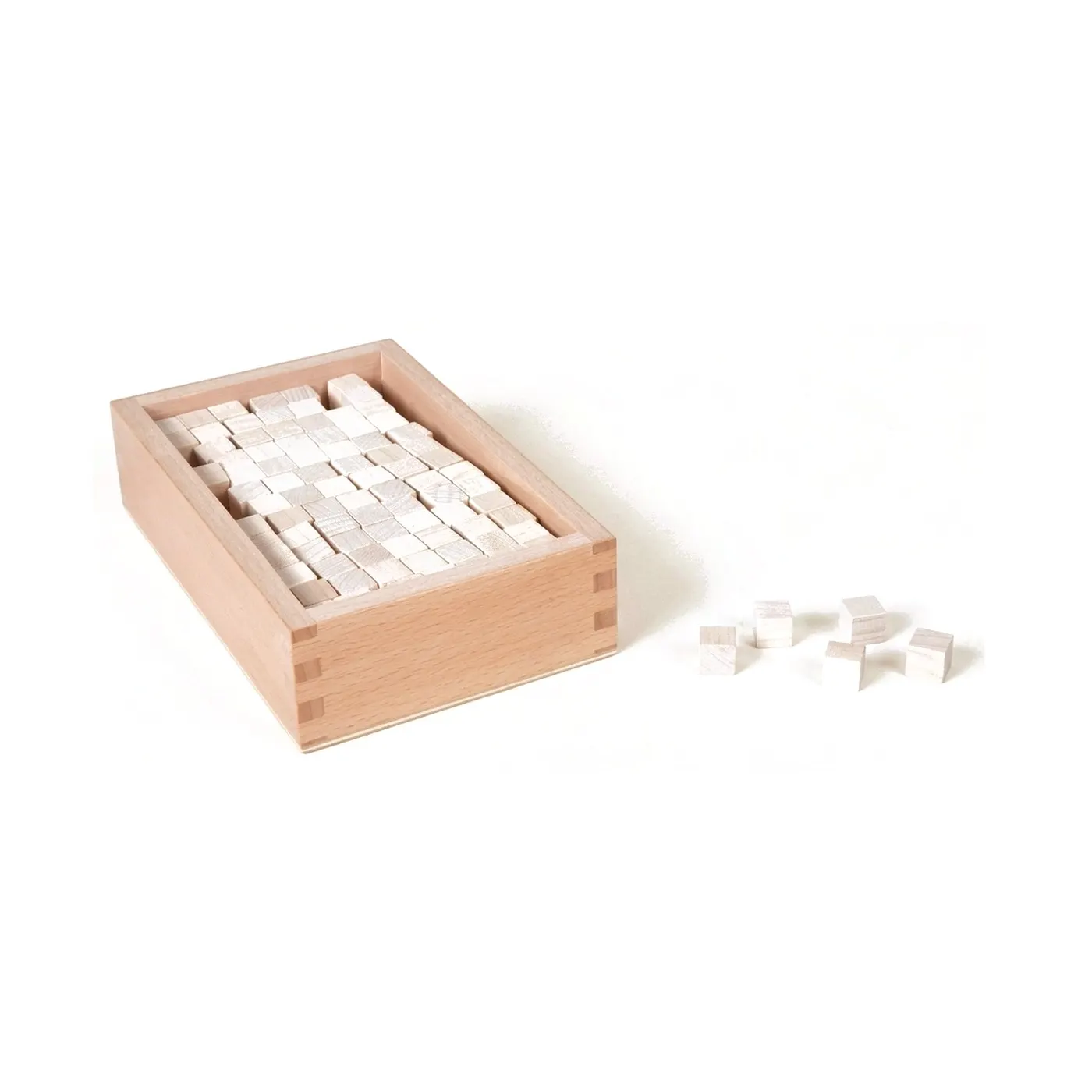
Unpainted Cube1x1x1 cm
The first photo is the maker's own. The other shots are illustrative.
Inv. no. NIE-00242001
- Maker
- Nienhuis Montessori, since 1929
- Product size
- 1 × 1 × 1 cm
- Primary Material
- Natural unpainted wood
- Finish
- Smooth sanded, no coating
- EAN
- 8719924001148
Final price incl. VAT. Delivery €5.90, €144.20 to go for free delivery.
 Pink Tower Extension Cubes €42.90
Advice, warranty and returns are handled by us.
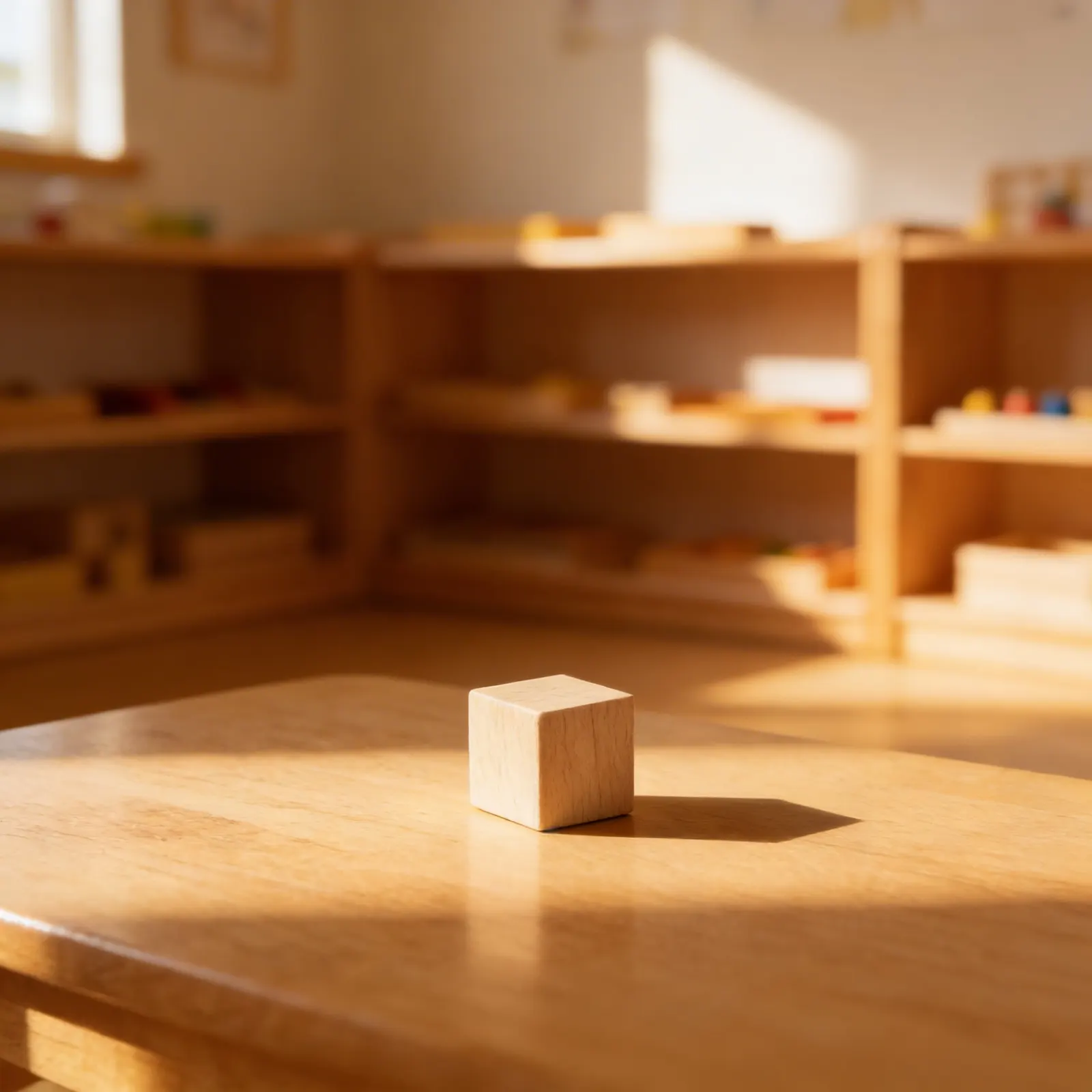
Unpainted Cube in a child's hands
The unpainted cube measures 1 × 1 × 1 cm and is made of beech wood. As the name says, it is not painted, so the wood stays visible. A cube with an edge of one centimetre can serve as a unit: the child picks it up between two fingers, measures short lengths against its edge and sees what one cubic centimetre looks like. Several cubes laid in a row can be counted or used for longer distances. Nienhuis lists the cube for indoor use. Wipe it with a dry cloth only, so that the bare wood does not get wet. For children aged 3 to 6.
Mathematical Foundation
Introduces the concept of cubic measurement and serves as a concrete representation of volume units.
Sensorial Refinement
Develops discrimination of dimension through tactile and visual exploration of precise measurements.
Abstract to Concrete
Bridges abstract mathematical concepts with manipulative materials for deeper understanding.
How to present it
Place the 1cm cube on a small tray or felt mat at the child's workspace. Ensure hands are clean and dry for optimal tactile experience with the natural wood.
- 1Invite the child to hold the cube between thumb and forefinger, exploring all six faces
- 2Place the cube on the mat and trace around each face with the index finger
- 3Compare the cube to other classroom materials by placing it alongside them
- 4Count edges (12), vertices (8), and faces (6) by touching each element
3 tips for parents
- Find household items that are approximately 1cm for size comparison activities
- Use the cube to measure small objects like erasers or coins
- Create simple patterns with multiple cubes if available

If you are not sure it suits your child, we answer in person.
Norbert Kovalčín, founder of Faborino · write to him
There is no review here yet. We will ask you for one after you buy. Write the first review
What's in the Box
- Wooden Cube: 1×1×1 cm unpainted
Size and material
| Product size | 1 × 1 × 1 cm |
| Packaging | 13 × 9 × 1 cm |
| Primary Material | Natural unpainted wood |
| Finish | Smooth sanded, no coating |
| Recommended Age | 3-6 years |
Care
Wipe with dry cloth only to preserve natural wood
Frequently Asked Questions
What is the exact size of this wooden cube?
The cube measures precisely 1cm x 1cm x 1cm, making it a perfect unit cube for Montessori sensorial and mathematical activities.
Why is the cube unpainted?
The natural unpainted wood finish allows children to focus purely on dimension, form, and texture without color distraction, while also ensuring the material is safe and non-toxic for young learners.
What activities can children do with this 1cm cube?
Children can use it for size comparison, building patterns, exploring volume concepts, counting, creating geometric shapes, and as a concrete representation of mathematical units.
Is this cube suitable for children under 3 years old?
This cube is designed for ages 3-6. Due to its small size (1cm), it may pose a choking hazard for children under 3 years and should only be used with appropriate supervision.
How does this cube support Montessori learning principles?
It provides hands-on, concrete manipulation of abstract mathematical concepts, allowing children to physically explore dimension, volume, and quantity through self-directed sensorial experiences.
Product safety
Manufacturer: Nienhuis Montessori, Anders Celsiusstraat 15, 7442 PB Nijverdal, Netherlands
Unpainted Cube