
Upper Elementary Geometry - Task Cards
The first photo is the maker's own. The other shots are illustrative.
Inv. no. NIE-ELC3038
- Maker
- Nienhuis Montessori, since 1929
- Material
- Durable plastic
- Finish
- Pre-cut with rounded corners
- EAN
- 8719924043865
Final price incl. VAT. Free delivery.
Advice, warranty and returns are handled by us.
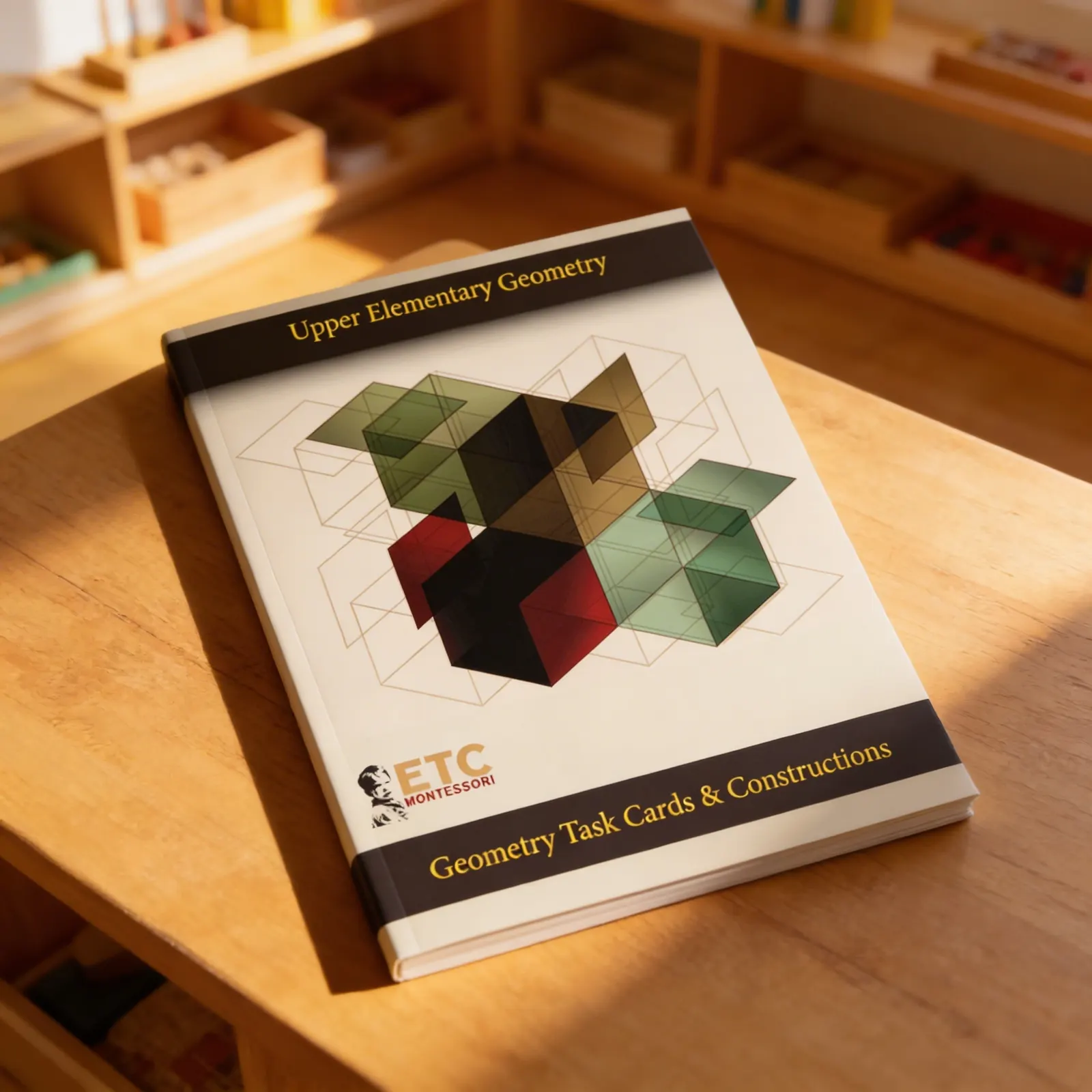
Upper Elementary Geometry - Task Cards in a child's hands
For hands-on mathematics, these Upper Elementary Geometry Task Cards present advanced spatial concepts through beautifully illustrated 3D cube formations and wireframe geometric constructions. Each card features translucent overlapping shapes and complex geometric patterns that challenge children to explore three-dimensional relationships, perspective, and spatial reasoning in alignment with Montessori mathematics progression.
Spatial Intelligence
Develops advanced understanding of three-dimensional relationships through visual analysis of cube formations and wireframe structures.
Abstract Thinking
Translucent overlapping shapes encourage children to mentally manipulate geometric forms and understand perspective.
Mathematical Reasoning
Builds foundation for advanced geometry concepts including volume, surface area, and spatial transformations.
Visual Discrimination
Complex geometric patterns refine ability to distinguish between overlapping shapes and identify spatial relationships.
How to present it
Arrange task cards in sequence from simpler cube formations to complex wireframe constructions. Provide graph paper, colored pencils, and geometric solids for reference.
- 1Begin with cards showing single 3D cube formations, having child identify visible and hidden faces
- 2Progress to cards with overlapping translucent shapes, discussing which shape appears in front
- 3Introduce wireframe constructions, counting vertices, edges, and faces
- 4Challenge child to reproduce complex geometric patterns from cards onto graph paper
3 tips for parents
- Look for geometric patterns in everyday objects and architecture during outings
- Build 3D models together using household materials to match card illustrations
- Discuss how video games and animation use similar geometric principles

If you are not sure it suits your child, we answer in person.
Norbert Kovalčín, founder of Faborino · write to him
There is no review here yet. We will ask you for one after you buy. Write the first review
What's in the Box
- Geometry Task Cards: Set featuring 3D geometric illustrations
Size and material
| Packaging | 28 × 12 × 5 cm |
| Material | Durable plastic |
| Finish | Pre-cut with rounded corners |
| Recommended Age | 9-12 years |
Care
| Cleaning | Wipe gently with dry cloth |
| Storage | Keep flat in dry location |
Frequently Asked Questions
What age group are these Upper Elementary Geometry Task Cards designed for?
Despite the product listing showing ages 3-6, these Upper Elementary Geometry Task Cards are specifically designed for children ages 9-12 who have completed primary geometry work and are ready for advanced spatial concepts involving 3D formations and complex geometric relationships.
How do these task cards align with Montessori mathematics progression?
These cards build upon the concrete geometric foundations established with Montessori sensorial materials and elementary geometry work, progressing to abstract spatial reasoning, 3D visualization, and complex geometric relationships that prepare students for advanced mathematical thinking.
What specific geometric concepts do these task cards cover?
The cards explore three-dimensional relationships, perspective drawing, spatial reasoning, wireframe constructions, translucent overlapping shapes, cube formations, and complex geometric patterns that help children understand how 2D representations relate to 3D objects.
How many task cards are included and what is the recommended presentation method?
The set includes multiple task cards featuring progressively challenging geometric concepts. They should be presented sequentially, allowing children to work independently or in small groups, with each card building upon previously mastered spatial concepts.
What materials or manipulatives should be used alongside these task cards?
These cards work best when paired with geometric solids, cube building materials, graph paper, rulers, and translucent geometric shapes, allowing children to recreate and explore the illustrated formations hands-on while developing spatial visualization skills.
Product safety
Manufacturer: Nienhuis Montessori, Anders Celsiusstraat 15, 7442 PB Nijverdal, Netherlands
Upper Elementary Geometry - Task Cards