
Vegetables Matching Work Cards (Spanish Edition)
The first photo is the maker's own. The other shots are illustrative.
Inv. no. NIE-ECSP0468B
- Maker
- Nienhuis Montessori, since 1929
- Base Material
- Heavy cardstock
- Finish
- Laminated coating
- EAN
- 8719924043612
Final price incl. VAT.
This material is no longer made
The manufacturer has withdrawn it, so we cannot order it in. The page stays here because the material itself is still worth knowing about.
Available instead
Vegetables Matching Cards
Would you buy it if we could source it or make it ourselves? Enough people saying yes is what makes the attempt worth it.
Vegetables Matching Work Cards (Spanish Edition) in a child's hands
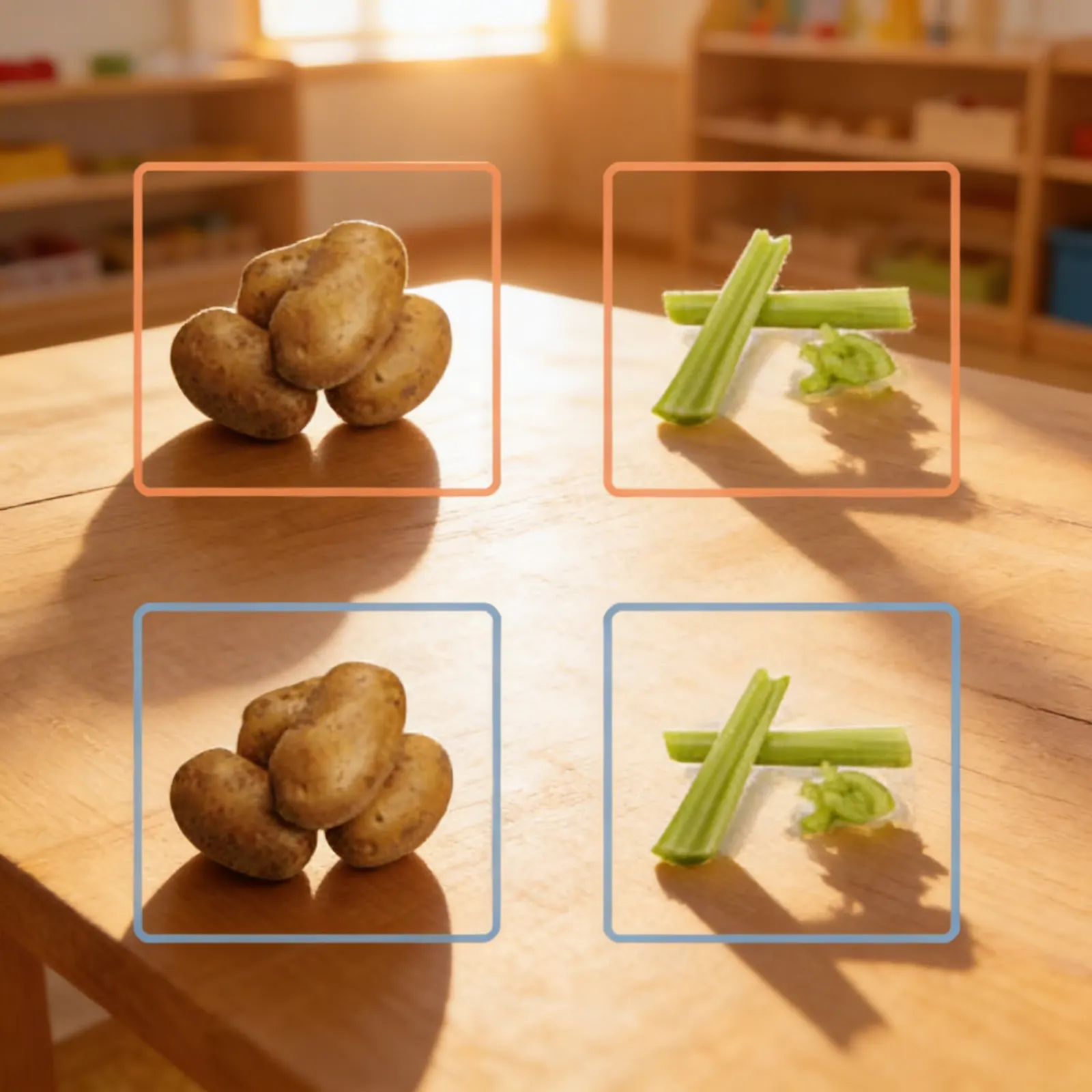
Verduras Trabajo De Emparejar, the vegetable matching work in Spanish. Pairs of identical photographs, each vegetable isolated on a white background so every detail of the real thing shows and nothing else does. Matching needs no reading, so the work starts before the Spanish does, and the language arrives with the labels. The cards are in Spanish. Card stock, full colour, pre cut. The English edition is a separate item.
Visual Discrimination
Children develop the ability to notice subtle differences and similarities between vegetable images, essential for later reading skills.
Language Development
Naming vegetables and describing their characteristics builds vocabulary and supports classification work in the cultural area.
Concentration
The focused attention required for matching pairs strengthens the child's ability to sustain concentration on detailed work.
How to present it
Place 6-8 vegetable card pairs face down on a mat, arranged in rows with adequate spacing for turning
- 1Demonstrate turning over two cards slowly, examining each vegetable photograph carefully
- 2When finding matching vegetables, place the pair to the side of the work area
- 3If vegetables don't match, turn both cards face down in their original positions
- 4Continue until all vegetable pairs are matched
3 tips for parents
- Connect the vegetable cards to real vegetables during grocery shopping or meal preparation
- Let your child match the cards while you prepare vegetables for dinner
- Create a vegetable tasting experience alongside the matching work to engage multiple senses

If you are not sure it suits your child, we answer in person.
Norbert Kovalčín, founder of Faborino · write to him
There is no review here yet. We will ask you for one after you buy. Write the first review
What's in the Box
- Matching Cards: Approx. 4 vegetable image cards with colored frames
Size and material
| Packaging | 15 × 15 × 1 cm |
| Base Material | Heavy cardstock |
| Finish | Laminated coating |
| Recommended Age | 3-6 years |
Care
Wipe with damp cloth, dry immediately
Frequently Asked Questions
How many vegetable cards are included in this matching set?
The set includes multiple pairs of laminated cards featuring clear photographs of common vegetables like potatoes and celery. Each vegetable is represented with matching pairs for classification activities.
What makes these cards suitable for 3-6 year olds?
The cards feature clear, realistic photographs of familiar vegetables with colored borders that help young children focus on the matching task. The durable laminated cardstock is perfect for small hands learning visual discrimination skills.
Can these cards be used for activities beyond matching?
Yes, these versatile cards support vocabulary development, sorting by color or type, memory games, and discussions about healthy eating. They're excellent for both individual and small group activities.
Are the cards labeled with vegetable names?
The cards focus on visual recognition through photographs, allowing children to match images without relying on text. This approach supports pre-readers and emphasizes visual discrimination skills.
How durable are these matching cards for classroom use?
The laminated cardstock construction is specifically designed to withstand repeated handling by young children. The protective coating resists tears and spills, making them ideal for daily classroom or home use.
Product safety
Manufacturer: Nienhuis Montessori, Anders Celsiusstraat 15, 7442 PB Nijverdal, Netherlands
Vegetables Matching Work Cards (Spanish Edition)