
Visual DiscriminationShapes
The first photo is the maker's own. The other shots are illustrative.
Inv. no. NIE-EC0618
- Maker
- Nienhuis Montessori, since 1929
- Material
- Durable plastic
- Finish
- Pre-cut with rounded corners
- EAN
- 8719924043124
Final price incl. VAT. Delivery €5.90, €126.10 to go for free delivery.
Advice, warranty and returns are handled by us.
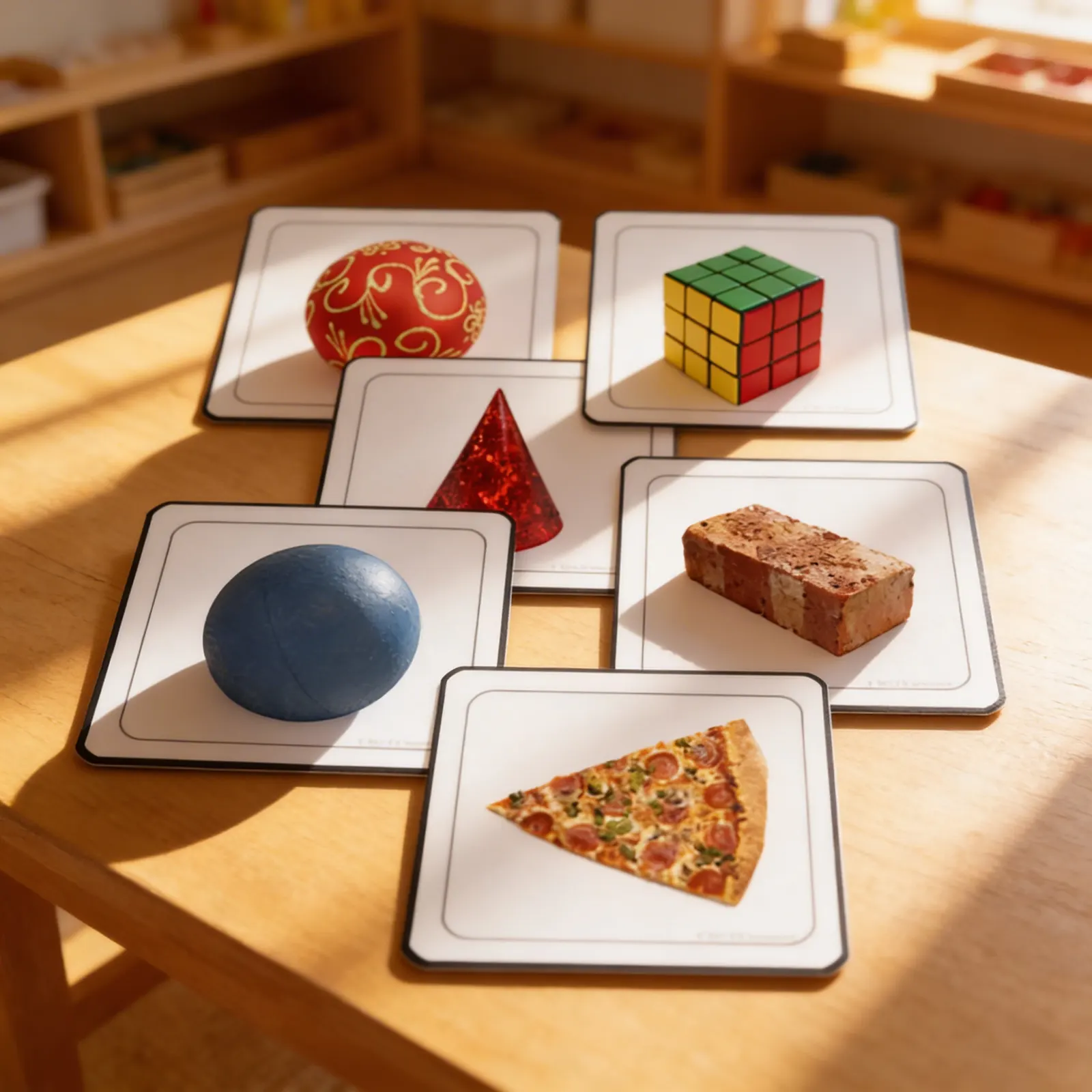
Visual Discrimination in a child's hands
This Visual Discrimination: Shapes material features durable plastic cards presenting geometric shapes alongside real-world objects, supporting the development of visual perception and classification skills. Each durable plastic card encourages children to identify and match shapes found in their environment, building the starting point for geometry work while strengthening observation and analytical thinking essential to the Montessori sensorial curriculum.
Visual Perception
Strengthens ability to identify geometric shapes in everyday objects through careful observation and comparison.
Classification Skills
Develops logical thinking as children group and categorize shapes based on their properties.
Language Development
Introduces geometric vocabulary while connecting abstract concepts to concrete examples.
Preparation for Geometry
Builds foundational understanding of shapes essential for later mathematical work.
How to present it
Place 3-4 shape cards on a mat, each showing a different geometric form. Set corresponding object cards in a basket nearby. Ensure good lighting for clear visibility of details.
- 1Introduce one shape card, tracing the geometric form with your finger while naming it
- 2Select an object card from the basket and examine it closely
- 3Place the object card below its matching shape card
- 4Continue matching remaining object cards to their geometric shapes
- 5Invite the child to verify matches by tracing shapes on both cards
3 tips for parents
- Point out shapes during daily routines: rectangular doors, circular plates, triangular sandwich cuts
- Create photo collections of household items representing different geometric forms
- Play 'shape detective' games during walks, finding geometry in architecture and nature

If you are not sure it suits your child, we answer in person.
Norbert Kovalčín, founder of Faborino · write to him
There is no review here yet. We will ask you for one after you buy. Write the first review
What's in the Box
- Shape discrimination cards: Approx. 6 double-layered cards
Size and material
| Packaging | 15 × 15 × 2 cm |
| Material | Durable plastic |
| Finish | Pre-cut with rounded corners |
| Recommended Age | 3-6 years |
Care
Wipe with slightly damp cloth, dry immediately
Frequently Asked Questions
What shapes are included in this Visual Discrimination material?
The material includes fundamental geometric shapes such as circles, squares, triangles, rectangles, ovals, and other polygons, each paired with real-world objects that contain these shapes. The double-layered cardstock cards present both abstract geometric forms and photographs of everyday items where children can identify these shapes.
How does this material support Montessori sensorial development?
This material aligns with Montessori sensorial principles by isolating the concept of shape recognition through concrete, hands-on cards. Children develop visual discrimination skills by matching geometric shapes to real objects, building their ability to classify and analyze visual information while preparing them for later geometry work.
What age is most appropriate for introducing these shape cards?
These cards are designed for ages 3-6, perfectly suited for the primary Montessori environment. Three-year-olds can begin with simple shape matching, while older children can engage in more complex activities like sorting objects by multiple shapes or creating their own shape hunts in the classroom.
Are the cards durable enough for daily classroom use?
Yes, each card is made from double-layered cardstock and laminated for durability, ensuring they withstand frequent handling by young children. The sturdy construction makes them suitable for individual work, small group activities, and repeated use throughout the school year.
How can teachers extend learning with these shape discrimination cards?
Teachers can create shape scavenger hunts, use the cards for language lessons naming shapes and objects, sort cards by attributes, or combine them with other sensorial materials. Children can also trace shapes, create art projects, or use them as inspiration for building with geometric solids.
Product safety
Manufacturer: Nienhuis Montessori, Anders Celsiusstraat 15, 7442 PB Nijverdal, Netherlands
Visual Discrimination